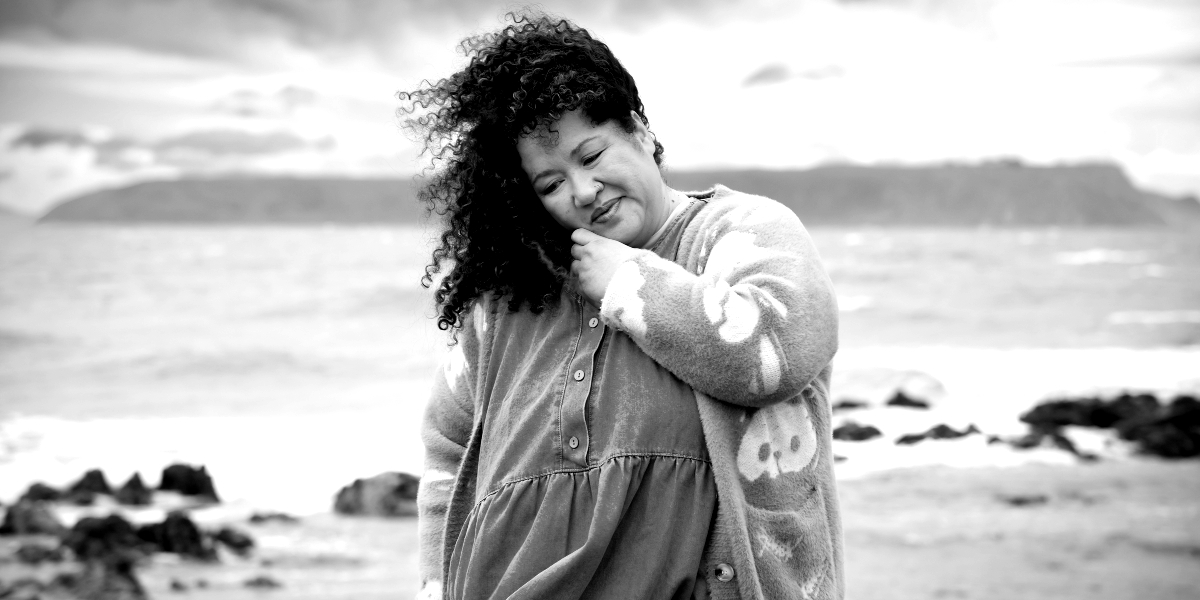
Image by: Robert Cross
In 2019, I found myself in a classroom at Te Herenga Waka Victoria University of Wellington sitting alongside 15 other Māori and Pasifika writers doing the CREW 256 course, led by Victor Rodger. One of those students whose writing stopped me in my tracks was Nafanua Purcell Kersel. Our shared journey to publication sings synchronicities in terms of timing and our chosen artist for the cover design of our debut poetry collections. Both of us unknowingly selected pieces by the remarkable artist, Momoe i manu ae ala atea’e Tasker. I was asked by Nafanua’s publisher, Te Herenga Waka University Press, to provide a blurb for Nafanua’s collection titled Black Sugarcane and I think my endorsement articulates the level of respect and awe I have for her writing and this stunning debut collection:
Nafanua Purcell Kersel yields her machete pen with ease, humour and aroha; clearing paths, riding waves, carving memory and bending time. Purcell Kersel’s poetic vision is both miniscule-microscopic and drone-distant, opening space for the vā to take shape. These poems are laced with panthers and cobras – read Black Sugarcane with haste.
Anne-Marie Te Whiu: Massive congrats e hoa – the last couple of years have been massive for you. Publishing for the first time – your incredible pukapuka Black Sugarcane, followed by epic acknowledgements in the arts industry for your incredible work. Huge that you won the Biggs Family Prize for Poetry at the Ockhams and you have just been named one of 2026’s New Voices of Aotearoa! With all of this in mind, who would you like to acknowledge as some writers you see as potential future literary trailblazers? How does it feel to have been awarded such significant prizes for your debut collection? Have your expectations in terms of publishing and poetry on the page been met?
Nafanua Purcell Kersel: Yeah, thank you e hoa! Publishing a book is something that I always wanted to do and yet I still feel like I jumped in blind because I dreamed into the product, and not the process! I think publishing with a university press was good for me. Ashleigh Young is an editor who is as kind as she is astute and we had a compatible flow of time and attention. That experience has now set the standard for me. Writing the manuscript through my MA year, I had a very simple intention: to have something tangible to hold my stories and family stories. I’m stoked it was published into a book and everything beyond that is a bonus.
The Ockhams and New Voices of Aotearoa happened simultaneously so that did feel a bit extra! I try not to have any expectations but of course, I do hold hopes. It’s a mash-up of feelings and realities because my life has moved on so much from where it was when I wrote the manuscript, and my intentions for it were already fulfilled. I hold such aroha for Black Sugarcane and the space, energy, effort it took to write but now that it’s published, I feel like the readers have their own vā with the work and I’m always going to be in awe that my poetry did that. I want Black Sugarcane to live its best life, and that looks like more than I dared to even hope for.
‘Trailblazer’ is so evocative and one of those words in english I have to look up to make sure I’ve got the definition correct because I’m so taken by the consonants and sound of it. I found synonyms like ‘breaking ground’ and ‘innovative’ (and ‘pioneering’ but ughh). With that in mind, I will name Amber Esau, Emele Ugavale, Joseph Trinidad, Laura Vincent and Rex Letoa Paget. I’m also excited to see what our friends Aziembry Aolani, Nicole Titihuia Hawkins and Kahu Kutia publish in future.
AMTW: Am keen to begin by hearing about your Grandma – can you please share a bit about her? How do you feel like your life is inspired by her legacy?
NPK: I was fortunate to grow up with my Grandmothers in my daily life. Both were widowed, one of my Grandfathers passed when my mother was a child, and the other passed when I was a child. My maternal Grandma, Uatifoti, immigrated to Aotearoa just after we did in 1983 and she lived between our home and my aunty’s, moving between the households as new grandchildren were born. My paternal Grandma, Anasoa, also lived in Aotearoa until most of us cousins were grown and she moved back to Sāmoa. They are now in their nineties and both living in Sāmoa. Growing up, and even now they were our closest and strongest link to Sāmoa and our language. My ‘Grandma Lessons’ poems are a reflection of growing up connected to them and realising how those cultural links and lessons have strengthened throughout my lifetime and become my true inheritance. It’s beyond inspiration. Just like my culture and lineage, my Grandmothers are an indelible part of me.
Grandma lessons (voice)

Find blankets to drape over your back during morning devotions
so the children wake to a warm, singing mountain.

Find a sunny spot on the floor for your feet to rest on while
your hair is being braided, then read aloud or sing.

Find in your voice a high pitch for hissing at cats,
a low pitch for growling at dogs and cheeky boys.

Find a song, even if it’s out of tune, and sing when you’re ready.
Everyone will join in and the tune will correct itself.

Find a nasal drone in your singing and you will
carry the sound of all the people we come from.


Black Sugarcane, Nafanua Purcell Kersel, Te Herenga Waka University Press (2025)
AMTW: Love to hear about the whakapapa of Black Sugarcane – I remember you saying to me that you didn’t know what form of a book you wanted to write. You just knew that you wanted to create and share stories. How did you land on the poetic form as your vessel?
NPK: I had several concepts to start with and some of those I wrote into theses or essays. My MA workshop was for creative nonfiction and poetry, so a hybrid work was always a possibility. When I started writing in earnest, it became clear that poetry was ‘the one’ to hold the stories with the space and grounding that they needed. I already had stories in me, and they kept coming through as poems so I requested a supervisor who writes, lives and breathes poetry, James Brown. My creative process for poetry was both comforting and challenging enough to keep me excited and invested, a sense of the familiar, as in familial. So I let it do its thing – like how families grow with stories and people, so did the poetry.
AMTW: Can you please tell us about the title of your brilliant book, Black Sugarcane. What is the whakapapa for this title? Black Sugarcane – you write “the centipede is punchdrunk, the sting I coat with sugar” – is a remedy for centipede stings.
NPK: The title is from one of the poems in the book. I had a working title for the collection but as soon as I wrote this poem, I fell in love with the sound of the words ‘black sugarcane’ and it wouldn’t leave my brain. I asked my convenor Chris Price what her thoughts were about my working title and without prompting she said she liked the energy of ‘black sugarcane’. That was all the confirmation I needed and the work that followed took on the nuance of that title.
The poem itself started as a challenge from my supervisor, to squeeze all the juice from a metaphor and not be afraid to go beyond sense. It challenged my lived experience of almost losing my language in order to gain english as a child – whereby I acquired an incessant need to make sense in english. The pain of that memory connected to another pain, and of a remedy taught to me by my Dad and Grandma – a poultice made from the young leaves of the black sugarcane to ease the searing pain of a centipede bite. Centipedes are so alien and scary looking, even the toughest of us fears the sight of them. I think I came to the remedy because, like many remedies it’s an unlikely pairing that makes your mind work to find sense. My mind goes to the story, who did this first and how did they reach for that particular leaf? Then, when you actually need the remedy in real life, you’re in a state of desperate pain and urgency so you have to throw faith at the story and grind the leaf into the wound. The centipede, the wound, the remedy and languages all come together in that poem.