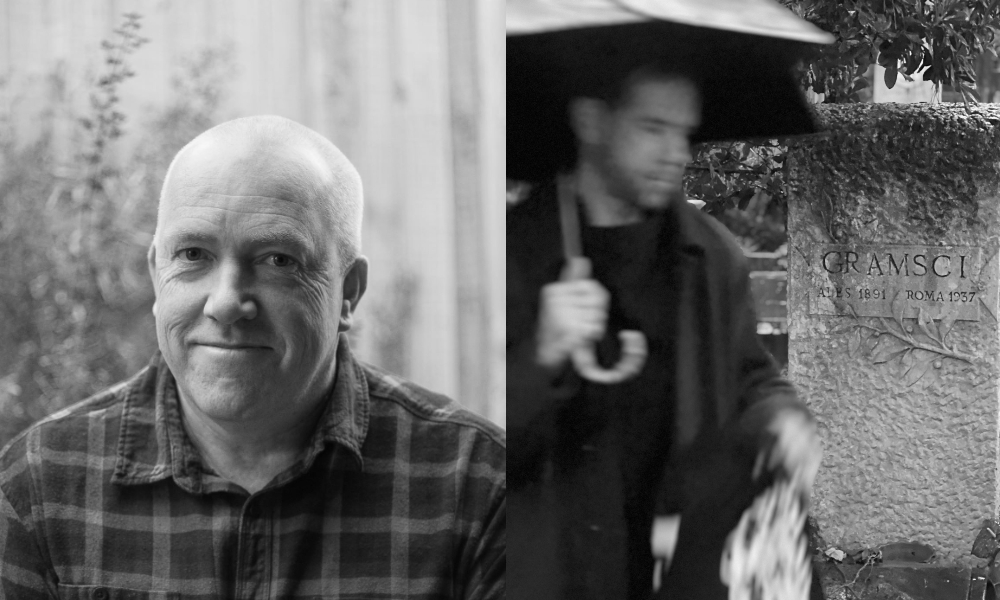
Declan Fry [intro]: Meet Michael Winkler: novelist, essayist, critic and all-round legend. He greeted me at his house wearing a tomato tin print T-shirt, the kind of tomato tins you might find at Basfoods or Brunswick’s Mediterranean wholesalers. He told me his son made it, before showing me a couch so red David Lynch must have made it for, if not wished to use it in, the TV show Twin Peaks. Sadly, I was too nervous to confirm whether those cushions ever had the honour of holding Kyle MacLachlan upright.
Over a couple of beers, Michael and I discuss masochism, the novelist’s freedom machine, being a judgey, grudgy reader, how Randy Newman might end the rise of One Nation. Apologies to the lead singer Powderfinger trying back in the 90s; it didn’t work, and Pauline Pantsdown, if you’re listening, we need you still. And ultimately, the biggest question in life there is: Is everyone but you enjoying a little too much of that illicit substance, happiness? So join us as Michael Winkler lies down on the couch and ask, What does that mean? Is he a nut? Is he crazy in the coconut? I’ll leave it for you to decide.
Michael Winkler: I can get lost in narrative, like everyone else. And also like everyone else, I’ve been reading Lonesome Dove. Why it’s having a moment, I don’t know.
DF: What’s that? Lonesome Dove?
MW: Lonesome Dove by Larry McMurtry. It seems that lots of people are reading it at the moment. A book from 40 years ago, and it’s 900 pages, about driving cattle from Texas to Montana. And I can be in that – and I’m really in that and enjoy that.
But, I just think for me that that’s something that doesn’t interest me all that much: I’m not terribly interested in plot. And I think it’s like a freedom machine in a way. With a novel, you actually are… enabled to go almost anywhere and do almost anything. And it’s a bit sad how often we fall back on more conventional shapes, and I don’t think life is shaped like that, necessarily. Maybe the way that we report our life is, but I think it’s more lumpy and… is that making any sense? If it’s if it’s mean-spirited, I think I can be mean-spirited. I think I can be impatient, maybe. I would certainly take the opportunity to… to try to pull the rug out, I suppose.
DF: Mean-spiritedness interests me. I think it is very, um… what’s the word? It’s relevant, like, there’s a fascination… I mean, I basically in Grimmish and in this [Griefdogg], this fascination with masochism, pain. And maybe also male insecurity or what did I say? Masochism, but also emasculation. Yeah, do you have thoughts on these topics? They’re very prominent in both novels and perhaps connected. When I think about mean-spiritedness, I think one source, especially for men, very liable to it…
It’s hard to grow old as a man without getting grumpy, it seems, in my experience. If you met my father, you’d see where my feelings, why I’ve formed this theory. You know, just when I grow up and looked at men, my suspicion about why – and perhaps this is relevant to things that you can’t see – the patriarchy and masculinity feel premised on materiality, explanation, visibility. And if things aren’t adding up, I think perhaps, the first urge – maybe it doesn’t have to be a man, but I’ll say for men – could be meanness prompted by cynicism, because if you’re cynical then you’re right. So just ways of basically being right, therefore secure, as opposed to insecure or lost. I don’t know, what do you reckon?
MW: I’ve got a whole range of responses. A whole range of responses. The first thing I’d say is that like you, I grew up in the country. Not as remotely as you did, but you know, I grew up in small towns and certainly the male culture in those towns that I grew up in was not a place where I ever saw myself. It wasn’t a place where I was ever comfortable. I didn’t fit. I’m interested in men: we just we seem to have such limited tools and fall back on, you know, such a small range of responses, and cynicism is is often one of them. Cynicism, aggression, retreat.
I think that the sort of existential crisis that Jeffrey [Griefdogg‘s protagonist] suddenly suffers might be more common in men than women, but I don’t know that for sure. But I think when it happens, men often have fewer tools to address that.
As a reader, I’m a judgey, grudging reader and I’m also a generous reader in that that I’m just filled with gratitude when things work for me. It brings me so much joy. But I’m not a forgiving reader. The books or other texts that earn that sort of response always earn it. And so, I suppose, as a writer, I bring some of that grudgey judginess to the writing that I have as a reader. And then, men growing up without getting grumpy or retreating for that matter… because I guess that’s what Jeffrey does. He retreats, he leaves the arena and chooses not to participate. And I understand that instinct. I don’t know that it’s the best response, but it’s one possible response. It doesn’t match up with me. You know, I’m more connected in the world than I’ve ever been.
You know, my happiest thing each day is if I’m walking down the street and I see a baby. I’ve reached that point in my life of sort of…
DF: …insufferability? [laughs]
MW: [laughs] It must be you know the world saying you’re ready to become a grandfather or something. I’ve been thinking about late style and how rarely I find it terribly rewarding when you read writers in that late style period. And as someone who started so late and is rapidly getting older, I think, I better keep writing before I become a grandfather because then I’ll just be so soft.
DF: Maybe you avoid late style when you start late. You’ll only ever be early style.
MW: That could work. Yeah. I’ll be the grandma Moses of prose styles. Are there any answers to the question in there?
DF: Yeah, tonnes. And I mean, I think there’s something in that for late starters. It can’t be based upon the exemplars where you’ve got so many… Late style sounds like, well, you have to have had this long ongoing style. There are a few famous writers who are late. I don’t know if they count as late starters.
MW: Not that many. Not too many. It’s a small group.
DF: There’s a minority. Are you insecure about that, about young writers, or about starting late?
MW: I don’t think so.
DF: Wish you’d started earlier?
MW: Oh… I mean, I did start earlier, it’s just that I was no good! You know, I was bashing it to the door for 40 years. No, one of the really happiest things that’s happened with Grimmish is that some young readers have liked it, and I get to hang out with them and chat with them and it’s so incredibly nice as an ageing person to find those things that will cut across the generational gap.
DF: Okay, speaking of that, you said there are three characters, I’d say there are four. The fourth is Gareth Morgan. Why is he a fourth character?
MW: He was in… so Mildura… I was born in Mildura, and we lived in Merbein, which was the little satellite town. We left there when I was about four to move to other country towns. So, that’s one reason that Mildura… there’s a connection. But another is that the Mildura Writers Festival has become a happy place. It’s a fantastic festival, and so the year that I wrote this I started my Mildura time at the festival and Gareth Morgan was there. I had his poetry books that I was reading to start the day. And so hence, he ends up in the book as the fourth character.
DF: Because Mildura is a big… it’s almost like he just became part of the Mildura. Mildura, I say, being another character in the book.
MW: I hope so, yeah. It was a very conscious decision to try to have it grounded in a real place, instead of this sort of… amorphous Australian country town that… sometimes people get them right, and sometimes you think, have you ever actually spent time in a country town, or have you only driven through? You know, like everything, they’re always more nuanced than the cliche and the idea that everyone in the country is a redneck or everyone in the country’s racist and stupid… um, it’s just not true. There’s a diversity of people, and you can find all sorts…
DF: Were you ever a Randy Newman fan?
MW: [laughs] Didn’t expect that question. Um, no. And I don’t know why not. He’s sort of perhaps adjacent to music I like, but no.
DF: Just because I always found him fascinating as I actually don’t know his background, but I always enjoyed this songwriting that would inhabit the people who were not meant to appear in songs. I think that’s really empowering. And again, ’empowering’ is not necessarily used as a word when we see, like, the rednecks in songs, the people who don’t have agreeable, correct thoughts.
I’ve been having a lot of conversations. It’s interesting because this book does kind of have an apology or a defense too, for like, people who are rural or whatever, being some of the most, I guess, kind of silenced, I mean, especially in Australia where it’s $10 to get an apple if you leave the CBD – actually, I think it’s not too bad in Victoria, in WA, it’s like that – but um, I was gonna say, it’s interesting. You know, the conversation I’ve been having actually is, when I was talking about this sort of topic with others, they would say, “Oh, I was on a bus, and the boys would say ‘tits out for the boys’.” And I’d say, no, I’m not talking about those people – that’s toffs and rich people who say rubbish like that. No politically incorrect marginalised person says that. But it’s interesting that it’s so hard to even establish what, to me, is such a clear difference in politics and cultural views between people who are scared of the middle class. Not because they’re saying things that are ill-intended, but just because they’re not saying them correctly.
MW: Well, I mean we’ve seen the voting figures, we um, we know that there’s more One Nation national voters in those areas, and we both, I assume you still live in Brunswick, we live in this…
DF: Yeah. Try to avoid voting for One Nation. [laughs]
MW: [laughs] Yeah, we live in the most progressive place in Australia. But in the supermarket here, I see a whole lot of people who look like me, and I go into the supermarket in Mildura and I see people from every corner of the world… refugees out there, and then a lot of low-paid foreign workers sent in. I also have to be around people who don’t share my polite progressive take on the world, and some of them I wouldn’t give you five cents for, and some of them actually, you know, perhaps don’t speak in those ways that you’re talking about, but are genuine people who you can have a genuine relationship with even if they don’t read the same books.
DF: Such a polite way of putting it.
If you get a chance, you might want to read ‘Americano Sal’ because it based upon trying to represent… I don’t know if you thought of trying to represent this sort of person who – again, like Randy Newman – doesn’t often appear necessarily in the arts, where they’re really like… I mean, they may be racist, they may be misogynist. Separate question though. The point is that their expression doesn’t – what’s the word? – prima facie, indicate as such, though. They’re simply saying things the same way we are, it’s just a different expression. And you don’t necessarily see it represented. It’s interesting.
What aspects of your practice writing Grimmish did you apply to this book and which ones did you? You leave behind or scrap?
MW: Yeah, wow. So, the sort of episodic, fragmentary nature of it, which is in so much contemporary fiction, that is an efficient and effective way for me to work. In those chunks. So, that carried over.
DF: Can I ask why you find it effective?
MW: Because it’s how I think, and I’ve got a short attention span, and they’re like building blocks, I guess. But you also can try to… you can work on and polish each little building block and then work out where they all slot in together. [Griefdogg] is less wacky than Grimmish, which I think is a good thing. I’m glad that Grimmish is as sort of zany as it is, but I wanted to pull that back a bit.
I suppose the the different thing here is the big sort of organising principle, central motif of water, of the Murray, but also of the groundwater. And there wasn’t a through line in Grimmish like that that I could sort of use as a guide and as something to knock against.
DF: You feel you wanted that this time because it made it harder without it in Grimmish?
MW: I wanted something that would tie it together, and provide that sense of throughness, so that it doesn’t feel as fragmentary. And you know, that I could use as a mechanism for the way in which [Jeffrey] starts to understand the world. Or perhaps it’s to not understand the world. It might be the Johari windows of the known knowns… I suppose it’s the unknown knowns and the unknown unknowns, yeah.
DF: Did you have that goal even when you were afraid this isn’t coming together, that early…?
MW: I’d already done all the reading. I read so many papers on hydrogeology. There’s maybe not that many… like, I don’t know that it’s an incredibly widely written about branch of science. So, it wasn’t that hard to feel like you’d got across all the contemporary thinking and the historical stuff. But I don’t have a science brain, so I’m reading this stuff and I still really don’t completely understand.
DF: I was amused by the idea of tears contributing to water, because I thought with salinity maybe that’d actually take away. Be a more apocalyptic novel, actually – people maybe shouldn’t give too much vent to feel. [laughs]
MW: That’s right, that’s right. The rising salinity.
DF: Yeah. I was actually surprised. I didn’t know if that thought occurred to you. I don’t know. Because I know nothing. But that was one thing I did actually think.
MW: You thought… that tear!
DF: Toward the end, you were being so nice about tears, but I thought, no, dangerous! Tears, bad! Perhaps the thought didn’t occur. You tell me.
MW: Ah… I can’t believe that.
DF: It’s still lovely. The sequel can be Deaddog or something, or Salinity. It’s apocalyptic. [laughs] I love this question: “Do you feel you have a talent for making things harder than they need to be?”
MW: [laughs] Is that your question or is that in the book?!
DF: That’s in the book! It’s unfortunate, you have to read the book – the writer’s the last person who wants to do that.
MW: I would say that that is true of me… and probably true of Jeffrey. I don’t know if it’s true of Hubert, because Hubert’s just… kind of flubbing along. Schlubbing along, yeah. Yeah, you know how some people just breeze through life.
DF: I wish! I imagine… Yeah, people who it’s like, they need a problem.
MW: Why is nothing hard for you? Why is nothing hard for you?
DF: Even the weekends are hard for me. I feel like I’m not enjoying myself. I’m thinking of things to do.
MW: Maybe your next album? Even the Weekends are Hard for Me. Declan goes country.
DF: I was actually thinking it sounds like I’m Dave Warner and I’m just a suburban boy or something kind of like angst. Even the weekends are hard… what do I mean honestly?