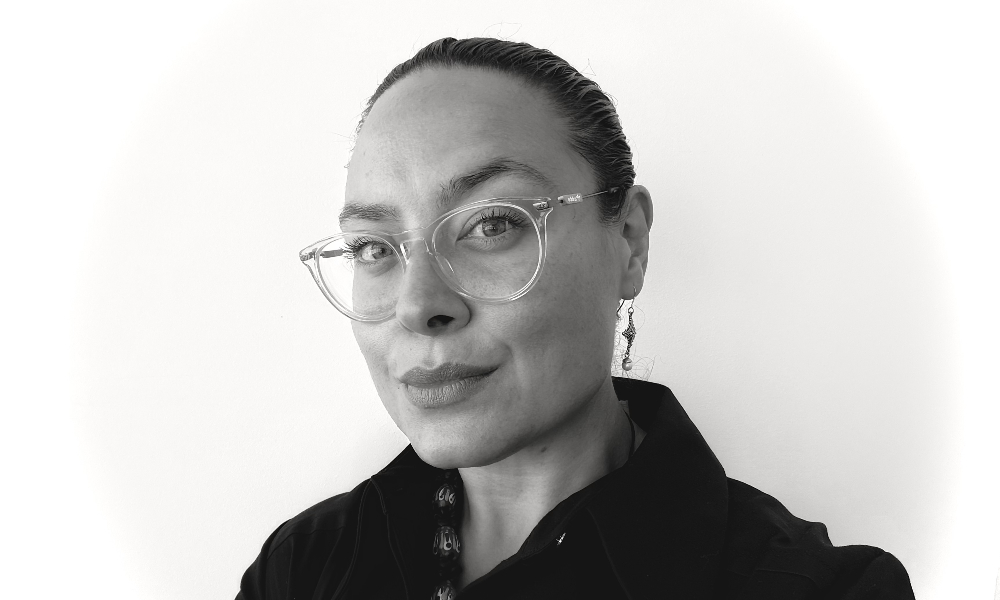
This interview features Dr Latoya Aroha Rule in discussion with curator and writer Dominic Guerrera, exploring justice, healing and the limits of colonial systems. Grounded in lived expertise, community accountability and deep relational ties to kinship, Dr Rule reflects on their PhD research and the ongoing impacts of state violence on Aboriginal families. Moving between personal testimony and political analysis, Dr Rule offers insight into concepts such as Blak space, truth-telling and decolonial thinking. They invite readers to consider what justice might look like beyond the state, and what responsibilities we hold in shaping more just futures.
Note: Aboriginal and Torres Strait Islander people should be aware that this interview contains the name of a deceased person.
Dominic Guerrera: How might Aboriginal concepts of healing offer forms of justice that colonial systems are unable to?
Dr Latoya Aroha Rule: Firstly, there’s always been a need for us to consider healing from an Indigenous point of view – healing is central to our being, despite the state. State violence and colonisation of Aboriginal Lands, which directly relates to us as relational people and to our Countries and stands somewhat adversely to our way of being, separates our person from Country and Land.
As a saltwater and freshwater person on all sides of my ancestry, including my Norwegian side, my cultural protocols and knowledges are steeped in such waters and Country and I see that when there is a grievance against Country, that’s also a grievance against myself, my nation(s) and kin, which given that same relationality, also impacts other Indigenous people. The need to continue situating our relationality is at the centre of our need to heal because we don’t look at ourselves, nor do we interact with Country and Waters, solely from an individualist position. Culturally and by way of governance, we share these in both the traditional and contemporary contexts. When there’s a grievance against Aboriginal Land, there’s also a grievance against us, let alone what happens and occurs on top of that Country. A call to action of course, is that the healing demands we consider ways forward that are Indigenous.
For example, to speak about Yatala Labour Prison, where my brother Wayne Fella Morrison allegedly fell unconscious inside a prison van with multiple officers inside, spit-hooded and restrained by his hands and feet, cuffed behind his back and placed in the prone position – face down. He never woke.
To me, that grievance is not only against my family and Wiradjuri, Kokatha and Wirangu people, but I believe also a grievance to Kaurna people upon which that event occurred on your Land. It’s also a grievance considering that that event occurred within a prison that’s named after a Kaurna word that means, from my knowledge of what the Western archives have said, to be by a river or by the water, because Yatala Prison is situated by a valley, a small valley that is where fresh and salt water commonly come through and meet, or would at least have done back in the day.
The fact of the matter is that Indigenous healing methods are not only necessary, they’re also essential when we’re considering resistance to the colony, because they’re staked in the necessity and acknowledgement of Country, and how that relates directly to our body, and that’s where we both belong to and must protect through those healing methods.
White law is inherently divergent from Indigenous protocols and practices. That’s something that my research shows, and that’s something that continues to be a grievance and a misunderstanding, because at the end of the day, this white law and the white legal system exists and continues to exist, especially through the Coroner’s Court and other spaces and places that are provided the power to govern and to have a say in the final word, in a lot of sense, over Aboriginal life and death. We know that inherently, they’re incapable of healing us because of where they stand and what they represent.
If we even look through the Ngarrindjeri case of the Hindmarsh Island Bridge / Kumarangk case, we might understand better that a lot of those legal processes were about Aboriginal women’s connection to not only place, but also the protocols and protections of that Country, for themselves and kinship right across the colonial state. Waters and ceremony surround such travel from that Ruwe or Land, all the way up to Wiradjuri Country, and impact many nations along the way and beyond. The Ngarrindjeri Elders and other women and people involved should be recognised for their defence of multiple different mobs, and our future health, because of their care and therefore their support for that Land to which they belong. Because they were not separate from that Country, that grievance they expressed was against their own bodies, against their own spirits, against their own ontologies and peoples, and many others to come. It was not external to them, which is why they took up such a fight. The personal is always obviously political, but the personal for us as Indigenous people is also steeped in Country. We cannot exist without it, nor can our relationships with each other. However, going back to that Western legal system, it came to separate us by law and to our own laws, and sever our sovereignty from that forced relationship to the state. Its necessity to continue the conquest and pillage of Aboriginal Country, which will always require the incarceration, arrest and detainment of Aboriginal peoples and Aboriginal Land, which is why we are the most incarcerated population per capita in the world, as Indigenous peoples globally.
DG: What are the limitations of reform, and why is it important to imagine justice beyond colonial institutions?
Dr Rule: When we’re talking about reform, I think it’s really important to speak about what types of reform have existed in Australia thus far in the terms of Aboriginal Affairs. A lot of Aboriginal Affairs reform has been situated within government structures and ideas and theories of democracy. Again, these bring us within and underneath the hierarchy of the colonial state to govern over Aboriginal people and they, again, don’t align with Indigenous ways of doing business.
For me, when I think about reform, I do take an interest in reforms across the world from other Indigenous people, Black and Brown people, and that’s steeped in non-reformist reforms, or what I would call abolitionist reforms. They are inherently, in my view, decolonial processes of moving us forward, of dismantling to the best of our ability at the very crux of that state, and chipping away. It’s something resonant of what Frantz Fanon said, Europe has laid her hands on our continents, and we must slash at her fingers till she lets go.
When considering the failed justice system and the need for reform, those reforms must sit outside of the colonial state in some respects, unless they too set us up for further failure. Such reforms, as an example, can be seen in South Australia, or Kaurna Yarta, as the National Ban Spit Hoods Coalition work, and stemming from the #JusticeForFella and also the ban spit hoods campaigns in Adelaide.
In that reform, we intentionally took the view that we want to decarcerate and decriminalise as per our abolitionist politics, and that we would create a bill brief and a setting where we could advocate around the ban on spit hoods, which was implicated in my brother Wayne Fella Morrison’s death.
We took that approach because not only is it abolitionist, but in the decolonial sense, it means that we’re not also then contributing to the rising increase of the prison population, let alone of those who are already, we know intimately, at the crux of being the most policed people. And this includes Indigenous people, but it also includes people who are people of colour, who are sex workers, for example, who may use these devices or instruments in their workplaces, or for us as civil society and other people from our communities who may be using such tools in their own home and in their own private spaces.
We’ve taken a lot of time to develop and to consider these kinds of reforms. And when I speak of reform, I also acknowledge, of course, that there are important reforms that must be pushed forward that will get us to a place where we can have conversations. I’m not oblivious to a lot of those reforms that have been really important in the past, and really necessary for their time. One being the Royal Commission into Aboriginal Deaths in Custody, for example. For the majority, that was a reformist reform, essentially working with governments to be able to roll out a whole sweep of findings and recommendations. However, we know that the Royal Commission into Aboriginal Deaths in Custody is older than myself, and only a very, very small percentage of the recommendations have even been implemented, which is where these reformist reforms fail. They continue to come under government, and have continued to be under the whim of governments who, from the flick of a pen, can undo legislation, can undo operational bans or operational policy, and can rewrite such policy.
Being very stern about the types of reforms that we advocate for is so necessary, getting real about what we’re actually going to need in the future, and being future-thinking people is really important. But we are also approaching a day here in New South Wales, where we’ve seen it in Victoria, where we are considering Treaty. It’s been a call from our Elders and Ancestors for many, many years, if not since 1788. It is something that we’re going to have to negotiate. The types of reforms that are going to surround treaties will depend on what nations need, if these are nation treaties. However, many of us do wonder if Treaty is even the right type of reform that we should be looking at right now, in a day where the government is arresting people on Monday night for wanting to peacefully walk the streets against genocide. It’s recognised as a genocidal government. Is this a government we want to be negotiating Treaty with? Or do we want nation-to-nation treaties? Or something else? To be working on these issues is complex, but must be reckoned with, and I’m glad people are taking up these questions seriously – Indigenous leaders and communities, and our allies.
I mean, these are some of the issues that are beyond my level of expertise in some sense, though I can contribute my labour to the communities and groups involved, and to which I refer to Aboriginal Elders and people with such authority and power in our communities over answering such for us. Real consultation is required to proceed over long periods of ongoing engagement, because without such that’s not really more than contractual advice and might simply re/produce the means for Native Title tribunal and other complaints and disagreements.
But on such issues, I think at least for our younger generations, we have the opportunity to be able to consider reform, but the types of reforms that have been successful overseas from our other Aboriginal and Torres Strait Islander communities who have created real change, and also Indigenous people across the globe who’ve already undertaken such agreement-making mechanisms.