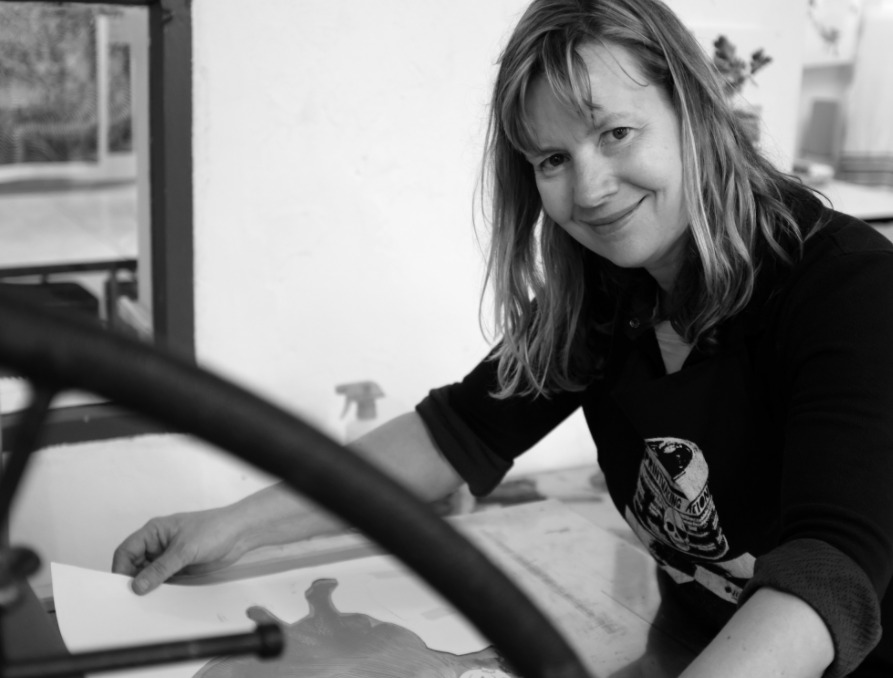
I am the Queen of Reduction Linocuts. At least, that’s how I am introduced to art students or fellow printmakers. I suspect one or two others, including former students, may now share that title, if not claim the crown outright.
My other regular moniker is the Wolf Lady. The two ‘claims to fame’ are inextricably intertwined, emerging from three decades devoted to creating elaborate reduction linocut portraits of female werewolves, most notably as part of my PhD project, The Girlie Werewolf Hall of Fame: historical and contemporary figurations of the female lycanthrope (undertaken part-time between 2005-2014), and a series of exhibitions known collectively as The Girlie Werewolf Project.
As an artist, there are distinct advantages to having an easily identifiable, niche expertise. One is more likely to be curated into exhibitions, to be represented by a gallery, to have one’s abstracts accepted for conferences, to be invited to present artist talks or run workshops, to feature in journals and books. Doors open more easily.
However. Recognition for a particular way of working sets up an expectation that one will continue making the same sort of work, ad infinitum. At the time of and around my PhD, female werewolves and the reduction linocut medium were my world. I couldn’t imagine doing anything else. I loved being the Reduction Linocut Queen and a world authority on female werewolves. My lupine ladies have taken me places I could never have imagined and will always occupy a special chamber of my heart, constituting the most sustained, most rigorous and most celebrated exploration of medium and subject within my practice to date. Even so, three decades is a long time, and I have become increasingly distracted by competing challenges, circumstances and opportunities.
This is the potted history of my art practice. I naturally understand that I was invited to write this article on the strength of my Girlie Werewolf Project, so this is where I will begin. But, in keeping with my voluntary abdication from the reduction linocut throne, I hope you will indulge my writing about my more recent works, namely, artist books from discarded print ephemera and sculptural lagerphones from recycled timbers and beer caps, as part of a shift towards more environmentally sustainable art practices.
Fifty shades of linoleum
First things first. For those unfamiliar with the reduction linocut technique, here are the nutshell fundamentals. Firstly, the entire image is created from a single piece of linoleum. The block or matrix is progressively carved away and printed from in layers, each a different colour. Once carving and printing have commenced, there is no going back. To achieve any level of detail or precision, registration is absolutely critical. Unlike most other printmaking techniques, it is not possible to create additional impressions afterwards, earning the reduction linocut technique the nickname ‘suicide print’.
A typical linocut portrait of mine will have around twenty layers, with anywhere between one to seven colours per layer, taking upwards of 600 hours to edition. It is not unusual for a printing day to last fourteen hours. There is a lot of cleaning up. All of which might provide a clue as to why, three decades later, my stamina has begun to wane.
The borderline masochistic martyrdom demanded by the medium was a large part of its initial attraction to me, no doubt revealing a lot about my personality. I had not seen any examples of anyone else working with reduction linocuts in this way when I began with the medium in the late 1990s and I felt confident that few would follow me down this path. (Of course, some former students have done exactly this, forging unique variations and refinements along the way. And I have since discovered many skilled practitioners who have come to the medium independently of me). It gave me a point of distinction that is critical in an art world over-burdened with talent. Aesthetically, I loved the enamel-like surface created by the layers of ink, as well as the medium’s capacity to encapsulate both historical and contemporary references.
The Photoshopped working drawings for my werewolf portraits incorporated photographic and digital source material, as well as historical printed images ranging from early woodblocks to screenprinted comics. Being able to unify so many different aesthetic histories within a single medium allowed me to create a unified body of portraits of both historical and contemporary female werewolves.
The reduction linocut process furthermore proffered a satisfying parallel between the transition of the image from linoleum to final print and the metamorphosis from human to wolf in werewolf lore. Both instances witness a progressive relinquishing of one state in the process of transforming into the other, embodying all the stages in between; the human is intrinsically implied in the wolf and vice versa, in the same way the linoleum block inhabits the final print. The difference, of course, being that the reduction linocut process is non-reversible.