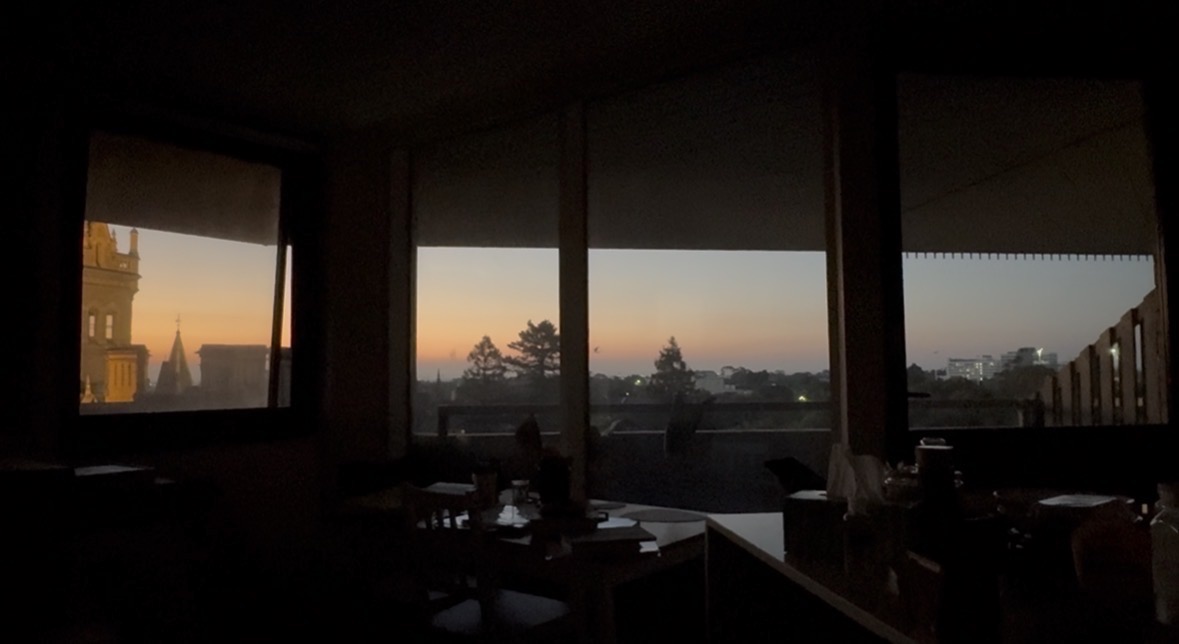
7am. Fellow’s Apartment. University Residential College.
I’m gradually getting used to living up here on the sixth floor, in Melbourne’s Inner North. The wide windows facing northwest. Canopies of Royal Park and Princes Park filter tram noise and invite nomads of autumnal little corellas, murmuring through the green air. When you are long-term at a residential college, people around you never grow old.
I began as a Singapore-born, Malaysian-Chinese, English-graduate student. I’m now an Australian permanent resident, Malaysian-Chinese Literary Fellow and former Resident Tutor. Melbourne Residential colleges are somewhat neither here nor there. Not the elite, exclusive Oxbridge colleges where we drew inspiration from, nor the halls of residences (aka frat houses) which the Herald Sun thinks we are. We’re in between the formal-informal, institution-relation, mentor-mentee. I move daily through the corridors, connecting, communicating…
“You’re from Singapore. You wear thick glasses. Are you studying Commerce or Engineering?” “Choir rehearsals begin in 5. I’ve printed the piano accompaniment parts for you.” “Hello, is this the duty tutor? I’m sorry to ring so late, but can you ask my neighbour to turn it down?” “Hello, is this the duty tutor again? Sorry, I locked myself out. I’ve only got a towel around me!” “Don’t open the windows. There’s a possum out there.” “I’m ordering in Uber Eats if they’re serving us Asian greens again.”
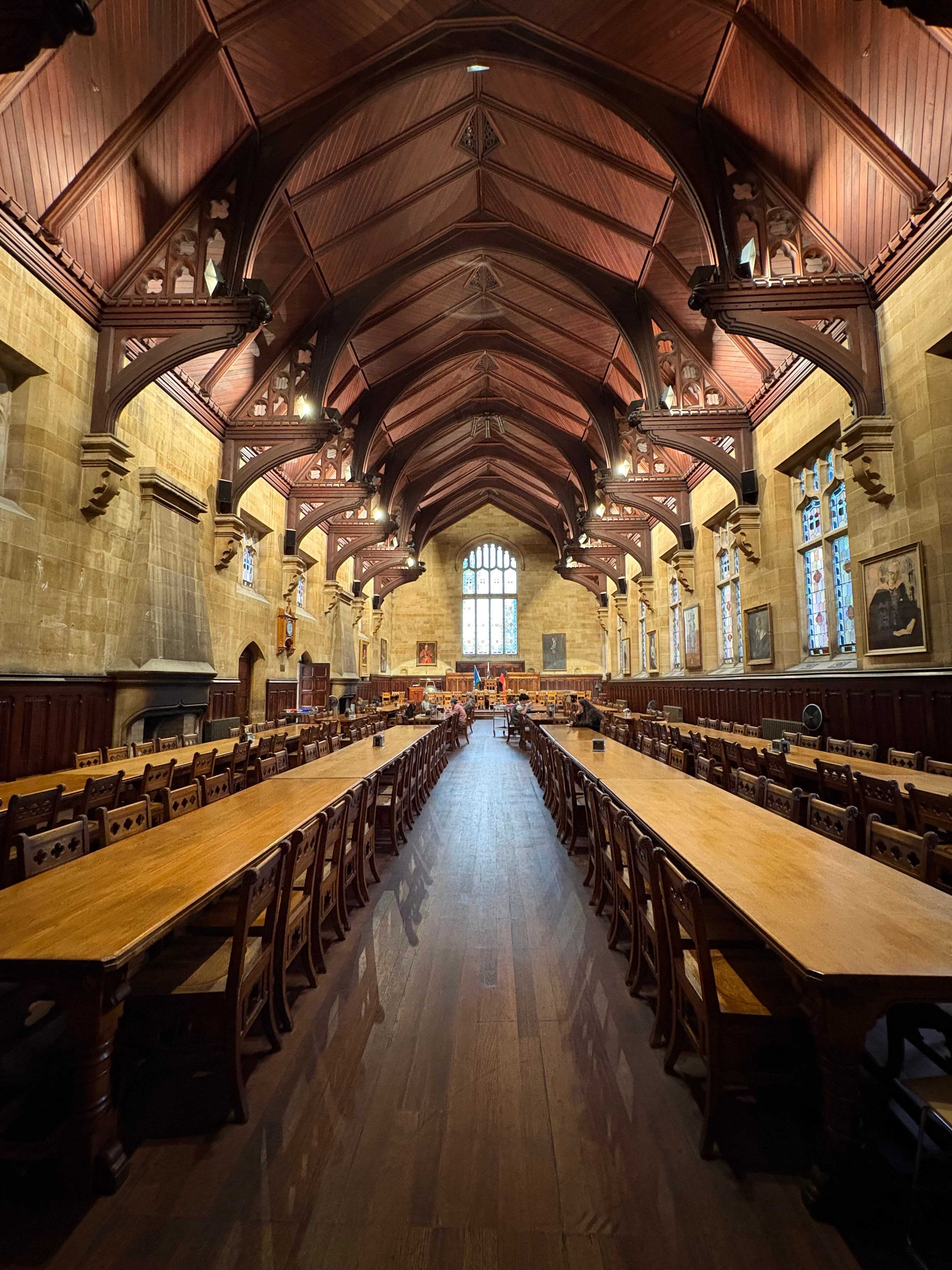
8am. Dining Hall. Residential College.
When I give tours to prospectives and parents, I tell them the dining hall is my favourite place. Some colleges observe the table rule: you don’t start a new one until you’ve filled one up. Collegiality fast-tracked. Long tables where parents and grandparents of students once sat. It’s a family tradition. An alumnus from my old college said he didn’t go to the large elite college all his friends from the same denomination went to. Because it would’ve become XX Grammar School Year 13.
A former head of college likes to tell students that there will only ever be two communities where you eat, sleep and work together 24/7. One: college. Two: prison. I like to sit with students I know, students I don’t know all that well… Prime time for mentoring, mingling…
“I beat my alarm clock today!” “You’re first to brekky again. Are you a Biomed student?” “Yeah, another 8am start.” “I’m a college vegetarian. I don’t wish to eat slabs of meat seven days a week.” “Come over to our table and meet Nat. She went to the Academy of Creative Industries in Brisbane too!” “You folks should collaborate on the college play.” “They’re putting on Cosi this year!” “I like how light-filled this space is!” “My grandmother sat on one of these chairs.” “She was the first Asian student to come to this college.” “And of course she studied Nursing.”
9am. Walk into Campus.
The cross over from college into the main university blurs the home-work boundary. When you live on campus, next to campus, with everyone from campus, when are thresholds crossed? I reckon it’s the moment you step across your apartment door, cultivating the air of a responsible adult.
When the colleges were conceived, they were tasked to provide dedicated religious education that the larger secular university didn’t. From the north crescent of the uni, bordered by the General Cemetery, Royal Park and Princes Park, land was allotted equally to the Anglicans, Presbyterians, Wesleyans, Catholics. Ten acres each. Today, every college accepts students of all faiths and none. They continue to run formal halls where Latin grace and benedictions bookend the meals.
When I first started as resident tutor, I mentored a young woman from Caulfield. She belonged to the Church of the Latter-day Saints. When asked about her goal for the year, she said she wanted to take care not to feel smug: that college kids are cooler than day kids. College kids are often late for classes, though. The unglam 9:55am dash down Royal Parade doesn’t happen with day kids coming in from the Eastern suburbs.
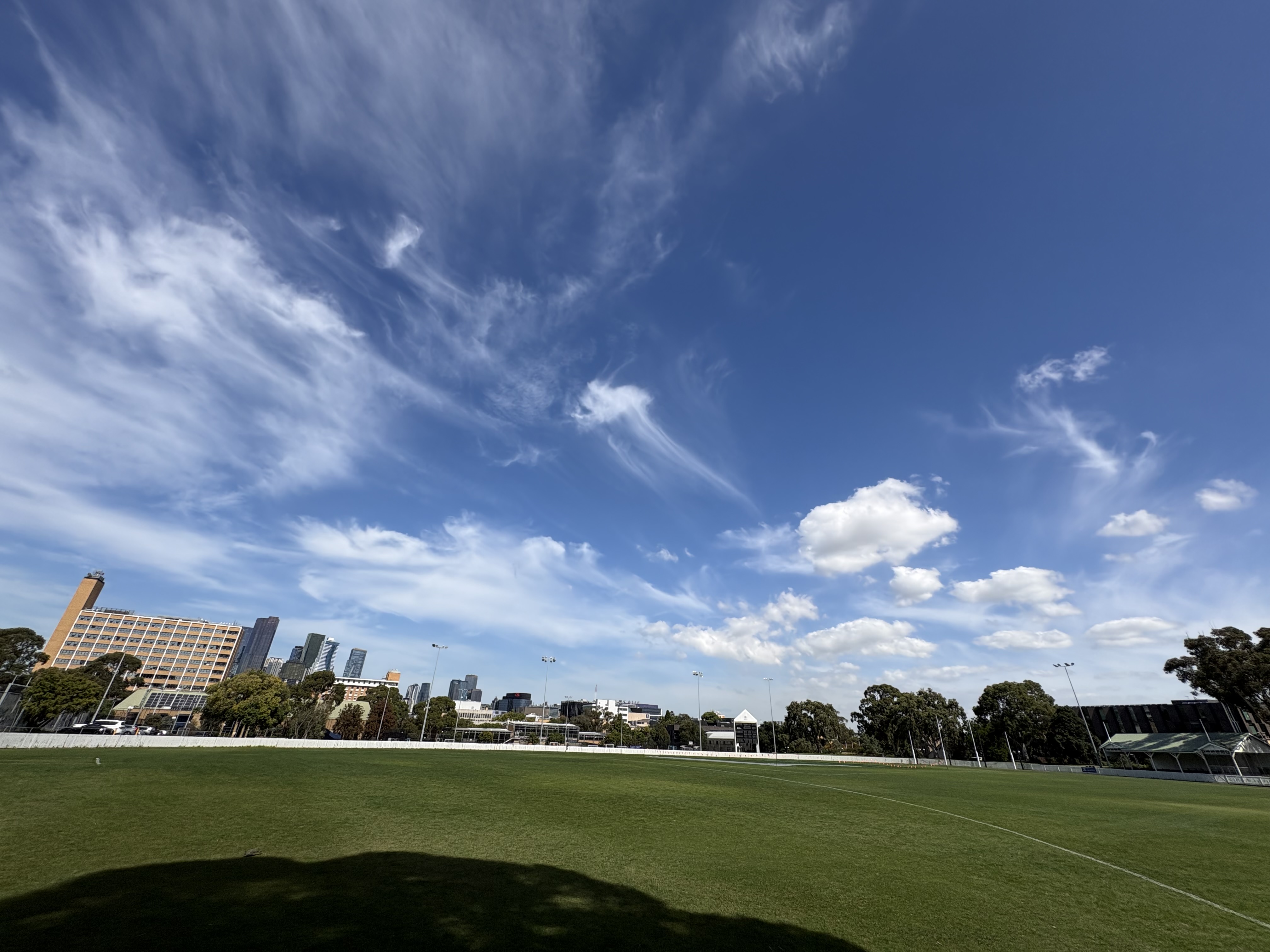
10am. South Lawn.
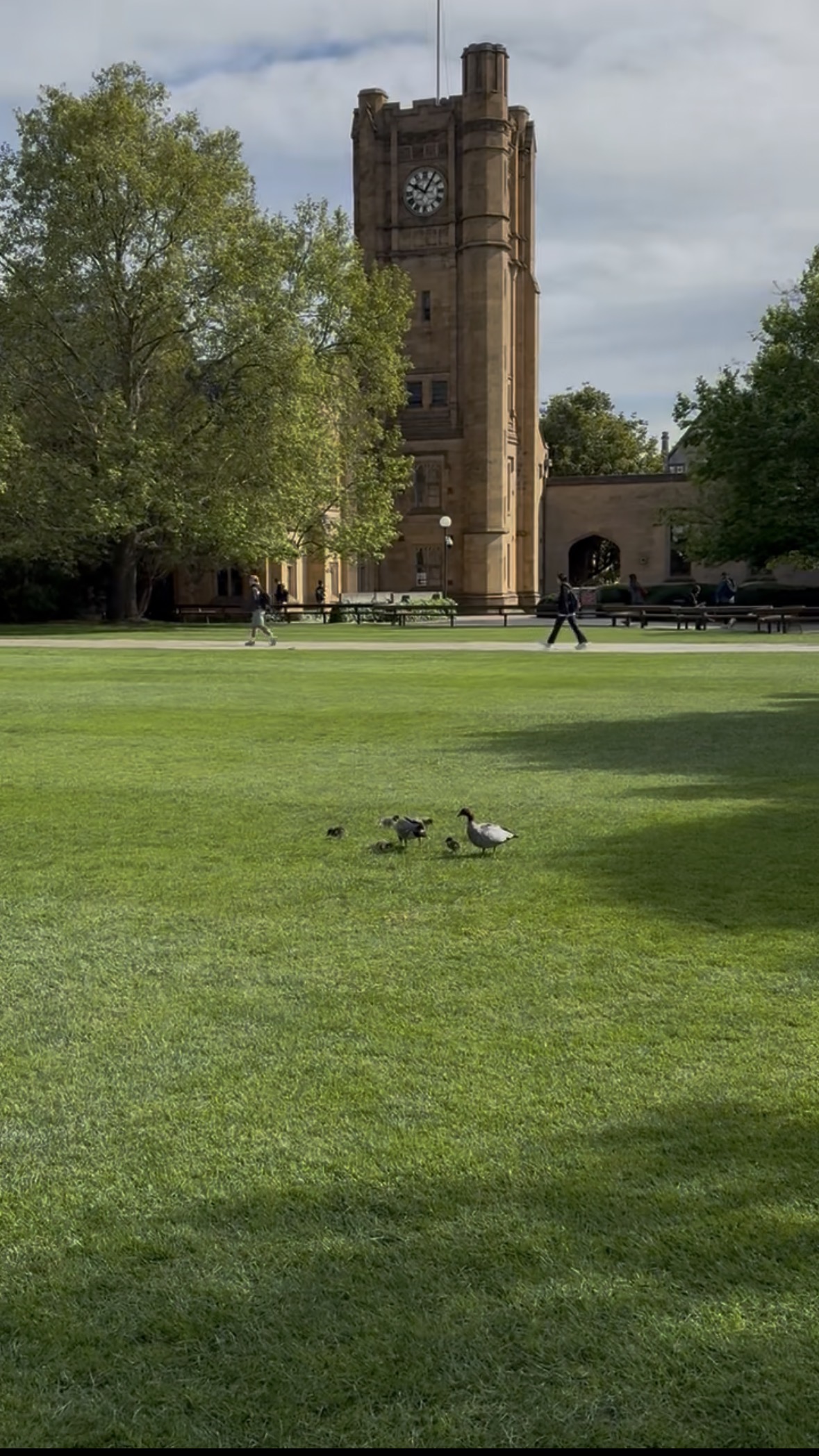
Scenic South Lawn is the major artery across campus. Students and lecturers moving between classes. Or you’re just as likely to encounter busloads of tourists posing in front of the Old Arts Clocktower. 墨大. Melbourne Uni in Mandarin Chinese. But also synonymously: Large Black Ink or Silent and Mighty. Gaining our degrees here guarantees job-readiness: our parents, politicians, education agents tell us.
It’s Sprummer: the contextually-correct time in-between European Spring and Summer. I’m on the lookout for nomadic Pacific black ducks on the lawn. I sometimes wonder where they disappear to, whenever the uni erects a suite of marquees for another marketing roadshow on the lawn. I channel my inner Holden Caulfield – because grid-like Parkville is best explored on flâneur’s feet. We have wandered across this lawn with Tony Birch, walking writing workshop extraordinaire. He tells us to look for unusual things while we walk. Things that call out to us, specifically – to sense and to write. We have taken part in a truth-telling walking tour with the university historian. We stand before buildings whose white settler professors’ names on walls are getting stripped off, replaced by those who were kinder to their fellow human beings. Once upon a time, I was moved reading Henrik Ibsen explaining why he isn’t feminist despite writing A Doll’s House: “I speak for all humanity.”