
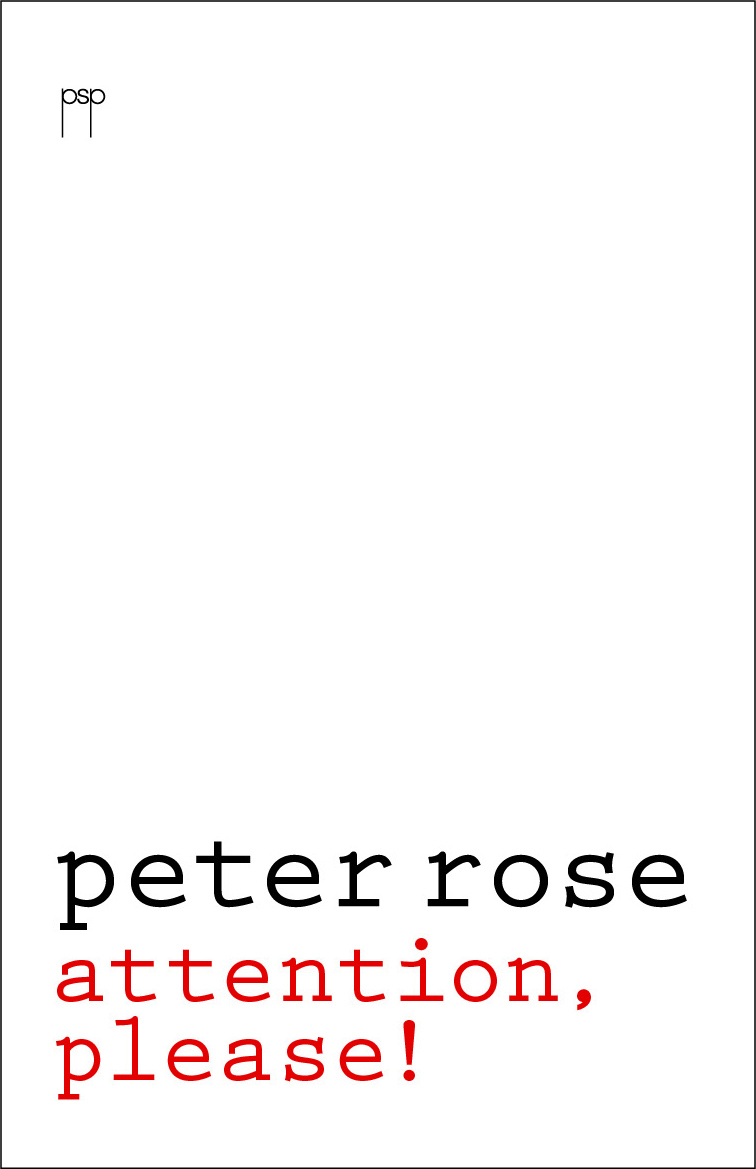
 Attention, Please! by Peter Rose
Pitt Street Poetry, 2025
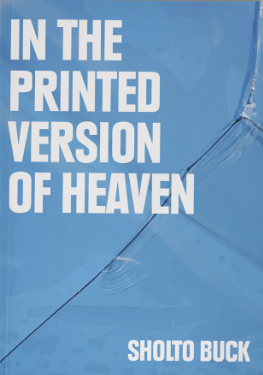
In the Printed Version of Heaven by Sholto Buck
Rabbit Poets Series / Hunter Publishers, 2023/2024
A tiny bag of crystal shard, almost empty, is tucked into Peter Rose’s Rattus Rattus (2005), presumably by its previous St Kilda Library–associated borrower. I am tempted to sample the remnants in order to conjure a different version of (my) critical self — the excuse being that I proposed reviewing Rose’s latest poetry volume Attention, Please! alongside Sholto Buck’s debut In the Printed Version of Heaven through a lens of performative selves. I move the bag from pages to table and back again, entertaining and then shelving temptation, unsure whose impulse will win out: the addictive personality of yore or this stable, routine, maternal self. It is said that memories tend to be linked to the specific context in which they were formed — say, under the influence. Such state-dependent memories can be retrieved by returning to such an altered state. Would conjuring my Sad Girl persona alter the colour of critical perspective?
Sholto Buck’s In the Printed Version of Heaven grew out of his practice-led research and accompanies his 2022 dissertation For a Rainbow to be Seen, the Sun Must be Behind an Observer Who is Facing Falling Rain. In the critical component, Buck offers “light-writing” as a unique form and method which he transposed from photography to literary practice — one that “explores the multiplicity of lightness (explosions, banquetings, floods of it) to layer up the affective power of the poetic image” (83). Within his Rabbit Poets Series debut, our lyric narrator locates splendour in reflective surfaces: raindrops and snow, fountains and ponds, mirrors and foil, glass and lacquer, lighthouse and waves. There is also the shimmering neon cast by “the florid / sunset of being inside / this exact 7-Eleven” (1). Water descends, freezes, melts, and evaporates across the collected poems. Other luscious liquids include “a stampede of watery horses” (14), “canned wine” (16), an “ice blue / mouthful of Powerade” (29).
I have encountered Sholto Buck in various tutor labs at RMIT University but have no relationship with him otherwise. I mention this only to convey the sonorous qualities of his voice, through which I hear his poems read to me (by my imagination, of course): gentle, lilting, melodious. Self-described as “a pernicious bitch / living in Melbourne” in his poem ‘Short bio’ (4), Buck draws attention the artifice of the constructed authorial persona. In the title of another poem the reader is warned: ‘Let’s keep in mind that Sholto is prone to exaggerate’ (17). Buck playfully establishes a reader-writer contract which allows us to suspend disbelief while entertaining an altered scale of proportion. In his dissertation, Buck proposes a label for the impish tone of his poet avatar: self-ridiculousness. It is an “absurd, theatrical tone of voice” that differs from camp in that it is “more authentic and complex” (Rainbow 87). Another poem which draws attention to Buck’s deliberate self-fashioning is ‘100% chlorine,’ which reads in its entirety:
I cast myself as object
of desire and revulsion
a mad thing
made of surplus
plastic like the face of Mars

(43)
Buck muses: “I have written poems because at some point / I decided that images mean something to me” (‘Between the mouths of people,’ 59). He continues: “I want to be better / than all the images that made me.” In particular, the poem ‘All an image can do is show the ways to be silent’ reveals the character of the narrator through such constellating influences. Here Buck charts a ‘phase’ of his iterative, artistically, and aesthetically constructed persona with that disarming sense of self-ridicule:
I recently bought a socialist newspaper
which I have only used
to kill moths

every day

I get less interesting

Add sandals to cart
going through my Joan Didion phase

(11)
With this last line, we might picture ourselves — reader, critic — reflected in Joan Didion’s oversized square sunglasses. Your critic, reformed Sad Girl though she is, locates a comfortable companionship in the lines “every day // I get less interesting.” This focus on the quotidian lowers the stakes — forget the hurried ethos of the biohacking, schedule-optimising millionaire! As we journey the weather-sodden tributaries of Buck’s image-capturing thoughtscape, we can let go a sigh, slowing down to notice whatever is illuminated by the poet-narrator’s diffused spotlight. What might appear banal is painted as sublime, as in this passage from ‘Intricate days’:
Every night I leave the city
through the doors of a train, and the sky is pulp
I am in a delusional time of my life
I think
I had a singlet-shaped sunburn
when it was summer

(26)
Buck’s queer, non-reproductive gaze audits as markers of self all of the attachments, influences, and fantasies that Anna Poletti, in Stories of the Self, argues are integral to a queer understanding of what it means to have “a life” (15, et passim). As much as identity, or the stories that we tell about ourselves, it is also our mediated environments which can give life meaning. I peruse Buck’s cultural references, indulging in Architectural Digest’s YouTube channel which takes me inside the home of Liv Tyler, and the hot erstwhile couple Zachary Quinto and Miles McMillan. These peaceful, aspirational settings — captured in the poem ‘Liv Tyler’s magnolia tree’ (13–14) — offer a soothing backdrop for our narrator to contemplate how
men have yelled from their driver’s windows

to call me a faggot
which is

though consistent with what I know to be obvious
quite unwelcome

(14)
The scene cuts from the discomfort of processing — and then reclaiming — hate speech to entertaining sensorial languor wherein the narrator contemplates Liv Tyler’s
gentle voice

as, in a dulling fashion
curative of my grudges

it soothes me

(14)
In Jeanette Winterson’s Art Objects, she laments that “[c]hildren who are born into a tired world as batteries of new energy are plugged into the system as soon as possible and gradually drained away”; by the time children are grown they are acclimated to “a world of shadows” (135). Our Poet of Lightness — or rather, “lightnesses,” as Buck phrases it in his dissertation (83) — recognises the shadows but seeks out what is good. Where the philosopher Simone Weil raised renunciation to a divine art, Buck finds grace instead “in the humidity / of all the jeans on Earth” (28). The title of the corresponding poem, ‘To be sensual is to suffer and I have suffered much,’ carries the aphoristic quality of Weil’s Gravity and Grace, but with eros as divine calling. Embodied sensuality appears in poems such as ‘I want simply,’ which concludes: “humidity tops / and I lie / beneath it” (21). Carnal pleasure peaks in the poem ‘Defenestrated, decapitated / I am the bottom in all my poems,’ which reads in part:
When your tongue was inside me
my face was pressed
against the bedroom window / if it broke

               I would cum
                            in mid-air as I fell

(50)
Using words as a prism, Buck’s poetry refracts an aesthetics attuned to light capture. As photo/grapher, Buck snapshots affective resonances, tempestuous weather, and ephemeral moments. Sholto’s avuncular avatar delivers hope to this Sad Girl critic, who finds joy in alternate construals of reality because: patriarchy. Reading In the Printed Version of Heaven conjures a feeling of spaciousness that I experience / hallucinate / fantasise when experimenting with creative modes of production in resistance of capitalist imperatives. Buck’s narratorial perspective acknowledges the structural embedding of misery in our world yet purposefully traces lines of desire which direct us to all of the beauty on offer.







