
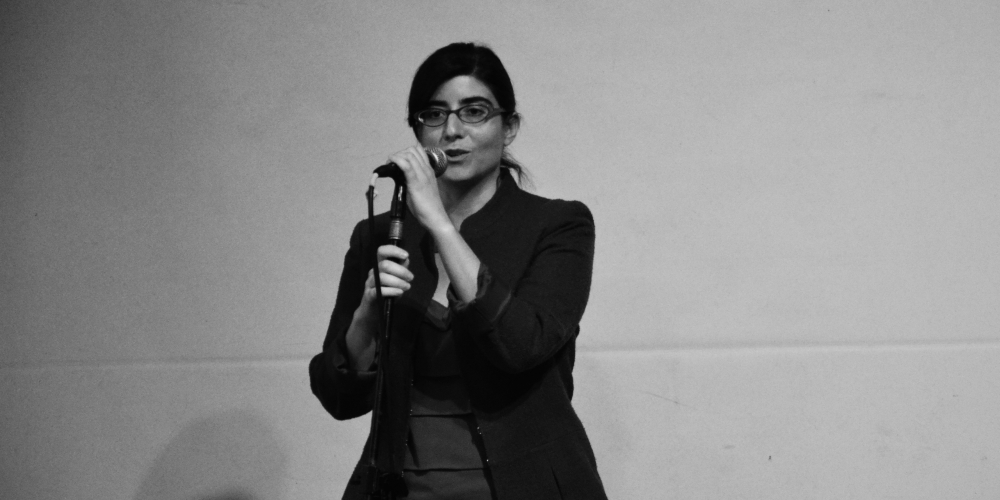
Photo credit: Nicholas Komodore
I first heard of the work of Eleni Stecopoulos while in the US in 2013. I was in San Francisco to spend an afternoon chatting and swimming with Petra Kuppers and Neil Marcus, both disability culture activists and writers. Eleni had at the time been working on a series of public conversations and programs at The Poetry Centre at San Francisco State University called The Poetics of Healing. Eleni is a poet and an essayist whose work on embodiment is always political, and vice versa. Petra had hoped to introduce us, but the timing wasn’t right.
While writing my PhD on disability and poetry in the late 2010s, I read Eleni’s book Visceral Poetics (ON Contemporary Practice, 2016), and while it never really entered my thesis explicitly, its fierce advocacy for embodied scholarship and its exploratory mien certainly did and continues to. Her follow-up book, Dreaming in the Fault Zone: A Poetics of Healing (Nightboat Books, 2024), was described by philosopher Alphonso Lingis as ‘light[ing] up multiple critical and paradoxical insights’. Reading it, in the midst of my own experiences of ill-health and of collaborative writing, I felt compelled to initiate a conversation.
Andy Jackson: First, I want to thank you for such a vast, provocative, loving, rigorous and beautiful book. Dreaming in the Fault Zone covers a lot of territory, weaving together thinking on performance, myth and ritual, language and translation, but above all it seems to me it seeks to radically reimagine poetry, health and community, their interrelationship. It’s a book that feels urgent, contemporary, but also grounded in the ancient past and the precarious future. One of the many paragraphs that resonated with me was, “I don’t think bodies tell stories. They archive them, travel on them. They transfer them as sympathy. Maybe stories do lodge in the limbic system and the muscles and organs; maybe the body can become disorganized, mired in stories. But it reorganizes them as poems.” There’s a lot in this book about what kind of writing might be healing, or at least true to reality, connective. It also occurred to me that the book itself is certainly not a story, not a linear one at least; it’s a poem – intuitive, awake to the incantatory, bodily effects of words. Can you tell me a little of how the book came to be, and came together? It seems like a project that would have taken a lot of time, a lot of care, in order to keep this sense of the poetic, open and palpable.
Eleni Stecopoulos: Thank you for this great and generous reading. What you say is everything I hoped my book could be. That you understand it as both rigorous and loving speaks to the way I wanted and needed to write it. Where the difficulty and dialectics of making the book could be felt vividly while reading it. A book that thought out loud and doubted and contradicted itself on the page. And at the same time also wanted to attend to the reader, wanted to offer beauty and solace and accompaniment, a place to reside and even rest in.
Initially Dreaming in the Fault Zone was inspired by my curation of live events and conversations on art, medicine, and healing with a wide range of presenters: poets, visual and performance artists, disability culture activists, physicians, psychotherapists, philosophers, ethnographers, and others. Collaborating with poets Steve Dickison and Elise Ficarra, who at that time directed the Poetry Center at San Francisco State University, we had received a grant to create the program series, and as lead artist, I was to write a book responding to what happened in this public, collective inquiry. My vision for the book began as a communal document, and through the project, I became part of a little community with other poets, including Petra Kuppers and Thom Donovan and Bhanu Kapil and Melissa Buzzeo and d wolach and a few others, people traveling kindred paths. I remember wanting a book that would be as complicated and rich and filled with people and questions and histories as our conversation. For a moment, spread out as we were across the country, we were creating something together, even though everyone had their own work and practices: the poetics of healing project became something of a hub or one way of formally articulating our affinities. And I wanted a book that could be alive to our connections, that could embody our collective thinking and learning from each other’s experiments.
Later, this writing joined writing on other interests I had: dream incubation, therapeutic landscapes, ethnographies of medicine, the medicalization of difference, iatrogenic harm and reclaiming sensitivity from pathology.
You wrote that the book is “not a story, not a linear one at least; it’s a poem”. I do think of it as a book of linked essays which is also a long poem, even as I always knew that poem would be largely in prose. I often write what I call “strophic prose”, a prose that has space in it, that allows for breath, and turns, including turning back or recursiveness. That lets you pause, or rest. Not knowing how to go on, but then going on.
In the first chapter I write about ancient dream incubation, its analogues in psychotherapy and contemporary art practices – and how they help me to think about poetry and healing now. The topic of incubation was so potent to me because it was both about a long history of healing practices (for which there is some evidence and yet which remain mysterious and open to speculation) and the process of writing itself, developing something in the dark, writing a book whose form you don’t know yet. I lived with my book for a long time, sitting with it as one sits with an incurable condition. But in the apparent impasse there is also movement, there is energy and creativity. It was in Petra Kuppers’s disability art encounters that I came to feel such movement and vitality and joy in my body even when I was in pain, even if I was coping with multiple chemical sensitivities. I learned a lot about beauty from Petra and Neil Marcus and others in the disability community.
That understanding relates to narrative for me. Alongside the many stories told in the book, fragments and versions and possibilities and impossibilities of telling, there is an abiding critique of the often-exclusive emphasis on telling stories as a means of healing, and of the compulsory narratives that constrain us, the ones we’re made to perform to assert that we’re human, ‘able’, productive, or that we ‘won’. Narratives of cure, the emphasis in American society on cure, often impede healing. And narratives of recovery and wholeness can also impede healing. I didn’t want to make a monument to my own pain or grief or experiences with the medical establishment – or to my own myth of transcendence and wellness. I bring in my own experience, but only as one element among others.
Like all language, stories can be efficacious. Diagnoses can be liberating or bring you community and lead to solidarity. They can also be coercive, oppressive, and punitive. My point is they’re never neutral. And a focus on narrative medicine is not neutral. It reflects certain assumptions about medicine and healing, about experiences of illness and trauma, about literature and value. Why do we speak of narrative medicine as legitimate, but not infusion with mantras? It’s culturally and institutionally determined – whether and how we think language and aesthetics have a role to play.
Yes, to stay open to the poetic, to follow paths wherever they led, took time. The philosopher Édouard Glissant writes of “a poetics that is latent, open, multilingual in intention, directly in contact with everything possible”. I wanted to write a poetics of healing that might be like Glissant’s Poetics of Relation, “requir[ing] all the languages of the world”.







