
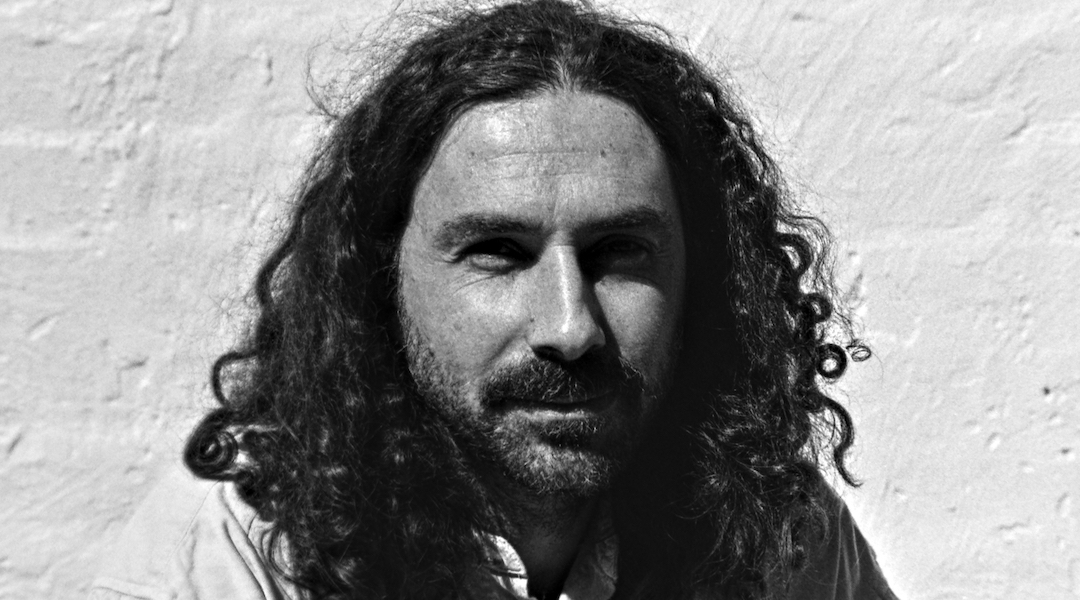
Image by: David Little
Ender and I first met during a brief encounter at a mutual friend’s house exhibition in Brunswick East, Naarm/Melbourne, well over a decade ago. My oldest kid is now 9, so I know it was more than ten years ago, but often the timelines blur into these loose categories of ‘before’ and ‘after’: the before and after of having babies, of writing poetry again, and of understanding the meaning of the word ‘oxytocin’ in this new, rapturous way. It was many years before we orbited one another again, this time via the Italian Marxist philosopher Franco ‘Bifo’ Berardi’s book Breathing: Chaos and Poetry (2018). I reached out to ask Ender if he’d like to contribute a small poetic prompt as part of an expanded cento piece I was developing on breathing. This was during lockdowns in Melbourne, after the birth of my second child, and it was imperative to find ways of being and breathing together, apart. It still very much is.
This encounter set off a chain of social and professional proximities between us, the kind that reinforce the convictions we have in where and how our energies should be spent. If we must account for such excesses of emotional and affective labour (and we must!) it should be said that I’m always up for expelling them in Ender’s direction. He is a constant reminder of the generosity that lives inside the word ‘community’.
This conversation occurred via email in the scattered, tired and dark or big, busy and gorgeous hours of a heady few months in late 2025. It straddled the before and after of the release of Ender’s debut poetry collection, Two Hundred Million Musketeers (Giramondo, 2025); the book’s nomination for the Victorian Premier’s Literary Award for Poetry; and Ender and my shared invitation to read in English translation for and alongside the Palestinian-Syrian-Swedish poet Ghayath Almadhoun. This exchange with Ender has been rich and life affirming, and one that I’ve felt to be long overdue. In it we ricochet off and around questions of the poetry of daily living, the sound of music, violence, attention, serious play, chunky frogs, ‘clean’ versus ‘dirty’ poetry, and much more.
Abbra Kotlarczyk: Your poetry is a warm and inviting terrain for me, where it’s often located in the kitchen or at the bazaar; it’s readily infused with the smell of coffee and the taste of joy in simple delights leaching from the page. Digestion and metabolism is a recurring theme that appears in my own poetry, and something I think our writing shares is that it deals with questions of the world, with capital, with human and beyond human relations, through the seat of the stomach via the throat, the mouth – always sites of happening that are proximate to and in conversation with the heart (“the wristwatch connected to the elbow, the elbow connected to the…”)
So, I thought we might begin at some kind of ‘given’ starting place, in the belly of the muse; a place where possibility feels itself (for me at least) resetting daily in morning kisses and a kind of innocent potential, before the grind of demands wears me down to a veritable husk. I’m wondering, what do mornings look like at your place, on any given day, and how do you think of this horizon of potential (if in fact you do) that is the morning in a house teeming with beautiful noisy children, misplaced hairbrushes, odd socks, the rush to fill bellies and get out the door?
Ender Başkan: There’s so much action in the first couple hours of the day. It’s pandemonium until we’re out the door. I wake up and notice everyone has ended up in a different spot. The best bits are the first sip of coffee, turning the radio onto PBS FM radio, having a quick shower and seeing my kids Dilân and Ezgi and my partner Sophie walk into the kitchen. There’s chaos and poetry in it, but I’m probably not paying enough attention, just thinking about getting through the tasks. Overwhelmed by time and accumulated fatigue. If I could get up earlier, I would, but just before 7 am is the best I can do right now given that the weather is still warming up. I definitely have a morning routine which I need to follow to feel OK for a workday. First thing is coffee; I never truly appreciated coffee until becoming a parent. I’m lucky my partner Sophie isn’t as rigid as I am. It has been a point of friction, the division of labour in the morning. We’re trying to make it work smoother. We have skills that complement one another, but my tempo is slow.
I tend to prep the food while Sophie helps the kids get dressed and ready for school and daycare. I make coffee for me, tea for Sophie, make kid breakfasts, pack lunches then eat, shower, brush teeth, quick stretch, get dressed and get the kids onto our big bike. I do the same things in the same order, eat the same breakfast. A bit ascetic. I grew up in a quiet house, an only child. Sometimes I get derailed and I’m working on being more flexible, being chill but in motion. Our kids either want a cuddle or just start playing once they wake up so it’s hard to get them moving through the tasks.
Sophie is an artist, so playing and making is the prime activity in our house. But once you start playing you don’t want to stop. Our kids are still little, 7 and 3 years old, so things will change. I get anxious with being late not so much for work but for school, but once we’re on our way, on our bike, I loosen up and we just chill in silence for a bit until we start singing or making up little poems. Yesterday we found ourselves chanting “celery spot spot” and that seemed to soothe us – lol. Getting outside seems to be the key. Some parents seem to have a boom-boom-boom kind of military approach to get the momentum towards the door, and it works for them. I don’t think that’s possible or desirable for us.
What’s it like for you? To me your poems and artworks are always sensitive and very beautiful, they’re very well thought-out. How does that trait in you figure in your mornings?
AK: I love that your morning routine contains this surprise element of where everyone has ended up! Ettael and Kitaj are still early risers at 8 and 5 years old, so this means I’m usually in bed when they run out to the back studio where I sleep, nestling in for morning hugs and kisses. Kitaj is a real morning person, and he sets me alight with his boundless energy and affection.
I’ve never really been a morning person (maybe now I kind of am?). I think this is the little horizon of possibility I referred to, being in that liminal space at sunrise, before the alarm goes off (I love the opening line in your book: “if you want an alarm clock to work / make sure you / place it out of reach”). My alarm is always too close and often it’s the kids who are my impetus for getting up, or for play when there’s time and space for it, when living poetry feels possible. Yesterday Kitaj ran in at 6:15 am saying “spiffigus, spiffigus, asparagus, biffigus, biffipoop.” This morning, I was editing some text and Kitaj perched up on my armchair and asked: “are you being a poetic duck?” This is my golden hour, what they call another time of day at childcare. After this little window, it becomes about trying to keep the focus on track: get dressed, eat breakfast, brush your teeth etc. After this time the kids can play, but this is possibly the hardest part, steering the focus. Like being a conductor of a train that keeps falling off the rails, that wants to plunge into the river and swim.
I’m the same, I need to follow a pretty strict morning routine to get me through all the chaos and unwieldiness. It sounds like there are a lot of similarities in our interpersonal dynamics in the home too. I’m straight into the kitchen, making breakfast and lunches, trying to stay contained and focused and not too over-stimulated.
Gender roles are sticky in our house, despite being a queer family. Really, I think the roles come down to personality, as well as a flow-on effect of early established patterns of birthing/primary at-home parenting. It takes time to understand how everyone works best as a team within a family structure, like any social structure, all the while things are constantly changing. This has been a huge learning curve for me, coming to understand what can often feel like insurmountable obstacles in identifying and then managing neurodivergence and chronic illness. ‘Sensitive’ is the right word to explain my work (and person) I think. My hyper-sensitivity to sounds and emotional inputs are opportunities for creative attunement that can also quickly derail and deregulate things entirely for me, which then flows onto the emotional wellbeing of the kids. It’s a lesson in knowing what our collective needs are, when they’re often at odds (I’m an introvert in a house of three extroverts), and how to minimise what activates this dysregulation.
Art and poetry play a central role in our regulation as a family I think, helping to calm us, shifting perspectives when things become banal or frustrating; disrupting the demands of the neo-liberal machine that wants to conform and discipline our movements. So where for you, being on the bike provides this space of transition, of moving, into a more playful zone, we jump in the car at 7:30/8:30 am (depending on the day), and either I’ll be non-verbal and needing to retreat like a hermit crab into the noise-cancelling headphones, otherwise the vehicle transforms into a submarine. On these days we push off the jetty and start encountering a wild array of underwater creatures on our way to school, childcare, work: a Jim’s Cleaning trailer is a prawn, a sweeper of the sea floor; we spot taxi fish and angel fish; a van with rainbow flower decals is a peacock mantis shrimp; a giant blue truck is a humpback whale.
I’ve been reflecting on how parenting factors into my poetry, and I was curious to know how it is for you. Tripping up in the more intense moments of it all: the physical accidents, the emotional eruptions don’t offer space for poetry per se. But I’m interested in what happens afterwards, when the adrenaline has simmered, how poetry becomes a reflex for reframing what’s happened, as a way of getting down on your knees, closer to the mind of the child. You write beautifully about this in your poem ‘Low Theory/Goodnight Gorilla’. I’m getting much better at this, and I find that writing through difficult moments facilitates a process of renewed understanding that can flip the lens, away from terror, fear, disgust into the humour of it all – my mind goes to Grace Yee’s Baby Joseph with the meat cleaver in her book Chinese Fish, or the hilarious (but surely wearing in the moment) repetition of your “daddy tissues daddy tissues” in your poem ‘Here Is The Shirt, (Get) Off My Back / Swimming In The Afternoon’.
Away from the heat of the moment of Kitaj running around the house with a serrated knife striking the walls and threatening his sister, I can appreciate moments of violence and destruction as something about him testing the limits of the quote/unquote ‘world’. Lately I’ve been writing a series of name poems, one of which draws parallels between Kitaj’s curious knife brandishing and the character in red with the pick-axe at the bottom of the painting The Autumn of Central Paris (after Walter Benjamin) (1972-3) by my son’s namesake, R.B. Kitaj – both hold this tension of the tool as destructive and creative force. The thrill of the knife is a form of creation and play just like drawing or role play is, but one that I can’t access at all when I’m in protection mode.
I’m wondering how you think about the role of poetry in engaging with the mind of the child, as reflective practice; of moving your relations with them into the world, and a world that often mirrors back an unfathomable degree of violence and destruction?
EB: There’s so much to discuss Abbra in the fullness and intensity of these years for us . . .
I’m definitely going to borrow the submarine surrealism of your commute. We’re deep into a classic musical film phase of Mary Poppins (1964), The Sound of Music (1965) and Chitty Chitty Bang Bang (1968), so the flying car/bike has been our vehicle, but the sky doesn’t quite offer the richness of the deep maybe . . . just yet.
I’ll start with the knife. Since becoming a parent I’ve kept a little folding knife in my pocket. I use it to cut fruit for us but also to open boxes/wrapping at work. Deep down there’s probably more to it, but I always have a few of these charms on me for practical and poetic reasons. Ezgi really loves chopping fruit and vegetables. She has this small blunt knife that she cherishes. It’s therapeutic I think, cutting, chewing, tearing, etc. I wonder if she’ll start wielding it more recklessly as she grows. To date, as the younger sibling, Ezgi hasn’t taken to weapons as an equaliser, but she makes her presence felt with her ferocity. It’s intriguing how we can observe the frustrations of language, as a kid or as an adult, leading to repression or expression as violence. Poetry in this is related to violence, not as its negative, but as another expression.
Yesterday I took a day off work, and it was meant to be a day to hang out with Dilân on school holidays, but Sophie had already booked her in for a day-long dance class. I decided to keep the day off anyway and just hang out at home. (Sophie had the day off too and Ezgi was at daycare.) It was the first day in ages where I wasn’t home for sickness or didn’t have urgent jobs to do. We did a few chores but also took the time to just go-slow, rearrange our spaces, tinker etc. I’d almost forgotten what it felt like to be de-tangled from the march of capitalist time – in other words – to be a child.
What I mean is, to be a child is to be human in a world that’s experienced as increasingly inhuman/inhumane. In secular terms we talk about dysregulation/regulation or overwhelm – but lately I’ve also thought about it as waiting for your soul to catch up to your body. This morning a parent at daycare said that some First Nations American peoples talk about waiting for your shadow to catch up under a tree after walking long distances. Time really does accordion in these bottle-neck periods. I guess kids are often these de/accelerators that infuse our lives with this raw energy and/or inertia. The world acts on us, so do our kids, and we have to mediate it, survive it . . . Poetry emerges the moment you’re paying attention and something happens, someone says something that sparks you and you accept it, tug on the thread . . .
Yesterday I was listening to David Harvey speak about how Marx was interested not in capital and labour as things, but as processes in motion, i.e. the labour process and capital as a ‘process’ not a ‘thing’. Harvey spoke about how children are very dialectical because they see everything in motion, how they see contradictions everywhere, but also how on ‘day two’ of our education system that method starts to get trained out of them. And I suppose art and poetry can be our antidote to the imposition and privileging of a certain rationality.
Raising kids has put everything in motion for me, including my poems whether they are ‘in them’ or not. Their way of seeing contradiction in the world jives with our horror at the immense violence unfolding around us. To answer your question, life is rushing past right now and writing, sitting in silence, helps slow me down – but the chaos of everyday life pours into and shapes the work, whether as subject matter, speed or techniques like repetition and zig-zag or looping patterns. It seems natural to me that the collision of inner and outer worlds should play out on the page. In that sense, I’m just putting my antennae out witnessing the world and writing poetry seems to be my mechanism for processing all these happenings.
I try to write very uncritically – just let it flow and see where it goes. Once the poem starts to exhaust me and feels close to being finished the critical/reflective mind comes in, usually with the help of my friend Gabriel Curtin, to help clip the excess away and give it a little shape. When the poem is done and I end up reading it over and over – I suppose it solidifies thoughts and feelings that inform ways of being.
I wanted to ask you about shape, how as a visual artist as well as a poet your aesthetic sensibility is refined. You make thoughtful work and your poems are often very sculptural, very beautiful on the page. How are you now thinking about parenting informing your work? Does it mess things up and how do you go along/or not with it?







