
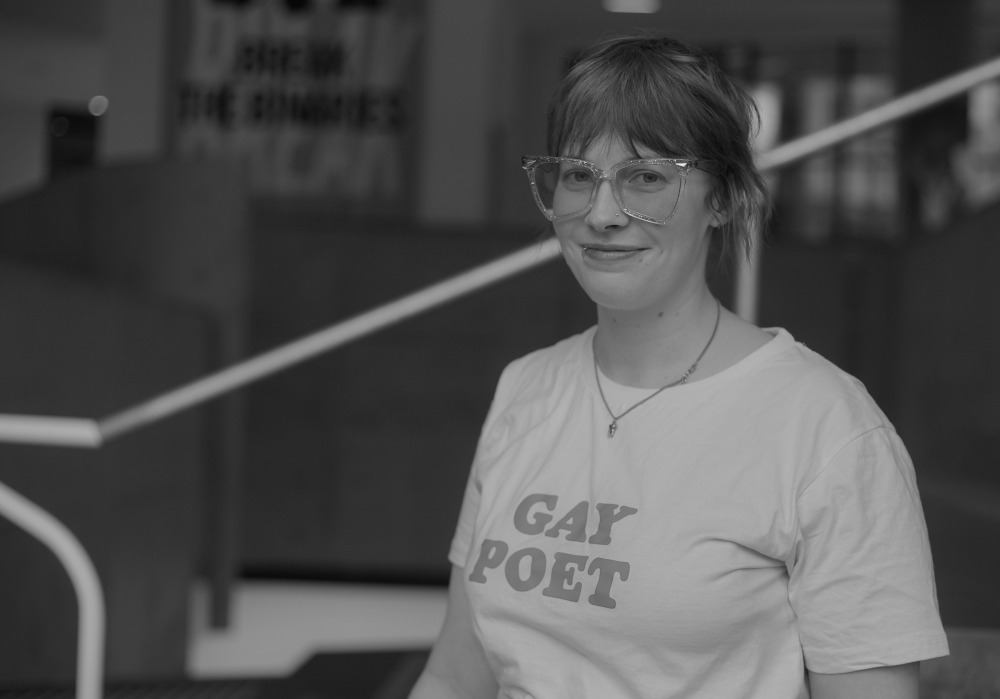
The poetry in this issue is damn juicy. As a writer, there’s perhaps an added degree of exposure or vulnerability in submitting a random suite of your poems, unmoored by theme. Showing your backlog = showing your poetic bussy.
In making my selections, I was able to tap into what’s on people’s minds, across a wide cross-section, without much concern over aligning to a particular taste, or gauging what an editor ‘wants’ you to write.
Lacking a unifying theme, these poems serve as a timestamp on this moment. Right now, in August 2025, with everything that’s brought us here. The horrors, the hopes, etcetera – it’s all in the soup.
As I trawled through the submissions pile of literal thousands of poems, I noticed the following motifs:
- cigarettes
- Sylvia Plath
- the ocean’s sluttiness
- fables, mythologies, oral histories
- data and microplastic
- the colour yellow
Make of that what you will.
But more so, I noticed a collective attunement to the ailing (and failing) world around us. You offered up segments of your guts like perfect, veiny little segments of fruit.
As I read through this record number of submissions, I saw in action how we flock to poetry in our darkest times – even from those who may not have previously entertained the genre.
It makes sense: eulogies and epitaphs are one of the few places where poetry exists in mainstream life, where it’s accepted by a wider audience. All else fails, and our spiritual wounds and existential pains transmute into art.
Poetry reaches for a feeling, says something bigger than its words, speaks something untranslatable. You don’t need typical grammar, punctuation or formatting to write a poem. You don’t need a typical body or brain. You can excrete a poem however you want.
I hope this issue serves as a heartening reminder that poetry is for the people – not for institutions, algorithms or Snapple cap marketing. Much has been written about poetry that follows tragedy, genocide and societal collapses. I was going to quote Adorno here, or someone like that, but I won’t pretend that I ever know what people mean. I’ll just say that I felt so much solidarity in your words, so much humanity, so much rumbling, energetic anger – determined footsteps on the page.
Over the course of developing this issue, reading your poems became a ritual for me. Wake up, read a bunch of thrillingly random poems from all over the world, start the day with a head full of flowering weeds. As someone who tends to carefully make their way through a full-length collection or themed anthology one at a time, I sometimes miss the deliciousness of poem-hopping. Like a poetry rolodex or a pokedex (poetredex?) or a ‘For You’ page jackpot in the storm of a doomscroll.
Poetry rattles the mind like a snow globe; it kicks up the dust. Reading in a scattered fashion certainly shook some cobwebs loose, but I also made an effort to go as slowly as I could. I don’t want to treat poems like an app – swiping for the next thing, all hard yeses and noes and self-conscious pandering. Instead, these poems offer an antidote to disaffection, a practice of delayed and challenged gratification, an antithesis to McMindfulness forms of self-soothing.
I wanted to platform a variety of forms, styles, aesthetics and topics. To preserve a poem as an archaeological artefact: strange but human. To showcase exceptional writing. To reward risk, to reward writers who help me – as a reader – think, feel, empathise and interrogate through poetry. To draw out the intimate from unexpected places, in unexpected ways. To pay close attention to language – not letting it roll away like a bead of sweat.
I didn’t want to tunnel vision onto what was familiar, or to what appealed to my own particulars and peculiars. I rejected so many great poems – not just good, great. I’m still mulling over certain poems that didn’t make it into the issue.
I think a lot about taste – how instinctive it feels, but how curated and constructed it truly is.
Should I like this more than I do? Should I like this less? Why did that poem make me feel that way and can it stop pls?
These are questions I return to, knowing that I’ll never figure them out. I’ll leave you with one revelation, however, that came to me across the course of this issue:
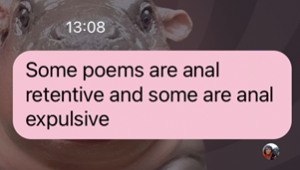
Text to my partner. Moo Deng backdrop.
Again, make of that what you will. And thanks for reading. ♡







