
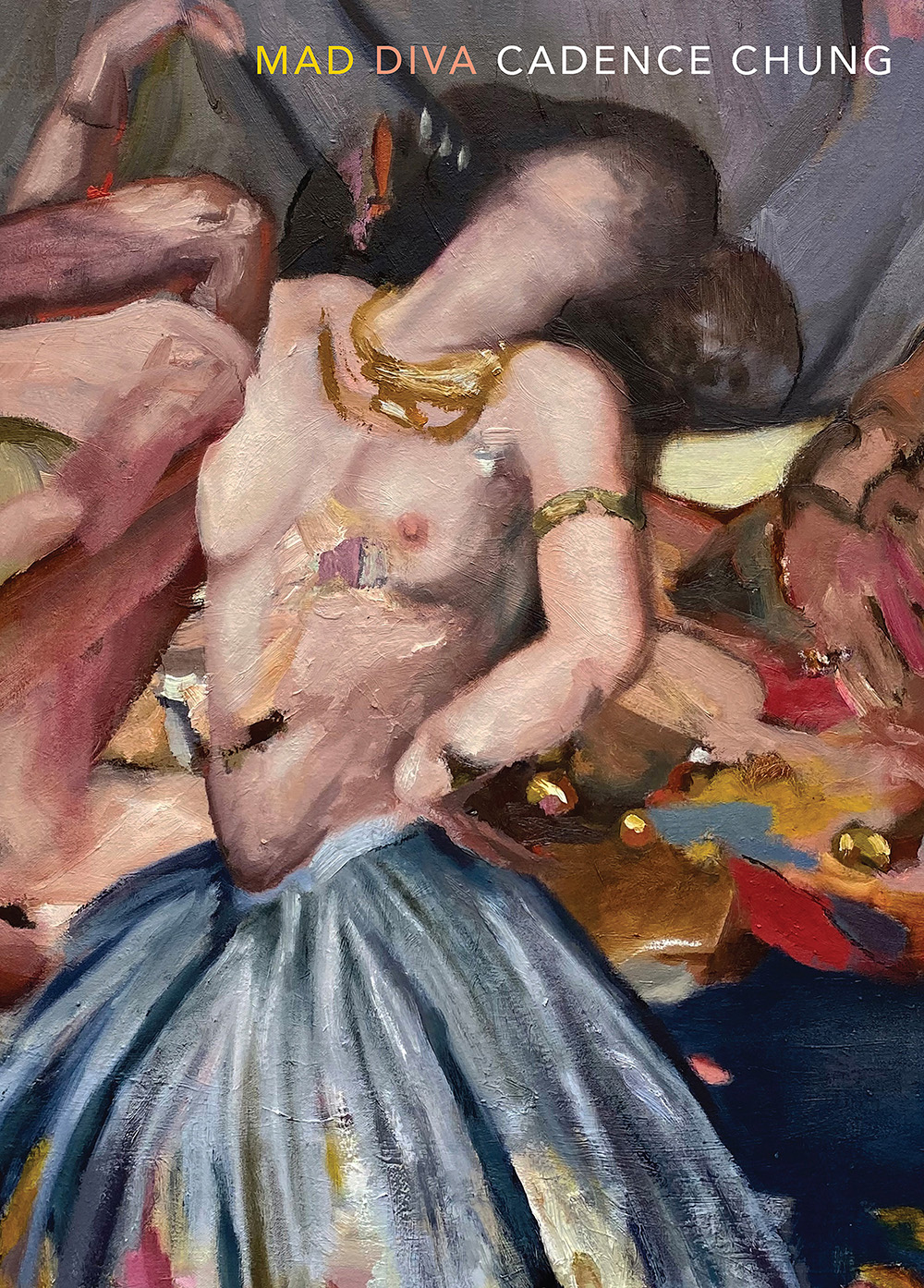
 Mad Diva by Cadence Chung
Otago University Press, 2025
My mother once said, “You have too many desires. If you had fewer desires, you’d be happier.” I wish that I then had Cadence Chung’s retort: “easy to blame desire easy to blame it on the want the wanton of a woman” (15). Breathlessly dispensing with punctuation, these words appear in a poem titled ‘Desio’, early in Chung’s sophomore collection, Mad Diva.
Meaning ‘goddess’ in Latin, ‘diva’ historically referred to a talented female opera singer. Over time, the title came to be used in theatre and cinema, morphing to mean, per Collins Dictionary, “a woman, often a celebrity, with a reputation for being haughty, temperamental, hard to please, etc.” (‘divo’, the male equivalent, holds no negative connotations). Chung plays with both definitions to explore diva as a way of life. In her full-bodied collection, divas wield their desires like weapons. Samson bleeds. Rome falls. A diva shrugs: “I didn’t mean to want you so badly // that I killed it all” (‘Salomé’, 27).
Mad Diva mixes the dramatic tension of classical opera, romantic flourishes and moments from contemporary life to effervescent effect. Across the two-act structure (‘The opera house’ and ‘The madness’), Chung draws on their background in classical singing, music, theatre and short fiction to craft prose poems and poem cycles that embrace the power of character and story. Their poems are not simply re-tellings but new narratives, reminiscent of Angela Carter’s approach to extracting “the latent content” from fairy tales to inspire The Bloody Chamber.
Layered with delicious intertextuality, the collection soars when it explores the messy ethics of autobiography: the cost of using one’s life and, by extension, relationships, for art. What are the consequences of “[t]he hungering. The eating it all up.” (‘Caroline’, 49)? What if artist and muse are one and the same? The speaker searches for answers, earnestly asking in one canto, “How do you make / art that matters?” (‘VIII. Mozart’, from ‘Scenes from a night at the opera’, 38). In another, from ‘Three Witches’, she asks, “How do I write about / the Great Themes?” (‘II. Muse Witch’, 29) before wryly conceding:
They say all poetry is about Love, Death,
and Time. What a horrible thing a poet is,
writing about these instead of living
them, deep inside a lover thinking about
what a sensual poem it’ll make. O folly,

(30)
Chung’s observations on the writing life are neither self-indulgent nor self-pitying. Rather, they subvert the western canon, acknowledging the absurdity of being a poet and highlighting the stakes:
Do you even think about
       how moral it is? you asked.

You put it all into a poem and
       expect it to just stay there?

(‘X. Why I am not a painter’, from ‘Scenes from a night at the opera’, ‘41)
Who is this lyric ‘you’? In many cases, ‘you’ is the speaker’s lover. In ‘Old Masters’, ‘you’ is a fellow poet. In ‘Love lyrics’, ‘you’ is a university crush. Throughout the collection, Chung uses ‘you’ to address characters and the reader simultaneously, breaking the fourth wall. At times, Chung’s ‘you’ is the speaker addressing themselves, as in the seven cantos that form ‘Metamorphoses’, each titled after a Greek mythological character. Here, the horror of the original myths is transposed onto modern settings, and the speaker seems to be reminding themselves of all they have endured: “every night, he’d turn off the console / to chase you to bed” (‘I: Daphne’, 68). The cycle’s title suggests an evolving, multitudinous ‘you’, reflective of Chung’s approach throughout the collection.
Recurring motifs – nipples, bitter negronis and citrus, lipstick, shaving nicks, nails, claws, teeth, spit – work to concoct a heady atmosphere. Sequential poems ‘Prophetic perfect tense’ and ‘Perfume’ feature a lover who has “neat and black” eyelashes (53, 56). The “stab-wound collapse” of a persimmon tree in ‘Aperol’ (26) echoes the title character’s onstage stabbing in ‘Carmen’ and foreshadows a lover’s face, “a powerline falling” in the canto ‘V. Quintet’, itself part of the cycle ‘Perfume’ (60). These reverberations cement the collection’s cohesiveness, rewarding attentive readers. Beneath the glamour, a diva makes sacrifices. Art and life bleed (literally) into one another, amidst the theatre of the everyday: “condom-wrapper kōwhai / pool in the streets […] where plastic bags whisper and moan against walls” (‘Curtain’, 13). Chung’s poems are sensuous yet poised. They teeter but never quite spill over:
when I wake, hot with desire, the figs
are so perfect. They are so red on the inside.
It takes everything in me not to eat them all.

(‘III. Moonlight Witch’, from ‘Three Witches’, 31)
In an interview with Paula Green, Chung explains how combining a first-person confessional voice and a character façade allowed them to keep some distance while staying truthful: “It’s a bit like a recital, where you’re still yourself, but a heightened, slightly over-the-top version.” Sometimes we feel most real when we are performing. A diva is ever aware of the thin veil between fantasy and reality, drawing on real emotion to create an enthralling performance. A poet similarly cannibalises her life. Performed pain is still pain, even as the speaker of ‘Lucia’ attempts to brush this off:
O, I like to say it’s all hellfire and suffering but really it’s all for show. I amuse myself
with a tortured sort of face, writhe around in a cacophony of high Cs.

(24)
The collection’s second act is experimentally introspective, focused on memory and love. Its opening poem, ‘Realism’, see-saws between remembering and forgetting:
kissed a girl in the nightshade brambles then un-
kissed her sucking my spit and my love back

(47)
Chung’s poems on love revolve around impending loss. In ‘Prophetic perfect tense’, she writes: “I knew […] that I will come to have loved you” (53). These are not poems about contentment but pursuit – the thrill of wanting something or someone out of one’s grasp – and love’s intersection with art. I may not have you in real life, the speaker seemingly suggests, but I can still possess you. ‘Two loves’, written after Lord Alfred Douglas, is florid with queer subtext, referencing “the love / that dare not speak its name” (52). Its surreal setting, characters who speak at cross-purposes and quoting of Yeats create a jarring effect. ‘Love lyrics’, in contrast, is delectably clear-eyed, skewering the English canon (“We read Keats, who is dead. We read / Chaucer, who is even deader”, 61) while admitting a similar violent penchant:
always finding love in every little corner
and squashing it flat on the page.

(62)
The diva too is often thwarted in romantic love, either murdered or dying by suicide. Sometimes, she kills. “Her jealousy,” writes William Berger for The Metropolitan Opera, “is greater than regular people’s. To cross her or incur her ire means death – but to love her can be just as fatal.”
Chung’s debut anomalia (first published We Are Babies Press, 2022; reprinted Tender Press, 2023) displayed the claustrophobic, nebulous voice of a “poked and prodded” specimen (‘rise’, 20, 21, ‘dedications’, 52). Mad Diva embodies the idea, expressed in anomalia, that “everyone contains too much to be held in one / body” (‘belated wishes’, 40). Chung’s emerging oeuvre has advanced from tentatively questioning societal norms to carving a life unbound by them. Mad Diva builds on anomalia’s themes of unbelonging with self-possessed conviction:
I chose art over life a long time ago […] That Muse, that ivory-chested girl, she has my heart.
If she didn’t, I’d be content with peeling oranges in the wine-weighted night.

(‘Lucia’, 24)
This line reminds me of Louise Glück’s response to the scent of mock orange drifting through one’s window: “How can I rest? / How can I be content / when there is still / that odor in the world?” (‘Mock Orange’, 147). A diva, like all artists, remains restlessly open to the world and to feeling. Our desires both pleasure and torment us. All this to say, if a diva relinquished her art-madness, could she ever be satisfied? Could a poet? What matters, Chung’s Mad Diva illustrates, is that a diva chooses her life, her insatiable desires, even if she never comes to fully understand them.