What’s in a name? That’s a question I’ve wrestled with for a long time.
A name is a key part of your identity. Each part contains multiple fragments of your story, your family and your history that create the image of ‘you’ when combined. My last name comes from Saint Thomas, who brought Christianity to India 2000 years ago; my middle name belongs to my paternal grandmother; and my first name is inspired by my mother’s favourite Emily Brontë novel.
But people are so much more than their names – more than a predetermined part of their identity, like skin colour. Just because you look a certain way, because your name has diverse origins, or because you hail from a certain part of the world, people unhelpfully assume you automatically subscribe to certain ideologies, occupations, and beliefs. The human tendency to categorise each other into neat, little, labelled boxes restricts who we think a person can be, where they can belong and what kinds of stories they are expected to tell.
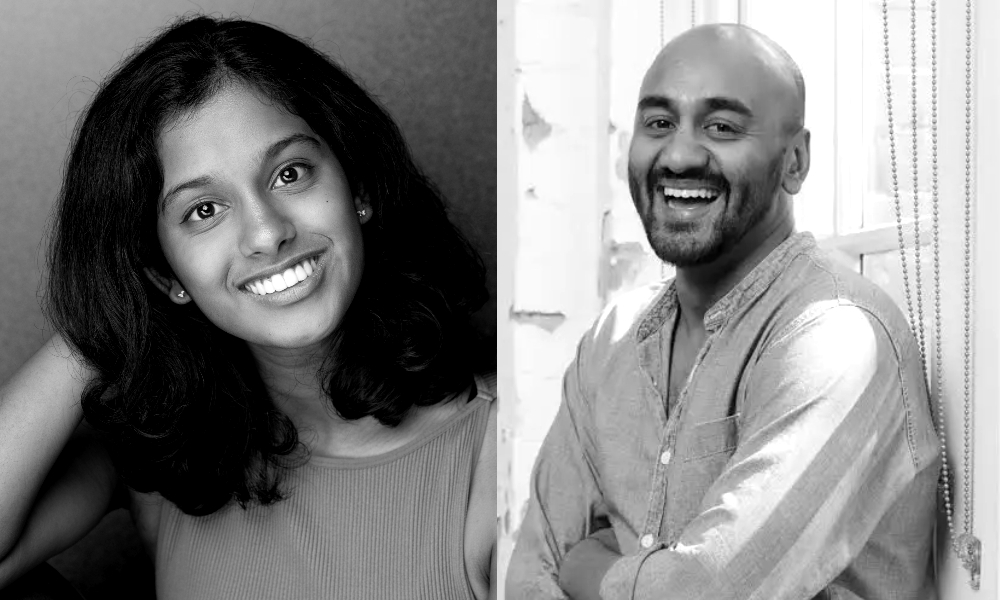
Growing up in a family of doctors and engineers, people naturally assumed I would follow those paths, not choose to become a storyteller instead. But in those storyteller rooms, when people see my name before seeing me, they don’t imagine a 20-year-old, mocha-skinned girl with wavy black hair. So, where am I meant to go?
I spoke to my longtime inspiration, playwright S. Shakthidaran, about this. When I was a wide-eyed teenager frustrated with the lack of diverse school curriculum texts and the scarcity of characters who looked like me, Shakthi’s plays showed me it was possible for people like us to be up on big stages telling stories about where we have come from and where we hope to go. That those stories can be made a reality, not just limited to the existence of shared dreams. Fuelled by curiosity, I asked Shakthi about his creative intentions: “Why did you choose to set your plays in Sri Lanka and India? Did you feel compelled to do so because it was what people expected of you?”
“I wanted to explore the complicated relationship between the diaspora and homeland,” he replied, “while also wanting to understand my personal heritage and roots.”
Shakthi’s process has always been rooted in discovery, honouring stories and community truths that have been purposefully hidden, rather than fulfilling a historical burden. “Regardless of what the industry says, if audiences love good characters and stories that they connect with, they’ll want to hear it again and again. Art should honour the multiplicity of perspectives that exist within history, and stories should too.”
As a third-culture kid who grew up in the melting pot of Western Sydney, inhabiting the spaces between different worlds (like me and many others), Shakthi has found purely emulating the West in his writing to be “a lost opportunity,” as hybridisation becomes a meeting point for various forms of storytelling, which then becomes a meeting point for many types of people. I wondered if this collective solidarity was achieved through language. Since his plays, notably Counting and Cracking and The Jungle and the Sea, incorporate Tamil into the scripts, I assumed Shakthi was proficient in Tamil. To my surprise, he self-effacingly responded that his grasp of it was “like a five-year-old”, but that he works very closely with cultural consultants to ensure honourable representation, especially for dialectal specificity. Fair enough, I thought, as my own grasp of Malayalam is very similar, while my Tamil is non-existent. I have fallen victim to my own assumptions.
“How do you create your plays then?” I asked him. “If language is a starting point for accessing history, cultures, and experiences, and if you don’t have automatic access, what do you use as an entry point instead?”
“The feeling matters more,” he replies earnestly. “I ask myself how sound and sensation influence meaning rather than language.” He starts with emotions first, then images, sounds, musicality, pace, rhythm, silence, and so on.
Shakthi tells me that seeing people from all walks of life in a theatre foyer after one of his shows feels like witnessing “a microcosm of Australia” in a space where art is allowed to speak for itself, regardless of the languages audiences might think and dream in. Stories are ultimately rooted in how they affect people – you move their heart to move their minds. But here’s what really stuck with me: making work takes a lot of effort, money and time. No one knows how much time they have, so use the time you do have wisely to craft what you need to see, that only you can bring into existence with your skills and story. That’s why I fell in love with storytelling in the first place: when the world wouldn’t accept me, it let me just be. To exist unapologetically in my entirety and share it.
But how do I begin when I don’t know where to start, or what I want to say? Gently and reassuringly, Shakthi’s voice crackles over the phone. “Try your hand at a multitude of things, then find your voice. Find the things that light your fire and make you who you are. And then, go deep.”

This article has been commissioned in partnership with Diversity Arts Australia’s Creative Pathways Parramatta project, supported by the City of Parramatta. Diversity Arts Australia receives core funding from Creative Australia and Create NSW.