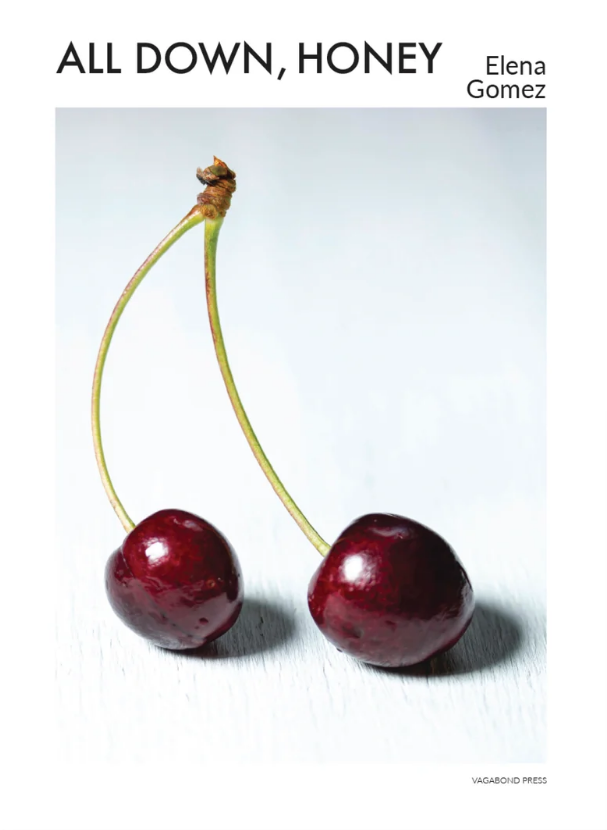
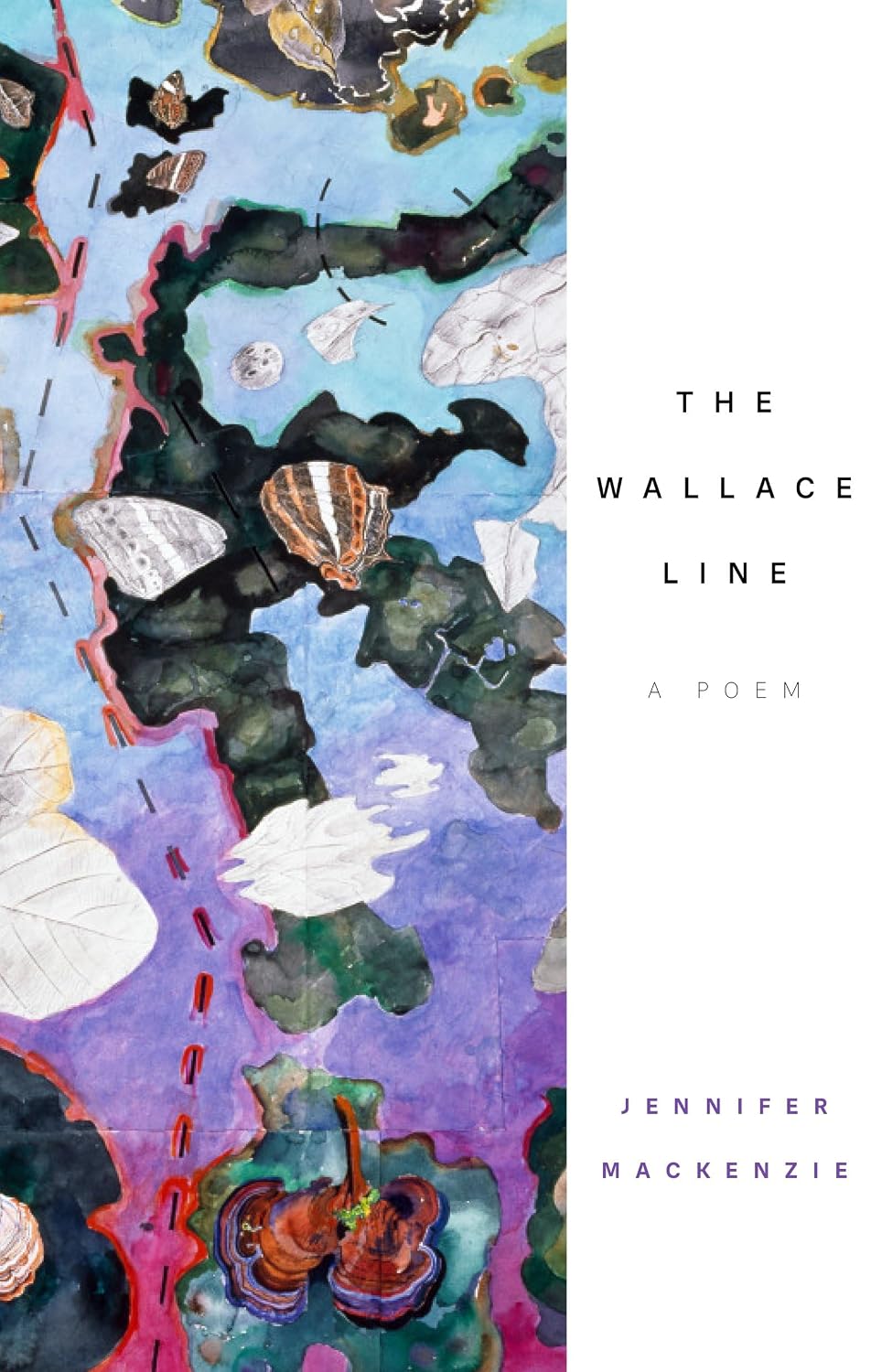
 All Down, Honey by Elena Gomez
Vagabond Press, 2026
The Wallace Line: A Poem by Jennifer Mackenzie
Transit Lounge, 2025
A pet peeve is when someone places the honey back in the pantry – lid up, label down. It’s a squeeze bottle! It’s a travesty. The bottle’s purpose is to assist the flow of honey by being placed sphincter-side down to the sticky, well-worn laminate shelf, ready for its next loving hug by an eager, hungry fist. It’s more than fine, encouraged, to misplace, flip, contort and mess with words – their syntax, their lineation – but do not be messing with the gravity, the gravitas, of the honey, honey!
The golden substance symbolising fertility flows, hopefully easily (as above), because it is a commodity snatched and commandeered from the living world, a world that ultimately goes about its business, trying to sustain its ancient bioways despite us. But it’s not a business. For the bees, it’s a way of life. In Bee Movie (2007), the young, newly graduated worker bee Barry B Benson becomes disillusioned with “the humans” and their centuries-long practice of stealing honey, proceeding to sue them in a court of law (run by the humans). It’s a case of the colony v the colony. Towards the end of the film, we see the devastating effects of a bee strike on the planet: a world without pollination. The image is momentarily catastrophic before the film crescendos into a groundswell of collectivised organisational efforts (by the bees).
Two recent collections that speak to the co-opting of the natural world, in attempts to ignite and ironise our (human) status as accomplished commodity fetishists, are Elena Gomez’s All Down, Honey and Jennifer Mackenzie’s The Wallace Line: A Poem. Both works reject the optics of Western Cartesian enlightenment and celebrate a kind of sensual methexis that turns away from the navel (belly) to be gazed at, towards the navel (fruit) to be lived through. Both works can be traced to the nub of a common denominator, the enduring legacies of migratory patterns made at and beneath ground level, with both insisting on the liberatory potential of our complicated relationships with matter. While Gomez takes us – in broad navigatory lines of taste – down on ourselves, to the pelvic, nay the deep seafloor via the throated pitting of the cherry, Mackenzie delights in wrapping us in the rich sounds, smells and votive fibres of her cross-continental reckoning. Through their own strange cartographies, these collections are sensed to place us back in the orbit of the world, aligning with what Cuthwulf Eileen Myles says of inventory as the emotional soul of poetry.
All Down, Honey is a sardonic and surreal feat of language-as-legume (organic? plastic?) that nurdles around in adjacent catastrophes smelting new poetic possibilities of the erotic and the erudite. This is a poetry that munches: on Marx, on “sugar / beet hydration therapy” (82) and a “pregnant”, delectable platter of “surplus-labour” (7). In Gomez’s grip, honey becomes both a lower-case ‘t’ trauma analogy (“write down: all honey”, (10)) and an upper-case Term of Endearment (“write it All Down, Honey”, (11)), teetering on a spectrum of pathological (patriarchal?) demand sensitivities flipped through the guise of a note to self. The opening poem, ‘Write it All Down, Honey’ is something of an ars poetica, immersing readers in the collection’s vivid contortions and code-switching capabilities as if a joyous declaration of intent or an oblique coming out:
Announced, we sang chroma
    a conversion of meaning
encoded and           shapely
    (pitted,
held)

(7)
The turns are rapid and frequent: the speaker articulates a personal pronoun shift from rat to plump sea worm (7), from a big speaking throat housing a cherry pit (9) to a gut-growing cherry tree that will
leak from nostrils, fill a mouth,
    escape my ears

Cranial orifices
stained eyes, […]
all before
we pushed my face
into the container &
drained the juice
your hands sticky & eager

(10)
The book gathers a retinue of non-human characters that animate the times we’re living through – flamboyant and liberating, disastrous and stultifying:
               hellacious and mannering in stamen
                rights but
    ‘femme’, underscored, urging and found botanical-core with
high pants & masc. coding pistils

(‘Ocean Stone Beds’, 75)
I read into this collection an oblique guiding – of oneself, one’s friend/enemy/lover – in the ethical task of being a thinking, feeling, acting, rooting subject, alive and bunkering down in the beautiful dying world:
& later at the karaoke bar
genre-shaped, vocally acute
      I’ve been trying to
      work out                 meanings
                                 Root out ontologically

(‘Ocean Stone Beds, 44)
The lineation of this fragment prompts us to ask: are meanings the things that root (themselves? us?) out ontologically, or is it the poet, “vocally acute”, doing the rooting in their downward-thrusting attempts to “work out”? However you interpret it, this is one in a litany of examples that carry us closer to the realm of the underground. Early on we find our attention is honed down, towards the small, the detailed, the creaturely:
               we trained our eyes on small feet
forgot skies

(7)
Where children, evangelists, capitalists, the dictionary will tell you that down is inferior to up, we can’t deny that the subterranean is the realm to which we owe our existence: it’s where our ancient ancestors cooked, dreamed and painted; it’s where Cathars, Cagots and Hittites went to survive and where resistance fighters still go; it’s where the downward-growing part of a plant, the radicle – from Latin radix (root) – lives, where we find ‘radical reform’, in the political sense, originating in the 18th century via the notion of change from the roots. The subsurface is also significantly, in the oceanic realm, one of the last zones of untapped ‘discovery’. Where the ability to hold an image in the mind’s eye is intimately connected to the reality of species extinction, it is no coincidence that deep-sea exploration is rapidly advancing at a time when techno-fascism is attacking one of the last sovereign realms of the human being: imagination. Gomez hints towards this connection, writing:
Desires collapsed into splash theory as
    we […]
  maximised ocean beds for sovereignty

(‘Ocean Stone Beds’, 73)
In the introduction to The Language of Inquiry, Lyn Hejinian writes that “language is nothing but meanings, and meanings are nothing but a flow of contexts.” Elsewhere, Myles says that “when you encounter a really powerful emotion often all you can do is say what’s there, let people look at your list & see how it feels.” All Down, Honey is a book that hydrolyses language into atomised fields: of vacated plains, refused meadows, archipelagos, reaching progressively further as the book unravels towards its 43-page poem ‘Ocean Stone Beds’ – down, down to the bottom of “Macquarie Harbour’s declining / dissolved oxygen” (36). But it also reminds us, in baroque proportion, that poetry – like all faculties of the will – requires snacks as much as it does oxygen to survive:
of course the acai bowl
has bled out
      the machines eat the worker
and I’m chewing on your arm. I’m
      thoughtful about it,
ever observant like this
hawk bin-diving
for a snack

(‘Write it All Down, Honey’, 17)
This isn’t a manifesto for surviving in the make-do sense of the word – to ‘exist’ or ‘endure’ – but in Audre Lorde’s sense of a collective liberation of selves bound up in earthly cohabitation. As I listen to the metal scrape of a stool across the crumbling kitchen tiles – my 6-year-old son scaling the pantry for a sugar fix – I’m reminded that to write ourselves into the world is to think it, the brain requiring equal parts oxygen and glucose to function:
The second encore, spike zombie
bathing in monosaccharides

—glucose fructose galactose

(16)
In an attempt to map the vast terrain of this collection, I keep an ad-hoc inventory of some of the more curious nouns I encounter. I collapse into and expand out from the work’s “differentiated forms” which, like Myles’s approach, tell me a lot about the guts of twenty-first century accelerationist ennui that this book is born of (17). The last of many words I collect – including apriplum; bathyal zone; Cam sành; donut peach; enteroctopus dofleini; Maugean Skate; pluot; and pelagic zone – is Zercher Squat.
Initially I think it’s a hybrid vegetable (zucchini + squash + kumquat?). I look it up, learn that it’s actually a weight-lifting term. Everywhere here, the making and living of poetry is physical; it’s anatomical, alimental, muscular, molluscular:
planning a feast,
we eat poems from
Sophia’s generative workshop
                        digest epigrams
    search for bitter herb

(‘Ocean Stone Beds’, 49)
and
[…]      slushed up shake in dialogue
with molluscular structures

(51)
In his essay ‘Muscularity and Eros: On Syntax’, Carl Phillips notes that
the poet controls our passage down the page both in terms of what we get to know and how we know it.
To this extent, poetry is not just a bodily thing but an erotic one.
All Down, Honey revels in the task of leading us, through the seat of the mind – “a mind is filled / with condiments” (66) – to the erotic potential of what it means to ‘go down’, adding a notch in a long lineage of poetic associations: from the “downe a downe, hay downe, hay downe” of the 17th-century English ballad ‘The Three Ravens’ (1611); John Milton’s Paradise Lost (1667); Alice Notley’s The Descent of Alette (1996); to the ‘down south’ of Charlie XCX’s song lyrics in ‘Guess’. Gomez leads our eye down the book’s pages, leaving our heart to interpret a prawn cocktail of its gravity-bearing illuminations, down to
               antinomies of food group
lobbies

(10)
where
               submerged                flesh                enters
[…]
                                             the story descending

(9)
This is a treatise on downward motility, in which we stumble into “timed shifts of mastication” (‘(memory’s fish cannery)’, 25) in which the speaker is “only a poet when [they] chew” (15). This collection digests its way towards a constitution, taking ample pleasure in devouring the still-plump offerings of the rotten, upturned world. Everywhere, the poems alert us to keep the realities of our ongoing struggles with the non-visible, the out-of-frame, and the violence of labour conditions firmly in our orbit, since “we feast now / blue oat mites feast later” (23).
While constructing this piece I apply the “ferret logic” (15) of the opening poem: I learn that Jake Rose (as Joan of Arc) wants “to be inside each material” while Lauren Elkin in Art Monsters believes “there is only matter combined with matter” in asking, “what does it do now?” Gomez, too, seems to be asking: what can matter do, or: what can we do with the knowledge we have of it, or: how might we play with and reconfigure it, to cast some joy over our lives while we ride the incessant “animals and dead-tree-to-fossil-fuels current / this colonial-violence-to-trade-route current” (65).