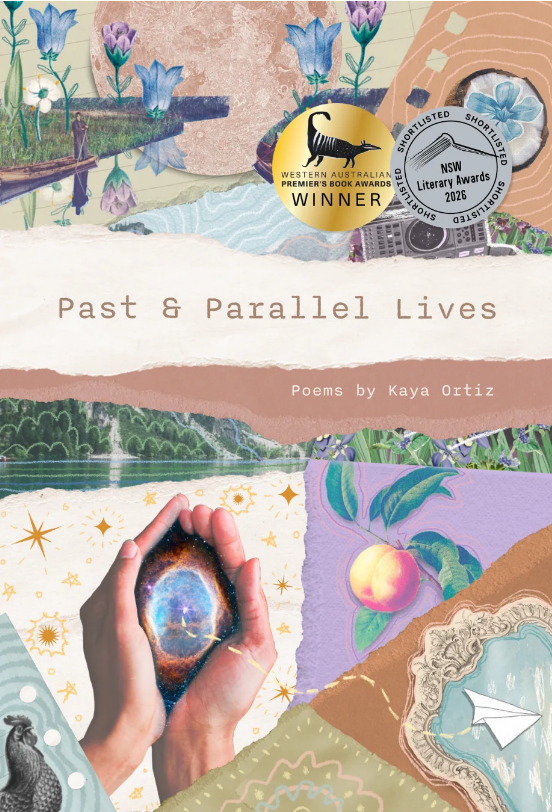
 Past and Parallel Lives by Kaya Ortiz
UWA Publishing, 2025
The Hum Hearers by Shey Marque
UWA Publishing, 2025
The first reference to water in Kaya Ortiz’s collection Past and Parallel Lives (2025) is “memory like water, fickle and evaporating” (‘Final Boarding Call’, 3). A positioning that struck me, disoriented me – foregrounding the properties of water as subsequent to something greater, vulnerable to temperature and environment, water as something shaped and controlled. It is easy for me to think of water for its enormity and perpetuity, the first and final thing, but Ortiz considers the qualities of liquid multiform. From the beginning, I must reorient myself to consider water beyond that ancient, endless ocean; there is water trapped in the pothole after rainfall, there is water in the baptismal font, there is water on the lip of the lover and perspiration on her brow. Water goes on to take many lives, as does Ortiz, who too evaporates “like sweat” (‘Uli’, 21).
Ortiz’s consideration of memory transposes water onto bloodline, expresses its continuity and expansion, transposes water onto vein and river in the same way. In ‘Dughan’, Ortiz dissects the etymology of the Bisaya/Cebuano word dughan; translated whole into ‘chest’ from roots of ‘blood’ (dugo) and ‘place’ (han). They go on to describe a bloodline:
like water it cycles and feeds
I imagine myself part of the story:
            family as country
            country as blood
            blood as history –
the tidal flooding
& seasons of rain

(49)
There are stories in our bloodline for us to fulfill, there are forms prepared for water to fill. We are to think about the body then, and its inheritances: the shape offered the eternal thing that precedes and outlives us, this brief mould. And if I am to consider this mould, I must consider it broken as well.
In examining the mould of religion through a queer lens, Ortiz draws out an experience of queerness that arcs from apprehension to divinity; a thread of god underlying this all. With similar patterns of confession, the tension between belief and want, Ortiz reminds us that “longing is queer domain” (‘Mythos’, 61). We are offered perfect images of this longing – the blue light of fan fiction on a screen, the lover emerging from a body of water wet and bleeding. An ambiguous want and a reflective questioning shape the speaker’s relationship with queerness in a similar way as they shape their relationship with god: “i ask god what it is / she wants from me” (‘Ritual two: sacrifice’, 53). It is a convergence of the want and the unknowing of youth. Ortiz captures all that desire, all that hunger and its imprecise origins, within the unsettled answer in ‘Alternate timelines’: “6. it was never about the girl but your hunger / 14. still you wonder if a girl is an answer” (67). Even if the girl isn’t the answer to it all, she is still an answer to something, and there is something good and holy for us when we are with her, there is something good and holy found in her mouth.
What is offered is a vision of connection where the symmetries created by languages are sites of unification, oblique proofs that these two people would converge, that these tongues would entwine as they have entwined before; “In the middle of the night, I google which words in her native tongue match those in Filipino” (‘Tasseography’, 76). Every version of the lovers intersects in some way; Ortiz contextualises their longing, offers it a history, offers it space to unform and reform. This love is positioned as an answer to the past and a question to the future, where there is always another conclusion to be drawn, an alternate vision, a clear multiplicity, a desire to inhabit it all. At times in the collection, this desire presses up against the constraints of religion, in which, an oppressive shame permeates. We hear of salvation, and perhaps we ache for it, and then, in ‘Hell’, Ortiz asks, “Is it worth it?” (26). What is the answer? There may be nothing holy in this denial, but there is everything holy in the girl’s face.
And so we follow the scar. We track and trace our profane hands over it. We begin with the scar fresh enough to “find and re-open” (‘Migration story’, 5), a scar tied to mouth twice over through the contrapuntal form. The scar persists in multipotent ways, refusing to remain discrete and sequestered to a linear pattern of healing. No, Ortiz aligns themself with it, writing, “time will render me a scar” (‘Uli’, 20) – it will make them, they suggest, a mark of their own absence. In ‘Etymology of paalam’, Ortiz offers a cyclical re/creation myth before closing the poem with self aligned to world aligned to scar, hinting at a conception of the scar as an alternate mode of being. “[T]he grave will scar over”, but it will not cease to exist (‘Dughan’ 50). Nor will those who occupy it; they will appear in dreams and the water in their bodies will return to the rain and they will be found and found and found. If the scar is the tangible persistence of an event in an altered form, Ortiz suggests a guilt inherent to the healed scar (“you curse yourself for forgetting” (‘Past life’, 85). We haven’t picked and prodded and scrutinised our grief enough for it to remain fresh, and the scar is the thickened, hypopigmented proof of our distance.
There is a convergence of these symbols, of scars and water, mapped over memory and the body, in ‘Memoir’, in which Ortiz writes:
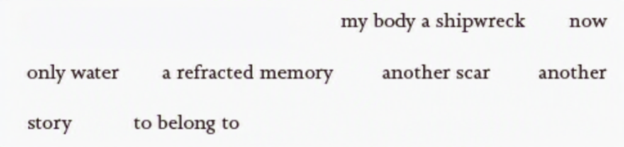
(11)
Here, Ortiz’s body is once again the site of transformation and multiplicity. A fundamental dislocation; ship dislocated by trauma, light dislocated by water, skin dislocated by wound, ownership dislocated to the story rather than the body. There is a perseverant communication between story and body, where the body remembers a story that is almost inaccessible to the mind: “the sound of my voice / is something I recognise / from a past life” (‘Uli, epilogue’, 97). With this recognition, comes renewal (“rebirth / & then baptism”, 97) and water, already established as a remembering force, returns as a purifying one. The desire for baptism persists – a longing wrought in an inherited shame, a desire for forgiveness, perhaps, a desire for absolution. In Past and Parallel Lives, the baptism will happen no matter what and take on alternate forms: a fundamental communion between self and god; an eternity that pulses briefly in the body; repeated acts of creation. In ‘Creation story’, Ortiz states that, “the water / becomes you / on every shoreline” (44). In this, there is a sense that we can palpate the body, attempt to find an origin, map (0,0) and find the indelible core of things, that stark, stubborn truth, “a sea inside a sea” (44), “water holding water” (‘Masc’, 91), body holding body, memory holding memory.