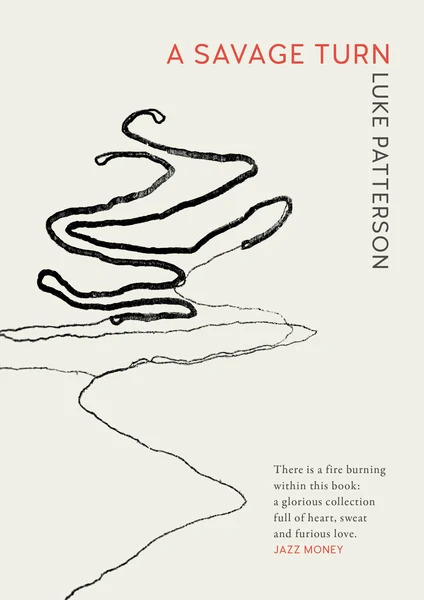
 A Savage Turn by Luke Patterson
Magabala Books, 2025
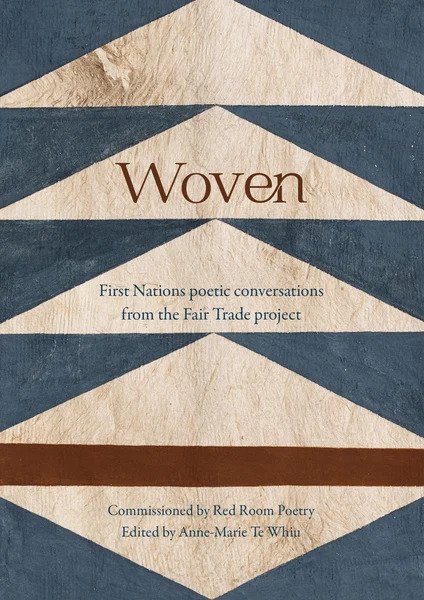
Woven: First Nations poetic conversations from the Fair Trade project edited by Anne-Marie Te Whiu
Magabala Books, 2024
Reading Woven: First Nations poetic conversations from the Fair Trade project and A Savage Turn, I remembered moments during my childhood when I would wake to the sounds of family members calling in to visit my parents late at night. Listening to the adults share conversation, I ached to be a part of their exchange. My door left ajar, the light of the kitchen would illuminate an intimate space around a table that held much more than cups of tea: our kinship woven together in stories, laughter and sometimes even tears. If I got up, I was told to go back to bed. If I called out for another drink of water, I was told to go to sleep. Reading these two collections from Magabala Books, I felt a familiar ache to be present with the speakers, hear news from their homelands and listen to their stories: one collection a lively exchange between First Nations poets from around the world; the other a bracing exchange between Gamilaroi poet Luke Patterson and the colonial archive.
In his acclaimed debut, A Savage Turn, Patterson interrogates the colonial foundation of the Australian nation, the collection burning with urgency as he calls on the reader to “remember / the way fire gives / space to meaning” (‘Untitled’, 86). Like fire burning through undergrowth on Country, the collection burns through the narratives of Australian history that have overgrown Indigenous narratives of identity and belonging. The phrase ‘a savage turn’, referring to an unexpected or harsh shift in a situation, narrative or person’s behaviour, is a compelling analogy for this reckoning with myths of Australian nationhood. Like that of eminent archival poets such as Narungga woman Natalie Harkin and Yamaji woman Charmaine Papertalk Green, Patterson’s poetic practice unrelentingly interrogates the colonial archive’s claims of truth, fact and objectivity from an Indigenous standpoint and reimbues records of hate and violence with love – the ultimate act of resistance. Speaking in the voice of Country in ‘Letter of the Land’, he writes, “and now my children come knocking / to retrieve the particles of me stolen / in so-called good faith”, depicting the contemporary practice of many Indigenous researchers who meticulously and carefully retrieve and decolonise knowledge about Country and kin recorded in the archive (53). In the tradition of these researchers, A Savage Turn masterfully weaves together the political and the intimate, creating a fabric of vibrant colours that gives full expression to the lived realities of Indigenous people’s lives.
Patterson challenges the reader to “unlearn the master’s mantras” by confronting the myths of Australian nationhood through his brilliant and bold engagement with archival records (‘To What Earth We’re Heir’, 42). In the poem ‘Australia: A Creation Myth’, for example, he reflects on the arrival of the HMS Endeavour at Botany Bay on 29 April 1770, when Captain James Cook attempted to land a small boat of British soldiers and scientists. The archive records that two Gweagal men from the Dharawal Nation opposed the landing, calling out, “warra warra wai” – “go away”. According to contemporaneous accounts such as Cook’s journal, the Gweagal men threw stones and spears and Cook then fired musket shots, wounding one of the men. Patterson cleverly chooses to direct the reader’s gaze to Cook firing his musket, depicting it as a moment when “[t]he salt air turned foul like earth had opened / its bowels; an explosion signifying / what comes next: a well-oiled machine called colony” (4). When “the salt air turned foul”, the opportunity for diplomacy and friendly relations was lost, exchanged instead for what Patterson poetically renders as “pox / and profit”. His searing critique of the colony as consuming and degrading Country and disrupting the cultural ways of life that ensured sustainability and abundance reminds the reader of the lack of two-way relationality between Indigenous people and colonial governments. The colony takes but never gives anything in return. In fact, what was taken was exchanged for misery, with Patterson describing the colony as having “swallowed the birds and their pearls / of laughter heralding sunrise, then shat out / saviours.” The final stanza becomes a triumphant act of resistance as Patterson writes of how the colony “swallowed earth’s / custodians, exquisite, ingenious, savage, always savage / but could not consume them” (5). Here again, he not only interrogates the colonial archive from an Indigenous standpoint but reminds the reader of Indigenous histories of resistance and survival and the contemporary reality that Indigenous sovereignty has never been ceded.
In the poem ‘Eclair Noir (Flash Blak)’, Patterson reflects on the arrival of French explorer Jean-François de Galaup comte de Lapérouse at La Perouse on the northern headland of Botany Bay on 24 January 1788 – just five days after the arrival of the British First Fleet. Patterson speculates about the historic possibility of Australia becoming a French colony, noting that “[m]en often sail adrift / in search of treasure islands / following faux maps / drawn by sly sailors” and reminding the reader of the arbitrary and artificial nature of colonial proclamations of sovereignty and territorial boundaries (14). His sardonic critique of Australian national identity is cushioned by jokes about a hypothetical legacy of French colonial rule in Australia – “Who knows? / Maybe we’d all be doin’ shoeys / out’a Louboutin stilettos / on our national day” – but nonetheless lands a blow, as when he asks: “Why don’t you listen? / Law written on this peninsula” (15). A Savage Turn teaches the reader that not only is the colony taking and not giving in return, but it is not listening to Indigenous assertions of sovereignty and lawfulness. It is these unethical practices, and not the myths of Australian nationhood, that are the true foundation of the nation. Patterson closes the poem with:
Though I do enjoy feeling the word ‘sovereign’
boom from my feet and out through my throat
because we all know it’s about land
and that there are two kinds of people in this world:
those who speak for their own and those who don’t
compelling the reader to reflect on their own standpoint in relation to Indigenous land.
Patterson is unrelenting in his assertions of Indigenous sovereignty, and the power of the colonial archive weakens under this weight. In the poem ‘Letter of the Land’, he critiques knowledge recorded about Country and kin in the archive as being “air-dried and light-eaten by history” (52). The reader is struck by a sense of absurdity that, in the same way that colonists attempt to own and control Indigenous land, they also attempt to own and control sophisticated Indigenous knowledge about Country and its care from their standpoints, which Patterson depicts as “the silence in your sciences” (53). The knowledge recorded about Country in the archive is “flattened the colour gone / pressed to the page” and when Patterson writes that, “you have tasted my berries / acid sweet when ripe / without a thought for the seasons”, he is critiquing the harm inflicted on Indigenous knowledge systems by colonial thinking, as when they are broken into pieces across academic disciplines and, for example, knowledge about native plants is not understood in relation to knowledge about Indigenous season cycles (52). In a novel and powerful technique, Country is given voice in the poem, lamenting, “unable to sing without returning / to regenerate to nourish to burn / I am an artifice and fact of thieves”. The voice of Country tenderly reminds the reader that, “no matter how you try to own / to possess my expanse and breadth / remember that I hold / you within my arms” (53). The final stanza re-imagines Country rising and “teaching again the first great archive / reigning all over you”. Patterns conceptualises Country as its own archive, its land, water and skyscapes recording Indigenous knowledge and protecting it for future generations. As humanity faces climate crisis, Indigenous knowledge about Country and caring for Country rises in prominence and offers us a blueprint for sustainability.
Patterson juxtaposes his deep love for Country with his sardonic critique of the myths of Australian nationhood. Listening to the acerbic exchange between Patterson and the colonial archive is exhilarating, like watching the poet himself wrestle with the archive and, at times, land powerful blows on an historic beast that continues to gnaw at the creative power of Country. Patterson assures the reader that the beast will be defeated “if you’re willing / to let the lucky country die” (‘To What Earth We’re Heir’, 42).