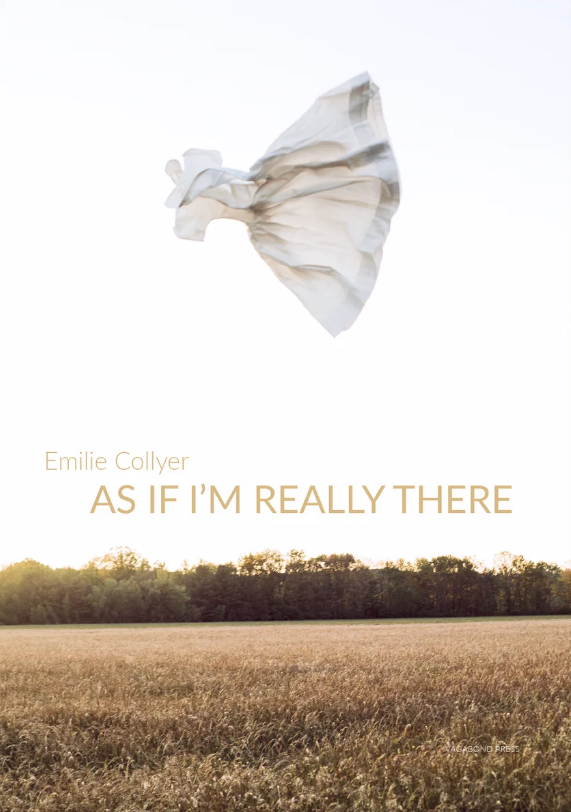
 As If I’m Really There by Emilie Collyer
Vagabond Press, 2025
Vagabond Press does an excellent cover. The windborne dress on the front of Emilie Collyer’s As If I’m Really There reminded me a little of the work of Francesca Woodman, the prodigious young American photographer known, among other things, for suiciding by jumping from a loft window at the age of twenty-two. Woodman’s photographs were mostly self-portraits – frequently nudes – keenly strange and clearly obsessed by absence. Often she seems to have been trying to capture herself in the process of disappearing, having used a combination of long exposure times and physical movement – jumping, falling, turning, hanging from a doorframe by her hands – to render herself spectral and blurred. In one untitled photograph from 1976, a kind of negative of her body appears on bleached wooden floors beneath her naked lower-half like a nuclear shadow, an image that has sometimes made me acutely emotional for reasons difficult to understand. In another, from her Angel Series (1977), a white dress or blouse or length of fabric billows in midair in the centre of a doorway that looks at first like a large mirror; beside it, in shadow, is what seems to be the outstretched arm of the artist, who is otherwise not there.
Collyer begins As If I’m Really There with ‘When I Was the Sundance Kid’, a prose poem about a made-up stint as a child actor (the Sundance Kid is the American outlaw played by Robert Redford in Butch Cassidy and the Sundance Kid, a Western buddy film from 1969). It is, I think, an ars poetica, a cleverly reflexive staging of what she is up to in the collection overall: “Of course,” she writes of the film’s famous cliff jump sequence, “it wasn’t me in that scene it was my stunt man, my body so precious it had a whole other body to take the fall” (9). What a perfect description of the act of writing poetry, of the secret substitution it demands! My speaker looks like me but only I know she isn’t. I’ve sent her in to represent me, to do impossible things on my behalf. This is not to repeat New Criticism’s insistence on severing poet from speaker so completely that the history of the lyric begins to look like a matter of so many dramatic monologues, but to admit the dramatic dimensions of any speech act – particularly when the actor is at a remove from her audience, giving her space to scheme, to suggest herself, to hide. Throwing oneself into freefall for the poem is a difficult business. Collyer’s advice? “Get a stunt double. Leap into that ever-blue Hollywood sky” (9).
One of Collyer’s themes in As If I’m Really There is the problem of self-exposure, of how to write poems involving painful, private, often bodily experience without playing into a range of historical schemas in which female exposure or suffering has been assigned a kind of fetishistic value (we might imagine that a particularly blunt version of this problem confronts the self-portraitist, i.e. how to undress before the camera without offering oneself up for instrumental use).
“Puritanical to say women should keep quiet / about their body life terrors, flush / feelings away, write anodyne tales,” writes Collyer in ‘Quiet Hook’, another self-reflexive poem that helps to contextualise the collection’s project. This much seems obvious enough. But then the demand for the woman writer to churn out an anodyne tale has never been far from the ancillary desire for her to produce her own abject exposure, to slip coyly out of the robe, a phenomenon that Collyer finds repeated in the contemporary appetite for trauma narratives: in ‘Quiet Hook’, “[h]undreds of hungry writers scribble ‘trauma’” in the knowledge that “to sell books there’s gotta be like a brilliant / pain to keep the pages turning” (30). All the better if the pain in question involves scenes of violation, their dramas of identification, their illicit thrill: “let’s be frank,” she goes on, “sexual violence hooks / people”, a difficult and honest thing to say.
How then to write poems about painful gendered experience without servicing such pathologies? To convey, as Collyer clearly wants to, that “the quiet / of ordinary tragedy [is] no real hook”? And a question from the other side of the equation: how to shut down the possibility of a voyeuristic reading of one’s body/life/terrors without risking squeamishness, even prudishness – in other words, without banishing pleasure, perversion, eroticism altogether?