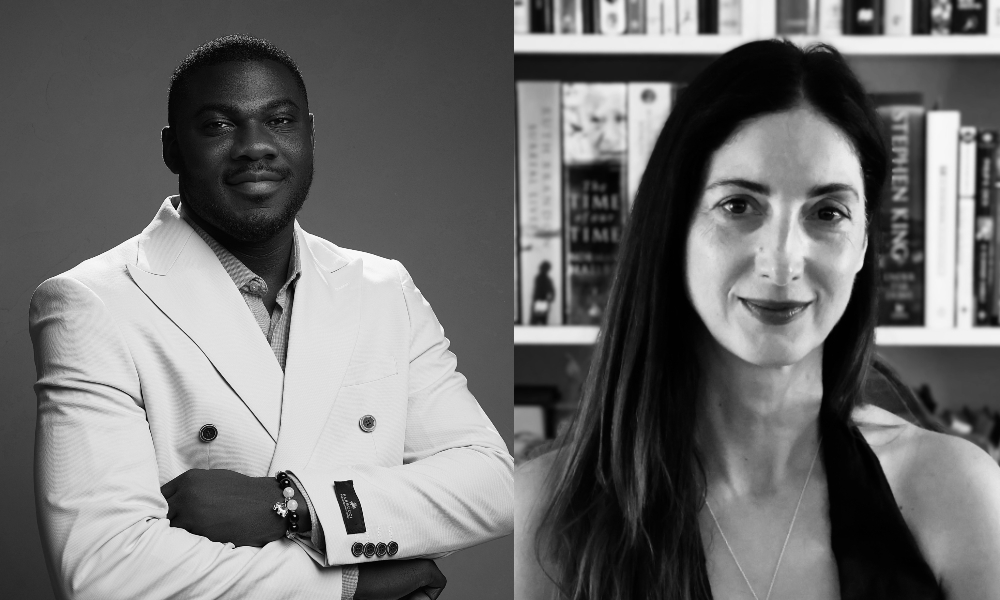
There is a characteristic lucidity in the poetry of Jelena Dinić: in how she experiences the world and fosters a flowing, expansive insight into phenomena of existence through stanzas. Her images invite you to re-envisage equations between lived time and continuing currents of being. When Jelena writes that “the sky takes the last look,” what direction or position of knowledge is the poet pointing us to? What (and how) does the poet want us to see? What motive vision would such phenomenological process illume? And how close can one get to ‘the last look’ knowing that the celestial sphere (or the earth) and ‘the look’ are infinitely in motion? Such is my entrance into Jelena Dinić’s poetic realms, someplace metaphysical, elsewhere bodily and indeed enchanting. Following this search for Jelena’s epistemology, the questions that make up this exchange turn our attention to the poet’s landscapes and horizons.
David Ishaya Osu: What readers may see or describe as a canopy of memories (of childhood, family, country, traditions) in your work is, in my view, an artistic transposition that leans quite sharply to the photographic – and the continuity of the pictured matter. I make this departure from memory for the reason that, from my perspective, your poems continuously move beyond metaphorical retrieval, reconstruction or encoding. Your reordering of imagery beyond the framework of recollection and historical referencing is something I would like you to comment on. For example, In the Room with the She Wolf begins: “When my country collapsed, I was on a swing. / My mother shouted from her window ‘hold on, hold’” (1). A simultaneous metamorphosis happens “on a swing” and from mother’s “window”. Another example is this line: “At the doorstep of / Palata Pravde / a tree had time to grow / young leaves” (9). Here I see the same mastering, remastering and reconfiguration of history or reality towards newness through the vision of a tree having time to grow young leaves. Could you speak on what poetry invokes, and how it does it for you?
Jelena Dinić: Thank you, David; you are right to question the word ‘memory’. Our memories are a rich source of our writing material. Poetry is a great portal for carrying an image from the past into the present in a single stanza. It can make past images visible and alive in a current moment. It allows us to rearrange the lines, the freedom to play and to pause, to be both mischievous and responsible. To suggest a universal truth, often. A swing is an elemental symbol of childhood. A dream of flying and a fear of falling. It is always about flying and falling. It’s that strange balance of life between innocence and catastrophe. I used that image to describe the collapse of my country. And how to survive, perhaps. The world doesn’t wait for us, it changes, it does what it wants. Like a naughty friend. There are moments in life when you must hold on. Then, let go. I think the tree at Palata Pravde (the Palace of Justice) has similar resonances. The tree carries history of a certain time, of course, but it also grows around it, or through it. An image from the past is like a photograph, but I think poetry can take the simple image and turn it upside down or inside out and unlock the vastness outside its frame. That’s the magic I am looking to capture.
DIO: In the poem ‘The House’ you write: “Now, to see and to tell is a double dare” (36). Is this where the practice of poetry manifests? between observation/experience/imagination and the transmutation of that experience/imagination?
JD: We play with words in our heads and on paper long before the poem is complete – if ever. We battle our fears and we take risks. Kate Llewellyn was kind to write a line on my book cover about me being a poet hunting with her microscope. We search for something elusive with a closely focussed eye, but observation is never entirely innocent. We dare to look, take another look, do we trust what we see? Always when we shape and edit, we risk failing. It’s a messy process. Between seeing and telling is often a dangerous little space in which a poem may reveal something new to us.
DIO: My reading of photography in your poetry relates to a method of vividness in your work that is intense, robust and metaphysical. I shall cite two examples: “A shadow / falls from her hand and // follows / line // after line” in the poem ‘A Letter from Vera’ (60). Such striking and dynamic poetics lexically typifies the aesthetic expansiveness of motion blur in photography. The second example is the poem ‘The Silence of Siskins’ dedicated to your grandfather (62). You explore the visible and the invisible so masterfully. The unseen, the said and the tacit; these realms mesh, co-exist in your work. What is your relationship with photography, or cinematography?
JD: I just pretend that I am photographer. In both artistic forms a poet and a photographer will try to catch a fleeting moment, a shadow falling, or a person we love. We like to frame things. There are people framed on our walls, desks, and bedside tables. A picture is worth a thousand words. I have been writing about the loved ones I lost. For me, writing is a way of seeing them. I cannot photograph them again; I can photograph an empty chair, or write about the siskins. There is space between the visible and invisible, as you suggest. Is that where poetry enters, to offer a meaningful silence, to give us a sense that something else is happening? For me it’s intuitive rather than camera focused.
I recently watched The Zone of Interest directed by Jonathan Glazer, based on a book by Martin Amis. It is a masterpiece. It’s atmospheric. There is absence. Persisting. So much is outside the frame – almost everything. Probably a perfect example of a motion blur that you mentioned. To use another analogy from movies, I am interested in cuts, the sudden movement in a poem. I do like to change focus, to move swiftly, allusively, from one image to another. Occasionally, it works.