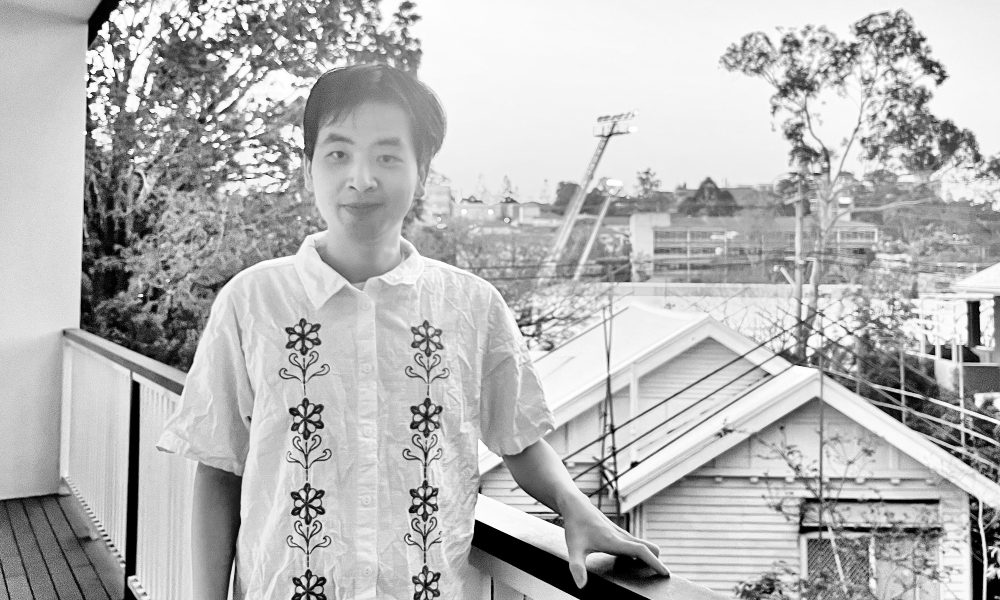
Poetry often asks the reader to navigate an incommensurable distance: the breath-length attentiveness of a line, an image set aglow, even an ending as it unfolds – to bend towards the silences thereafter, to sit and listen to what remains. My conversation with Gavin Yuan Gao was one such exchange, widening across questions of distance, memory and the seemingly impossible task of approaching what inhabits the body.
I was introduced to Gavin’s writing through their debut collection At the Altar of Touch (2022), early in my own practice and have since admired the ways they peer through a tender world of family, queerness and survival. Born in Beijing and now living on Yuggera and Turrbal Country in Meanjin, their lyrical handling of image-building, alongside evocative choices in language and form, holds that tenderness alongside quiet absences and moments of loss. In doing so, allowing us as readers to see ourselves from a necessary distance all the while considering how neither tenderness nor loss can arrive without the other.
This interview traces Gavin’s insights made luminous through attributions of myth; other modes of seeing through music and influences not only of poetry, but of language, its potentialities, and the body it too inhabits enfleshed into poetic consciousness. During our conversation, I found myself returning to and re-realising the very reasons why I write: that continual approach towards the unsayable and the wandering awareness of an unseen world that we can make visible.
Thomas Enriquez: From first reading your poetry, I was moved by the relational quality of your image-building and the quiet intensity of your lyricism. There are stories of desire, heritage, family and grief that emerge with allusive but telling detail. I’d love to hear more about how the act of writing focalises lived experience for you and whether writing itself opens up the possibility for new patterns and meanings to become legible through an interplay between intention and discovery?
Gavin Yuan Gao: I love the idea of “writing focalising lived experience.” The word “focalise” immediately makes me think of adjusting a camera lens to bring an image into focus, but in the case of my writing process, that image might not even be an image, or anything articulable, at first. It’s this vague animal hunch that some squirming, whispering, knowing thing lives beneath the illusory surface of the known world and troubles it, that it knows more about reality than I do and demands to be let out so it can show me once and for all what else the world can be. That strange first whisper, that inchoate sense that something seemingly ordinary feels funny and not quite right, is what draws me to the desk to pursue it like a hunter/diver/sculptor, until a completely new order of reality, a new way of experiencing a world, is excavated. What I most often seek from a poem is not transcription or novelty of figuration, but an expanded and transformed consciousness.
I know that when writing it’s very tempting to give in to that generative part of myself that keeps asking, what else? what else? and that every minute, a million strange new things are vying to be said, but I also feel that it’s helpful to step back once in a while and ask, why this? why that? What kind of pressure does each new image or metaphor exert on the one before? Does it deepen and reconfigure my perception of what precedes it? Is this new thing necessary, or just another decorative abstraction? This is where I feel intention comes in to temper discovery – the logical mind cross-examining the unconscious, the intuitive vision, to make sure every small discovery gathers towards (this also being a kind of focalisation) a greater revelation. This is the part that makes me feel like a film director slash editor, the filming and cutting occurring at the same time, while it also means that I can’t always be detached enough to cut the “scenes” that I’m attached to, the things that I feel are ingenious in themselves, take tremendous pride in (and suffer a great deal over) making, but which ultimately don’t add to the poem as a whole.
Indeed, how does one know whether a particular moment in a poem, or even the whole poem, is necessary? Perhaps it comes back to intuition, back to the idea that intuition and logic aren’t entirely separable in acts of creation. Perhaps it has something to do with emotional pressure. Many times when I encounter a poem (sometimes it’s my own), I’m struck by the technique, the polish, the clever references and irony, the dense dazzling linguistic inventions, or the sheer brilliance of its conceptual framework, but still it leaves me cold. I love the emphasis on lived experience in your question. I think the raw material for powerful writing isn’t just lived experience, but lived experience that the poet is emotionally attached to, an experience that is deeply entwined with one’s sense of survival, and the resulting poem is the evidence and manifestation of that entwinement. I don’t think that lived experience has to be autobiographical in a literal sense, but it must come with an inner necessity, a Frostian lump in the throat (not necessarily sadness), a volcanic pressure in one’s head and heart. Technique and intuition must be supercharged by an emotional imperative, a force that “kept treading—treading—till it seemed / That Sense was breaking through.” It might be a small, quiet poem, a delicate whisper in space, but its emotional source must be enormous.
TE: In your poetry collection, At the Altar of Touch, many of the poems seem anchored in myth. From resonances of the afterlife and the mythic dimensions of romantic trysts, the dreams of Telemachus, transformations into swans, and the language of rivers, myth transforms from inherited narrative into a mode of attending to the world. Across the collection there’s a palpable reverence and tenderness. Can you speak towards your relationship with myth, and what it makes possible within your poetry?
GYG: My first education was in myth. This was before I learned how to read and write. I’ve been trying to find this animated short film that I watched when I was about five. It’s based on the myth of the Chinese goddess Nüwa, who created humans from mud and clay and repaired a massive flood-causing fissure in the sky with five-coloured magical stones. But in this particular (perhaps quite unorthodox) version, Nüwa runs out of stones by the end and sacrifices herself by sealing the fissure with her own body, eventually becoming part of the sky. The film ends with the humans emerging from their shelters and searching for their mother goddess. I remember being so moved and stunned by the image of Nüwa’s final sacrifice that I stayed very quiet for the rest of that evening. It’s an image that I’ve since come to associate – and will forever associate – with love, even though I didn’t (and still don’t) have the language to articulate what I felt or why I felt that way.
For me, myth seems to have this unique capacity for speaking to the part of ourselves that is pre-rational and pre-analytical. It produces a form of knowing that precedes explanation and even language itself, a kind of truth that resists paraphrase and can only be felt. With a few select images, it plants an enduring seed in one’s unconscious: I’ll never be able to look at a lump of clay without thinking soul, or at the sky without thinking flesh, and somehow all of these have become entangled with death, life, and love.
Myth estranges the world and the self, enlarging our sense of what constitutes reality. It transports us from the familiar world while simultaneously giving us another world/consciousness to inhabit. The myths that have stayed with me most deeply are stories of transformation. At their deepest, transformations consist of two happenings at once: the shedding of the old self and the emergence of another self that had remained latent within us. Perhaps that’s why myths are so emotionally potent: every true homecoming is also a leaving-behind. “Je est un autre,” Rimbaud writes in one of his Seer Letters. In writing, I crave the same kind of radical transformation: by the end of a poem, neither the poet/speaker nor the reader should remain the same as at the start. Some old habit of perception or feeling, some much cherished illusion of safety and stability, must be pulverised. The Ithaca that Odysseus returns to isn’t the same one that he left, but one that’s been refashioned from all the changes that have taken place in him in the intervening years.
Unlike fables, or poems that set out to make a point or illustrate a belief, myth or myth-making poetry contains the infinite because of its finite form. It’s full of silences and implications, riddled with unanswered and sometimes unanswerable questions. More than twenty years have passed since I last saw that animation, yet to this day I’m still wondering: where did Nüwa come from? Where did she go? Did she die or merely take on a different form? Did the sky become alive and sentient upon her sacrifice? Was the sky ever alive? I want to stand at the end of a poem as the humans stand beneath the sky, looking for Nüwa, finding her everywhere and nowhere at the same time.
TE: Further to the idea of language, in your poem ‘海, or Memory as a Water Language’, the luminous task of traversing the distance of memory comes into view. I found that the poem evokes the ways language can become a vessel for connection between mother and mother tongue, memory and the present, absence and presence. As a multilingual poet, could you reflect on the relationship between language, distance and connection?
GYG: When I come to think of it now, it seems both the most peculiar and the most sensible thing that I should write poems about and to my mother in English more than 20 years after her passing. She couldn’t read poetry in English, nor could she have travelled into the future to read my poems. Yet somehow that double distance – linguistic and temporal – liberates me to speak to her with a degree of honesty that would have been impossible in person and in Chinese, the only language we ever spoke to each other while she was alive. It makes possible a strange kind of intimacy that could arise only from the impossibility of communication itself: the more unreachable she becomes, the more freely I find myself able to address her. Or maybe I’m more shameless writing in English. Chinese is the language in which I feel most surveilled. It’s the language in which I grew up hearing my father, teachers and other authority figures urging me to be more reasonable, more balanced in my ideas and emotions. I still remember very vividly that a middle school literature teacher mocked me for a composition I wrote from the viewpoint of a daisy (clearly inspired by Dickinson), a piece she dismissed immediately for being childish because of the flower persona. I feel that in some way, my subconscious has always associated the English language with greater permission to be vulnerable and fallible.
Speaking of distance and connection, I often wonder how far memory is from the past itself. The more I think about it, the more memory begins to resemble a language. The past, unreachable, feels like something written in a language that I forget how to speak as soon as I translate it into the language of the present. Each attempt to remember is therefore also an act of translation and re-creation. As soon as I narrate a memory, something slips away and returns changed. Something is lost in the process of being put into words, while something else comes into being, as if remembrance itself were always poised between death and birth. The past is irretrievable, but perhaps poetry isn’t interested in retrieving the past so much as reconstituting our relationship to it. Perhaps language doesn’t diminish our distance from the past so much as allowing us to inhabit that distance. It keeps our relationship to the past alive by continually transforming the ways we experience it.
TE: The titular poem of the collection ‘At the Altar of Touch’ includes sequences inspired by the life and art of Chinese painter, Xu Beihong, alluding to paintings such as Galloping Horse and Horse Drinking, the former of which you encountered as a child. I’m curious whether other forms of artmaking or writing similarly compel you to write in response. How do these encounters become sites of subjunctive entry, allowing you to inhabit and move through histories or other ways of seeing?
GYG: Music has been one of my most important muses, especially instrumental music – soundtracks, folk music and classical music. For me, instrumental music offers the greatest possibility for co-creation. In the absence of lyrics, my imagination is given free rein to shape and build the world that I glimpse from sound, unmediated by semantic language. The music provides rhythm, emotional atmosphere, tension and release, as well as a felt sense of time. In response, my imagination generates images, places, bodies, histories, and narratives – a kind of living landscape of interior experience. There is something so primal and immediate about instrumental music: before the rational mind can interpret it, the body has already registered its movement, pressure and emotional weather. That freedom makes listening feel like an act of collaboration, in which experience and meaning-making occur at the same time.
That is not to say I don’t love music with lyrics. Some of my earliest music heroes are contemporary songwriters who have inspired me to write through their capacity for embodying particular consciousnesses. When I listen to Kate Bush singing as Bess Houdini, or Björk singing as Mother Oceania, I’m always struck by how the music seems to elicit an overwhelming visceral response from me before the words have become fully intelligible. The harmony, rhythm, vocal timbre and the melodic shape reorganise my emotional world so powerfully that I’m convinced that Kate Bush is Bess Houdini, and Björk is Mother Oceania, with all their longing luminously alive. Bess Houdini is no longer some long-dead historical figure; the ocean as mother is no longer a trite, flat metaphor. That’s one of the things I most admire in any art form: its ability not to represent another consciousness but to let us inhabit it, to perceive and feel the world keenly and multidimensionally as the characters (and the artists) themselves do, if only for a moment. I think the best kind of poetry strives towards this condition.
Like music, poetry at its best doesn’t tell us what to feel. Its language is not functional but experiential. It doesn’t merely offer us information or representation, but a chance to inhabit a transformed and transformative consciousness, in which our perception of reality is altered by our felt experience of the whole poem through both semantic and non-semantic means. In poetry, meaning is experienced before it is conceptualised. Before we’ve fully interpreted the words and registered their semantic meaning, we’ve already been affected by the poem’s rhythm, syntax, tone, sound and pacing, by the tension between the line and the sentence, between words and silence. Great poetry reminds us that language has a body, and what we experience in the heightened language of poetry is the movement of enlarged consciousness. The best poems seem to occupy a space somewhere between instrumental music and music with lyrics, guiding the imagination without determining it.