I am trying always to return back to the body because as an Indigenous person, as a Latina, as a queer woman, I haven’t been given the permission or the space, to be fully in my body. Things like pleasures, and the autonomy of pleasure, and ecstasy – those things weren’t allowed for us… I am writing a lot of love poems.
And there is, for me, no difference between writing a good poem and moving into sunlight against the body of a woman I love.
After I won a poetry prize this year, a friend asked me how much prize money I would be receiving. Her response to my answer was, “That’s worth four vibrators!” My reply: “It’s more like three if we’re talking top-of-the-range Womanizers.”
I want to speak here about queer activism (though only a little about orgasms and vibrators). Specifically, using myself as case study, I focus on pleasures, both sexual and non-sexual, that queer people have had to fight for.
A few years ago, I came across the book Pleasure Activism: The Politics of Feeling Good, by queer Black pleasure activist, adrienne maree brown. The book gave definition to what I’d been pursuing as a human right. As brown defines it, pleasure is a feeling of happy satisfaction and enjoyment, activism involves efforts to make social improvements, while pleasure activism is the work of reclaiming full, complex selves from the impacts of oppression.
Following brown, I argue that the pursuit of social justice is not simply serious work. Pleasure activism decolonises queer bodies and longings. It recognises that pleasure is both political and a measure of our freedom. Queer people continue to fight for what is ours because the targeted denial of pleasures stems from the denial of our humanity and embodied selves. “I am trying always to return back to the body,” Natalie Diaz poignantly explains in the epigraph. Raised Catholic, Diaz writes in one of her love poems, “the single blessing I had to give was Mouth – / so gave and gave I did” (‘Waist and Sway’).
My first – and unexpected – orgasm, at around the age of 10, was an initiation into pleasure so thoroughly corporeal it stunned as much as it pleasured me. This kind of pleasure was not something my devout Catholic Vietnamese parents had brought up with me, let along encouraged. Despite, or perhaps because of, such omission, this momentous experience would help shape my future interest in pleasure activism.
And the fact that I was listening to a library cassette recording of a fairy tale, while lying across a swivel chair and blithely (gayly?) swinging my legs, would also mould my experience with words, stories, texts. Unsurprisingly, I will turn in particular to poets, the supreme pleasure makers of words, to explore the right to queer pleasures.
Books helped me navigate the choppy waters of sexuality in my late teens and twenties. I am referring to the 1990s and early 2000s, before the sophisticated advancement of the internet and search engines. If knowledge is power, then I felt empowered by gaining knowledge of things never formally taught me. Sex ed at my Catholic schools was about reproduction, never pleasure. We were not taught about clitorises or erogenous zones, or that sex and masturbation could be pleasurable, or how to do relationships.
So, I read what I could find: from entries in the World Book Encyclopedia to books devoted to heterosexual sex. I still have the copy of The Joy of Sex I purchased at the now-defunct Co-op Bookshop at the University of Newcastle. And I bought a delightful second-hand pop-up copy of the Kama Sutra, which I eventually gifted to a friend for her birthday. The pop-up book embodied for me the strange delight – and indeed the delightful funniness – of sex.
Of course, I devoured what I could of the joy of queer sexuality. The first time I heard the word bisexuality was at university, and it changed my life. I had never felt entirely heterosexual or gay, but once I came across the term and accepted it, I felt a secret thrill. It was like I had been at sea and had now caught sight of a wondrous island I had never been told about. Bisexuality is a hard-fought identity for those of my generation (and earlier generations) who had not come across the term until the confusion around attraction had already set in.
In 2020, I was a coordinator of the largest bi+ group in WA and was asked by the local queer newspaper what being bisexual means to me. I answered that it means freedom. The freedom to interrogate systems, along with the limits, the boundaries, and the borders of established norms. The freedom to cross over into new, and so-called enemy, territory. The freedom to embrace multiple ways of thinking and being in the world, so they can coalesce with each other.
To be bisexual is to instinctively understand what nineteenth-century American poet Walt Whitman means when he says:
We are seas mingling, we are two of those cheerful waves rolling over
      each other and interwetting each other,
We are what the atmosphere is, transparent, receptive, pervious,
      impervious,
We are snow, rain, cold, darkness, we are each product and influence
      of the globe,
We have circled and circled till we have arrived home again, we two,
We have voided all but freedom and all but our own joy.
                                                                     (‘We Two, How Long We Were Fool’d’)
I first heard of Whitman in 1998 because of the Clinton-Lewinsky affair (Clinton had gifted Lewinsky a copy of Whitman’s Leaves of Grass). Once I read Whitman, I understood him to be bisexual or queer. I like to believe the above poem speaks of queer joy, of its “interwetting” with freedom, and how the two are as natural as nature itself.
As an undergraduate, I studied Jeanette Winterson’s semi-autobiographical, queer coming of age novel Oranges are Not the Only Fruit. Winterson’s youth and Pentecostal background led to idealistic pronouncements such as “I want someone who is fierce and will love me until death and know that love is as strong as death, and will be on my side for ever and ever.” Age and experience have moderated this degree of romantic hopefulness in author and readers alike. Even so, the book’s publication in 1985 made it a crucial literary counterpoint to the grim realities queer people faced under Margaret Thatcher’s moral crusades – in the midst of the AIDS epidemic, no less. Despite this homophobic political climate, and in contradistinction to her religious upbringing, Winterson passionately upheld her right to love and be loved. No wonder I was enamoured.
Winterson’s combination of lyrical prose and biblical references, in particular the Bible’s erotic poem the Song of Songs, was formative to my own “interwetting” of religion with sexuality. I knew from an early age that religion and sexuality were unnecessary adversaries. Yet the widespread belief of their irreconcilability has led generations of queer people toward shame.
Much of my research as an activist-scholar has been devoted to reducing shame by (re)claiming the queerness of Christianity and the Bible. In the process, I have often focused on the erotic poetry of nineteenth-century celibate converts to Catholicism. Thus, the priest Gerard Manley Hopkins becomes at once someone who writes love poems to God and desires and aestheticises men’s bodies. In the writing of these queer poets, I see something of myself and the queer dimensions of Christianity.
The tree of knowledge has been a source of my empowerment. Putting aside moments of procrastination and self-doubt, I believe my research – of queer poetry and literature, of sexualities, of religion – has had a profoundly positive influence on both my mental health and pleasure-based way of being in the world.
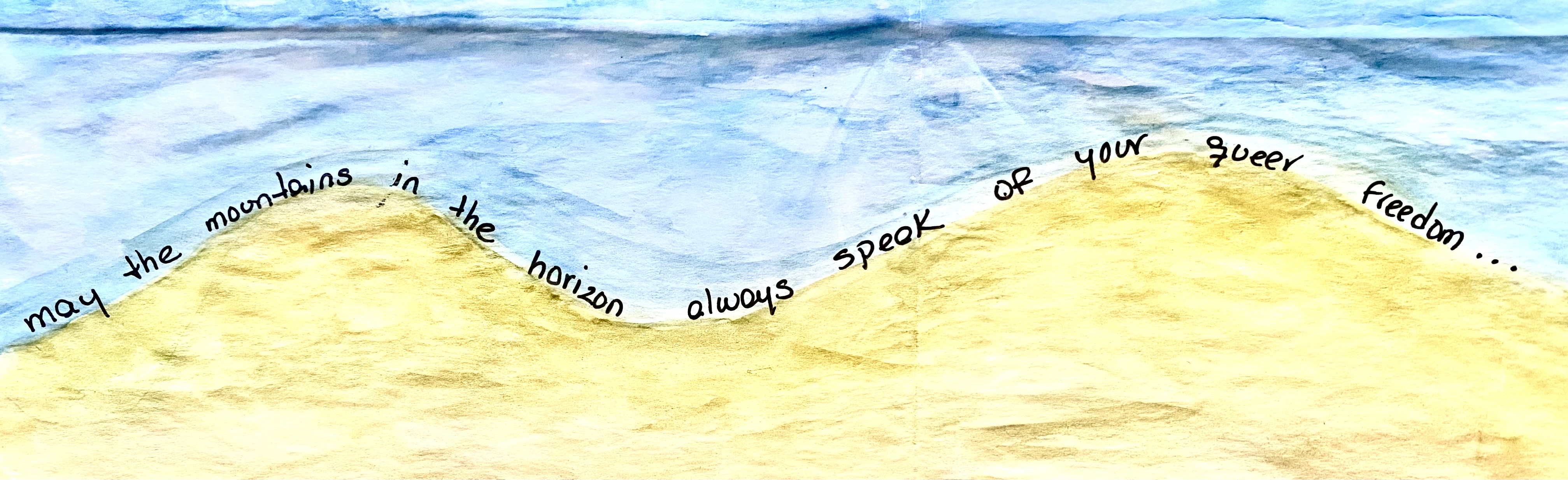
Image: Juliet Hernandez, Núi series
The way we manage the consequences of our upbringing impacts our wellbeing and how we experience our queerness. I credit the following queer version of Maslow’s hierarchy of needs for helping me break from the oppressiveness of my upbringing: my queer research, recognising sexual hypocrisy, the intellectual and relational freedoms I accord to bisexuality, being out about my sexuality, Winterson, the queer poems and other forms of media I consume, my atheism, engaging in therapy, the safety of found family, the sense of belonging I have fostered in myself and others from having been a bi/queer activist and community organiser, being an intersectional feminist and ally of trans people, having a curious mind which led me of my own volition to read the Bible and study religion. And, of course, orgasms.
Because of these protective factors, I am able to appreciate what gives me pleasure, including the capacity to read the Bible as literature and for queer subtext, without the damp stain of shame.