Shame is a pleasure killer. Freeing myself from personal shame has been one of my proudest achievements as a queer person brought up in a collectivist, shame-honour culture. I need to make it clear that my parents aren’t just Vietnamese, and they aren’t just Catholic: they are Catholic Vietnamese, which is its own category. Growing up Catholic Vietnamese amplifies any shame and need for secrecy one could experience.
My parents are so devout that I willingly came out to them as bisexual before I came out to my mother as an atheist. And even then, it was only because she turned to me in the kitchen one day and asked if I were a believer. Oh, how I froze for a moment; but I wasn’t going to lie.
When I was a child, my parents lived a life of survival and religion. We were a war-traumatised working-class refugee family in a new country, far away from close family. I wasn’t taught to seek out pleasure. Love did not encompass pleasure or joy, whether given or received, but in duty, loyalty, and obedience. I was taught to obey, pray, attend church, repent, be good. When I wasn’t good enough, punishment and shame inevitably followed.
The concept of the good child is damaging to children. I understand why people get tattoos bearing the first line of Mary Oliver’s poem ‘Wild Geese’: “You do not have to be good.” A queer American, Oliver is known mostly for her nature poetry, but ‘Wild Geese’ is one of her best-known poems, and for good reason. From the second line she writes, “You do not have to walk on your knees / for a hundred miles through the desert repenting.” Instead, “You only have to let the soft animal of your body / love what it loves.”
Moral codes based on the punitive concept of sin have unobtainable standards that work against human flourishing. Recognising this, Oliver elevates love as a philosophy for life and pleasure that harmonises with instinct and body, the “soft animal” part of ourselves.
In order to escape our childhoods, some of us become godless or flee organised religions. It should be recognised, however, that queer people of faith do exist and that they might wish to see queer-affirming work by fellow believers. One poem I regard as a central work of queer and anti-shame Christian poetry is by Jay Hulme, a trans, British, Anglican convert. ‘Jesus at the Gay Bar’ was published in Hulme’s debut volume The Backwater Sermons (2021) and soon went viral. The poem opens with a memorable image of a robed Jesus “in the midst of it – / right at the centre of the dance floor.” His robes are up to his knees “to make it easy to spin.” The rest of the poem is worth quoting in full:
At some point in the evening
a boy will touch the hem of His robe
and beg to be healed, beg to be
anything other than this;

and He will reach His arm out,
sweat-damp, and weary from dance.
He’ll cup this boy’s face in His hand
and say,

                    my beautiful child
there is nothing in this heart of yours
that ever needs to be healed.
Jesus’s sheer and queer joy in the dance is obvious in his weary, sweaty arms. His tender act of cupping the boy’s face, his loving message against shame, could well be curative to readers who live or have lived with religious-based shame. Espousing the gospel message that God is love, Hulme is a poet capable of marrying his faith with queerness.
The gospel theme of love has influenced both my research in love studies and my activism. While I don’t believe in God, I do believe in love. Love is my god. My Catholic upbringing instilled in me the importance of acts of service, which I reframe through a lens of love. It doesn’t surprise me, then, that my greatest act of service, my most enduring act of love, has been my bisexual and queer activism. In 2021, I published an autoethnographic article on bisexual activism as a “love story,” reflecting on my activism and community building as a form of love in action. The framework makes sense to me because activists are passionately enamoured of justice and are driven with yearning to achieve it.
I have learned from mistakes that activism is not the same as love martyrdom, which eventually drains love of any semblance of pleasure. More recently, in an essay on love-politics in the writings of Black feminists and womanist theologians, I talked about the resistant, anti-Capitalist need for rest, self-preservation, and self-care – for dwelling on pleasures that enable the work of resistance to continue without burning out.
Queer activists of colour and Indigenous poets like Audre Lorde and Natalie Diaz are among those who have inspired me to combine activism with love poetry and the truth-telling of queer identity and pleasures. Closer to home, non-binary Aboriginal author, Ellen van Neerven, has written powerfully about social alienation and queer Blak joy in ‘The Only Blak Queer in the World’. Van Neerven’s is a love poem to found family, shifting as it does from the speaker’s solitude to finding community with other “Blak Queers” one Mardi Gras; from meeting a couple who marched at the first Mardi Gras in 1978, to waking up “in a queer share house with a text / from the other Blak Queer asking to go on a date.” The poem ends with the speaker being immersed in textual kinship and Country:
        I read Natalie Harkin’s, Yvette Holt’s, Nayuka Gorrie’s and
	Alison Whittaker’s writing online and in bookstores. I saw
	love for Blak Queers everywhere. Outside the city the sky
	sent me hints, the walks on Country along the river kept me
	safe. I saw the colours of my own heart, and they were not
	the colours of isolation and fear.
The queer joy that van Neerven reaches over the course of the poem is something I have wanted to lean into in my poetry, because we activists often focus our energies instead on areas of deficit.
But how to show joy through an atheist Catholic Vietnamese-Australian lens? Last year when I decided on poetry as a vocation, I did not know of many queer Vietnamese diaspora poets. Vietnamese-Australian Jennifer Nguyen published a chapbook which includes humorous poems such as ‘Love at First Laugh’, about a date with another woman. American literary sensation Ocean Vuong uses Christian references in queer poems such as ‘Ode to Masturbation’ and ‘Devotion’. However, given that Vuong is a lifelong Buddhist, exactly how much Christian experience he internalised and digested through lived experience before it reached the page is debateable.
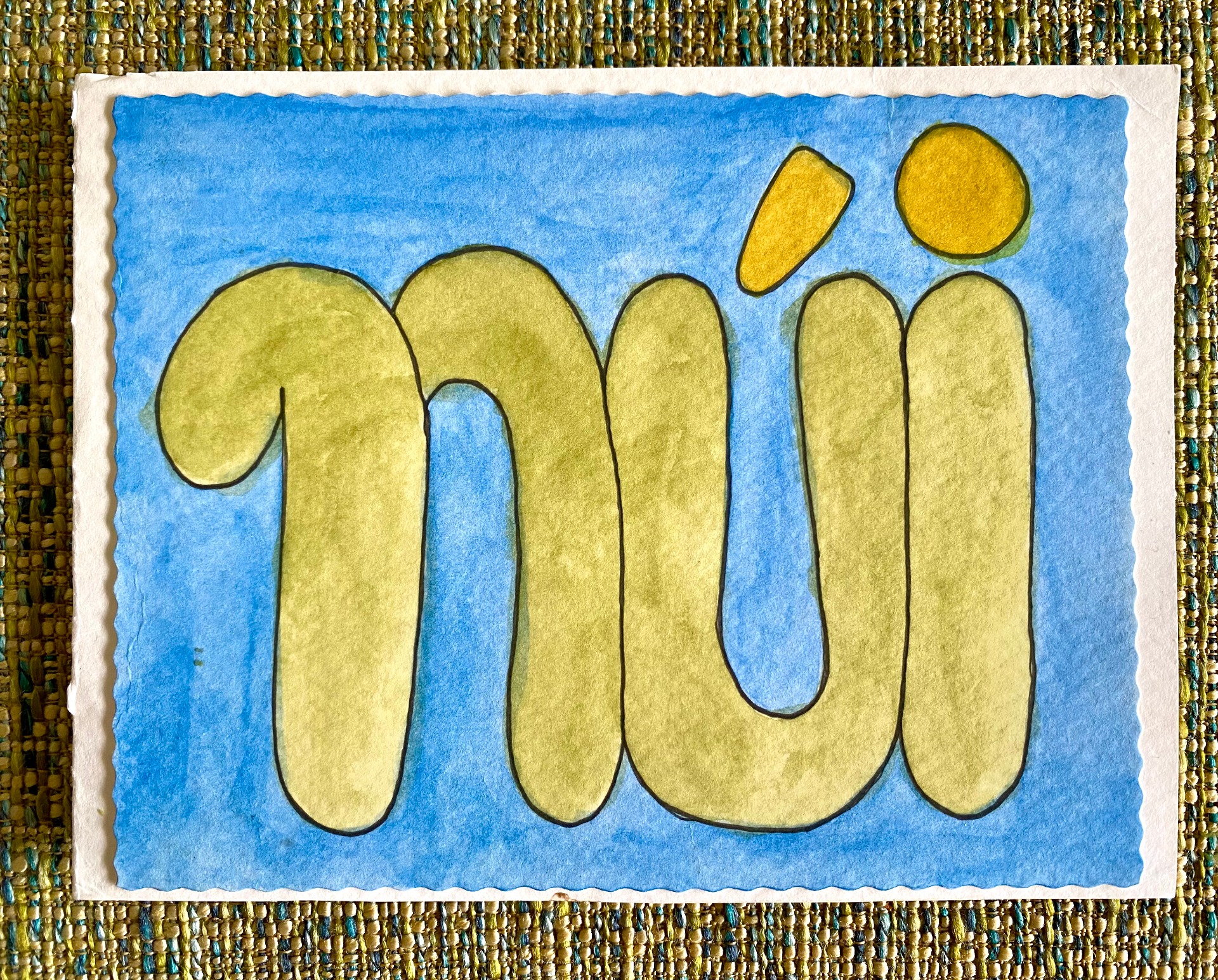
Image: Juliet Hernandez, Núi series
I decided that if I were to express queer joy through my cultural background and academic specialisation in religious eroticism, then it would be by appropriating a Catholic translation of the Bible. I concluded my previously-mentioned prize-winning poem (‘Broken Vietnamese: Sonnet Sequence’) with fragments from 1 Corinthians, the Song of Songs, Ruth, and Revelation. Influenced by a remarkable sex scene from Umberto Eco’s novel The Name of the Rose, which is composed entirely of passages from the Song of Songs, I reconstituted the Bible for my queer needs.
At the beginning of the first of the poem’s six sonnets, I briefly reference our family’s escape from Herod’s sword. The flight of Mary, Joseph, and the infant Jesus to Egypt stands in for our escape from Vietnam to a Malaysian refugee camp. In coming full circle, the conclusion of the final sonnet represents my symbolic return to paradise as an atheist and a queer pleasure activist. With the sixth sonnet, I conclude this essay:
VI. Amen vietnamese + catholic + parent x 2 = a new car for my therapist2 my parents knew before i confessed the worst no penance and absolution for the godless the church is concrete in my bones my earth-bound pleasures as coarse and bent as the pot plants on mum’s porch faith / hope / love and the greatest of these is love love / not hell-bent on bloodtiesbut attends to the tar and feathers love / like lissomly arms around the thickest torsos let him / her / them kiss me with the kisses of his / her / their mouth let me praise your love above wine how right it is to love you gazelle / dove / lily among thistles the mandrakes yield their fragrance your lips / honey and milk under your tongue drink deep / my dearest friends wherever you go / i will go the watchmen came upon me / they wounded me but i will feed from the tree of life set in god’s paradise amen / amen / amen
‘Broken Vietnamese: Sonnet Sequence’ first appeared in the Newcastle Poetry Prize Anthology 2026, published by Hunter Writers’ Centre.