
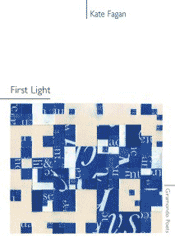
First Light by Kate Fagan
Giramondo Publishing, 2012
Poetry, Paperback, 96pp
First Light is Kate Fagan’s long-awaited second full-length collection. It was published in March 2012, almost ten years to the day after her successful debut, A Long Moment, was released. Ten years is a mere blip in time for planet Earth, but what does it mean to a poet and her history? Ten years can bring a well of experience and an abundance of living – of living the poet’s life and the musician’s career, and of the academic’s savoir vivre. Labels such as lover, wife and new mother are also pertinent to this slow burning collection.
For the reader, First Light begins with its cover – or more specifically its artwork of the same name – a deceptively simple collage by Nick Keys depicting a cut up of letters and half-letters or fragments of words. There is something abstract, clinical and mysterious about the artwork, and its scalpel exactness seems wedded to Fagan’s mathematical precision. The artwork also acts as an introduction to the second section of the collection, ‘First Light’, and its ten cento poems. These centos were mostly written for Kate Fagan’s predominantly academic circle of friends and family, who are also poets. The poems were written between 2008 and 2011, and in most cases are placed in chronological order.
A cento’s chief purpose is to sample existing references in order to create a collage poem. No original writing is included; therefore a certain amount of meticulousness is required when placing one fragment next to another. Fagan samples her dedicatees directly in individual poems and she also includes third party references relating to the cento subject’s academic research interests or creative influences. ‘Dadabase’, for example, is dedicated to Michael Farrell and successfully works his hybridity and testing of language, of breaking it down to components, so that ‘Dadabase’ becomes an often absurdly light-hearted poem that sings of Farrell and Tristan Tzara.
The section and book’s title poem does not immediately correspond with the cover artwork of the same name, but rather the artist who created it. This poem is dedicated to collage artist and writer, Nick Keys, who would best understand the nuances and inside jokes that unfold within the piece. Beyond the purpose of collage, artwork and poem do not connect here. I think if they were presented together on a wall without respective titles, someone coming into the room would not be able to associate them as corresponding pieces, except for the fact that this is a cento poem and the artwork is a collage. But the poem does, toward the end, speak of light ‘as if this being’s old light carries / the whole world of present activities’.
In many respects I felt that the cento poems work as portraits of their subjects, aligning the personal with the professional. The problem for the reader lies in the need to be conversant with the dedicatees work and professional interests in order to fully understand or sense a poem correctly. Fagan asks the reader to work a lot harder, which is an essential requirement for Language Poetry, a movement firmly rooted in Fagan’s early preoccupations as poet and academic. The idea that language dictates meaning rather than the other way around is most evident in ‘Cinematico’, a cento for Sydney experimental poet and University of Technology Sydney tutor, Astrid Lorange. This cento was created by sampling Gertrude Stein, who happens to be a major research interest for Lorange:
This makes no difference
A sentence
the sentence
makes no difference between.
Array her in cloth of gold,
she does not remember any oranges.







