
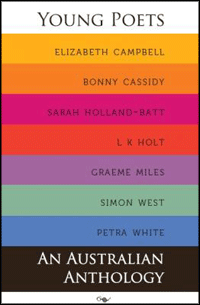
Heather Taylor Johnson Reviews ‘Young Poets: An Australian Anthology’

5 June 2012

Young Poets: An Australian Anthology

Young Poets: An Australian anthology, edited by John Leonard
John Leonard Press, 2011

I’ve respected John Leonard Press since its beginnings in 2006, and over the years a theme has formed across its publications. Leonard’s poets have a lot in common. There is nothing slapdash about any of them. These are poets clearly enticed by language and by the theories of life. Don’t expect rhyming. Don’t expect clichés. And do not, above all, expect anything simple.

Let us begin, as Leonard has in his press’s new anthology, with the incredibly skilled Elizabeth Campbell, whose poetry is as textured as it is precise. Though I mean that summary to be a compliment, I cannot help but feel that I’m missing some emotional connection with Campbell’s poetry – as if her writing is precise almost to a fault.

Take this excerpt from ‘A Mon Seul Desire’:

Ashy heron, fallen magpie
face off, and both are hunted by the falcon.
Myth we reject

turns inward – the selfless lover
loves no self in his other, loves only love, ends
folding on himself, ceremonial:

love’s mind loves
its own luminous terminology:
you, only, I, we, two: my sole desire ... 

It is final lines like this which can make my heart grow large, as if it were a lung taking in new air, but we cannot read a single line of poetry in seclusion to the rest of the poem, and it’s the rest of the poem that distances me from what ‘desire’ might imply. It’s clearly a very complex word, and it would appear as though Campbell takes a round-about way to get to the heart of the matter.

She goes so far beyond the word that I become lost, and it is this persistent manner of interrogation which has me re-reading stanzas, trying to follow implications. Understanding that this may be the way Campbell’s mind works, tenaciously incorporating philosophy and mythology into her poems, I find it interesting that her writing style is so sparse. In fact it might be why I find her to be such a fascinating poet, one I admire. I just can’t feel her poetry.

Onto Bonny Cassidy, whose imagery is intoxicating, if you can only be patient enough to follow it through. From ‘Range’:

There’s a slip
             incised into the bank – a deep shelf
             wedged well with kindle and roll, some of it bunched up
             to roots, some flipped –

             under the rim of earth and wrack
             a slip cut round the sandstone skirting: no rushing cavers
(that bird was landing in a puddle, after all)
             just a deeper crevice		swallowing striped chips of shale.
             An opening for some kind of

except it ducks in from the bank
and turns a few metres down,
back to the bed
sinking clack and drop in currents of gravel.

             Instead of light there’s air
getting higher and
oaks shedding themselves
             into dark, thrown circles.

Her style is visually intense and demands close – too close? – reading. And this leads me to the crux of my critique. John Leonard chose an alphabetical ordering of poets, and Campbell and Cassidy just happen to be the heaviest. As they represent the first two of the ‘young poets’ whose work, according to Leonard’s introduction, ‘ensures the serious continuance of an art that is possibly vulnerable from being too little read’, I begin to feel intimidated. There’s an intellectual approach to these poets’ work which erases any chance of gut and instinct, and I’m immediately feeling their weight.

When I reached Sarah Holland-Batt’s section I found relief. This is not to say she is easy or accessible because she does take us out of our comfort zone with emphasis on foreign soil, but still there are moments of everyday speak that I find great comfort in after the intensity of Campbell and Cassidy: ‘Five years I lived / by that black mountain range’ (from ‘The Idea of Mountain’) and ‘Noon, / I bring the mail in’ (from ‘Letter to Robert Lowell’). It is so nice to finally feel less of an outsider and more of an ally. We read in ‘The Quatrocento as a Waltz’,

Open the window: outside it is Italy. 
A fat woman is arguing over the artichokes,
someone is dying in a muddy corner,
there’s a violin groaning in the street.

This writing is clear, the images so plane (however out of the ordinary), that the poet’s world on the page becomes our world as well.

LK Holt returns us to the intensity of the first two poets, leaving Holland-Batt to be that memory of splashed water on our faces. As her pen name gives little away as to the question of her gender, so do the poems fail to lean toward an obvious male/female slant. One half of her poems are about males, with four beginning with the word ‘He’ and one – my favourite, ‘Unfinished Confession’ – about a male wishing himself sexless and genderless. Holt shuns the ‘I’ in the personal sense and holds fast to assuming new identities. When we think we might grasp a bit of the poet, it is in the form of the pronoun ‘we’, in which the poem is again about someone else (the second half of the ‘we’). Holt promotes the personal stories of others, rather than of herself, and narrative and content often triumph over imagery in the process.

Leonard writes in his introduction that, in the case of the poets in this anthology, ‘the momentum of the poem is not so much inward, towards a presented self, as outward to a world and its mysteries, of being and of language’. I’m a fan of Holt’s and have no doubt she should be included in a book which showcases not only our best young poetic talents but our best poetic talents, but in the case of this anthology, I feel pairing her with Campbell and Cassidy in the first half of the book, means that too much of the ‘outward’ is overload. I find it difficult, then, to not compare Young Poets with Felicity Plunkett’s Thirty Australian Poets, which also aims to highlight today’s young poets, and make the judgement call that the later is a better production for its overall diversity.

Another negative of the alphabetical ordering is that the structure ensures we only hear female voices for more than half of the book. It jars at first, but when you reach the end of the collection you realise that Graeme Miles and Simon West aren’t only situated too far down the ABC procession, but they are indeed the only males out of the seven poets. Quite an interesting statement on today’s young poets, when historically the case is the opposite.

With Miles it’s very personal – however personal surrealism can be. In his poems it’s as if the physical body diverges from the rational and enters into absurdity. Examining its parts rather than its whole, new perspectives emerge, as in ‘Body’s Poem’:

I read the body’s poem in different ways.
Thinking from the centre of the chest, I
peered up through a swan-like, periscopic neck.
While thinking from the belly and the crutch
became an old drunk or a cat.

Miles compares the human body to those of various animals again and again in his short selection, suggesting primal instincts are more than sexual desire and the nurturing of an offspring (thought he goes there as well). Sometimes the body becomes disassociated from the soul, as in ‘Isis and Osiris’, in which a man at a party jumps into a box, which is then dumped into the sea:

Somehow his body breaks up
through whole countries. Fingers
worm their way into soil and deserts.
Toes curl up under their nails
like snails. Limbs turn tree ...

The man’s wife puts him back together and we see the power of love and the vulnerability it yields as ‘though in bed at night / he creaks where he’s mended’. I could attempt a reading of ‘Talking Glass’, begins with these lines:

I went to find pasta for the wary 
to prepare their pianos. I tried to speak,
knowing that I’d spoken pasta
in the past, but now there was broken glass
between my teeth.

But interpreting this poem would mean that I might have to reach too far. I could say that the mouth works mechanically, that speaking – apologising – is what is socially acceptable though in essence is nothing more than words as useless as shards of glass, so the mouth and heart are disparate entities, but I might be trying too hard. Nothing is simple with Miles. But his work is a lot of fun.

Simon West is the nature poet of the group, but to say his poems are simply about nature would be wrong. The focus is not the apricot tree, but what a person can learn about himself and those around him through the apricot tree; there is a symbiosis West seems to be working with. Birds make an appearance in more than half of his poems, but not one single poem uses a bird as its focus. Such is the case for language, or rather the absence of language. For West, a poet dependent on words must accept silence into his day. In ‘A Minor Sense’ ‘you’ must block out the cacophony of the neighbourhood to find your way to meditation:

an awareness of surroundings,
and through a window without curtains
a light glows in your own empty room.
You know when you take
a deep breath and can feel the air?
Well, that’s how it is,
here, in place, at the end of the day.
But all this, is it told in praise?
And on what grounds?
And it’s gone, as you circle in.

So once you begin to interrogate, forcing words into the empty room of your mind, that perfect moment is gone. West’s poetry is about recapturing it. As with nature needing man in these poems, the absence of language needs the presence of words. It is a case of the after being of no use to us unless there was a before, and I find this idea very spiritual.

Petra White fits into this group of young poets not only in age but also in the way she steps outside of her poetry, reserving her words for others. Yet there is little distance to cover in reading a poem like ‘Woman and Dog’, for instance, if you begin with an outsider and want to reach the heart of the poet. I feel as though I am capable of understanding White more than any of the poets presented in this anthology, and recognition can be a major factor in liking (that is going beyond admiring) a poet.

In White’s work, we see a young girl playing in the water in ‘Ricketts Point’ and though White is not in the poem, we know she realises the joy of abandonment. We read office memos and, though White does not claim to be one of the workers, we see she’s aware of how business and commerce run our lives. We see a kangaroo and, well, this is where I have to change gears. White is so talented that we begin to think she must live in a kangaroo refuge, or work in the field of animal linguistics, or was once in a former life an actual kangaroo!

And here I end this review, giving thanks to the alphabetical ordering of the poets for at least giving Petra White the perfect opportunity to end the anthology: a good one, an important one, but at times a bit too much like a text book.


This entry was posted in BOOK REVIEWS and tagged , , , , , , , , . Bookmark the permalink.
Heather Taylor Johnson

About Heather Taylor Johnson


Heather Taylor Johnson is a poetry editor for Wet Ink magazine and reviews poetry madly for literary journals around Australia and in America. Her second poetry collection, Letters to my Lover from a Small Mountain Town, was published earlier this year. Her third will be out early 2013. HarperCollins will be publishing her first novel, Pursuing Love and Death, in July 2013.


Website:
http://heathertaylorjohnson.com

Further reading:

Related Posts:

23 Responses to Heather Taylor Johnson Reviews ‘Young Poets: An Australian Anthology’

  1. thomas james angoisse says:

    ‘White is so talented that we begin to think she must live in a kangaroo refuge.’ After reading this review, I think we can confidently say that Heather Taylor Johnson has become the amyl nitrate of Australian poetry reviewing.

  2. A G McCall says:

    Great article. The analysis was thorough and even I who finds some of our most popular poetry rather hard to follow took a lot away from it. I tend to beat myself up about my poetry not being intellectual enough so this article gives me some perspective.

  3. Adam Aitken says:

    It was good to read a review of this important anthology, and although it’s the right of every reviewer to celebrate their own subjective reading pleasures and biases, I am left wondering how the reviewer comes to devalue poetry that is “opaque” or initially difficult to read. This is the poetry she can’t “feel”. That which she can’t feel is “intellectual”. Why is it in Australia so many people cringe at the word ‘intellectual’? Is there something wrong with poetry that exercises the brain’s analytical side without pushing all the affect buttons? Of course I want poetry that moves me, but I worry about the reviewer’s elevation of “gut and instinct” over the “intellectual”. Sometimes I feel that the reviewer has discouraged further close reading and interpretation of this so-called intellectual poetry because it just doesn’t get her in the gut. She does admit, reading Bonny Cassidy, she’s not patient enough to get through the imagery, which she praises as ‘intoxicating’. But I would have liked to have know more about what poets like Bonny Cassidy (among other smart poets) are trying to do, or at least I would like the reviewer to tease it out more. The Cassidy excerpt seems more descriptive and quite readable and thankfully free of sentimentality and grand statements. The reviewer gives the impression that such poets are “too difficult” and therefore aren’t as good as other more direct speaking poets. What does she mean when she writes, about Graeme Miles’ poem: “But interpreting this poem would mean that I might have to reach too far.” I am happy for the reviewer to tell me that the poetry is cool, meditative, linguistically playful etc, but please allow yourself to interpret to your heart’s content!

  4. pete spence says:

    Adam A…sometimes i feel these critics haven’t read their Ashbery or Berkson
    or to take a step further Brownstein the stuff written through the 60′s
    and 70′s most of the snippets in the review are almost circa that period
    in their style must be a slow place this poetry in Australia!!
    pete spence

  5. pete spence says:

    though i think the younger generation of poets are out there
    well read and doing stuff i would have hoped had happened
    in the 1980′s and 1990′s maybe its just some reviewers have
    stood still?
    pete spence

  6. Adam, while I totally understand your desire for more rigour or explication in the review, I have to say I appreciated her honesty – it’s a thoughtful, subjective take – I don’t see it as anti-intellectual per se – though that is certainly an issue in Australia broadly (in the poetry community, hmmm, not so sure…).

    & I would also say, Pete, that aesthetics don’t progress but diversify – maybe “some reviewers” just have a different opinion, or are moving in another direction.

    Interesting & important conversation…

  7. amelia says:

    I’m not sure how or when this discussion board turned into a review of the review, but I’d like to point out that one of the major strengths in this piece is that it critiques the poetry in a balanced, respectful and professional way. For every criticism the reviewer makes, she also finds something positive. And she never attacks the individuals on a personal level. Nor does she extract a tiny snippet out of its proper context and use it to humiliate somebody. Thomas and Pete, you could take note and learn from this.

    • Adam Aitken says:

      Amelia, I don’t think anyone has devalued Heather’s ethical integrity and her intention to be balanced. What I was querying is the way she structures her world of poets in a black-and-white way. She writes: ‘There’s an intellectual approach to these poets’ work which erases any chance of gut and instinct, and I’m immediately feeling their weight.’ Why does one have to erase the other? And, why is the intellectual poet accused of being ‘heavy’ and ‘intimidating’? I want to get to grips with this very common fear of the so called the intellectual poet. Or, to put it another way, I want Heather to discuss this in more detail (if she has the time and space).

  8. pete spence says:

    i’m more interested in the condition of poetry in Australia at this time
    and i’m happy with it in fact the younger generation are doing far better
    stuff than i see recently from the USA and elsewhere i would have become
    an ecstatic if that had been the case during the 1980′s and early 90′s
    apart from a handful of poets back then…personally i just don’t think reviewers
    are moving fast enough to keep up with it maybe that is set deeply in the English
    tradition…don’t know! but also what is wrong if a reviewer takes it out on a poet
    if its needed i don’t see the point in being kind with poor writing…also i haven’t
    really said anything in the above to deserve my re-education…progress does
    diversify!!!!
    pete

  9. pete spence says:

    the question of “other minds” … which of course was J J C Smart’s main topic apart from the mind/body question
    i remember a really nice sunny day mid 1980′s walking with him in the botanical gardens in melbourne when he was down from Canberra visiting his son and daughter…re his son i reckon Al Wearne and i could tell a few funny stories about him!

  10. pete spence says:

    now that was slipped in from an email to the coordinator when my last message went awol! the basis of which was in answer to “maybe “some reviewers” just have different opinions, or are moving in another direction”. if they don’t have different opinions or aren’t moving in another direction then the establishment has finally succeeded in cloning the 1930′s model of reviewing a task they would dearly prefer…again if they don’t have these differences then J J C Smart
    never had a question to answer!

  11. Cam Lowe says:

    Nice name-dropping Pete! La la

    The review does what it’s supposed to do – review. And it does it well. You want some kind of deeper analytic layering of the text, then pull your finger out and do it yourself.

    Adam, your concerns are legit, yes. As are all the other folk here, but bagging someone for a review does absolutely nothing for the reviewing culture in this country. And in your review of Mateer, Adam, what’s so especially thought-provoking?

    Cam

    • Adam Aitken says:

      Cam, “bagging” is not what I am interested in at all. Bagging implies “A scornful remark or tirade; a jeer.” I want to contest a certain reviewing commonplace that privileges the gut-response to reading. Any response to poetry is better than no response, even a response that provokes little “thinking” in the analytical sense. I feel uneasy about this mind/emotion split anyway. Reviews should encourage further thought, further reading, contemplation etc. I don’t feel that the gut-response review always does that. I got the feeling that Heather’s review would seriously discourage readers from looking into Bonny Cassidy’s poems. To be honest, there was a hint of dismissal in her responses – just as you reveal your dismissal about my review of Mateer. I have written the review so it does provoke further reading and if you have no thoughts provoked by it, I imagine you are not likely to read the book, which just shows the limits of our reading, not our reviewing. I was trying to encourage all readers to go to the book, because I think it a very original work.

      But I think it’s not a good comparison as Heather was reviewing an anthology and that’s always more tricky I think.

  12. Corey Wakeling says:

    I think you’re question whether bagging out as productive or not is fine, Cam, but I think Adam’s comment is more than legitimate, it’s important. Strange that you would ask what’s so thought-provoking about his review of Mateer, I think it is very much so. Its analysis of identity politics is substantial, the reference to Pessoa especially so when it’s brought to a writer that seems on the surface to interrogate little of the self that sees in the poem but in composition do, whose poems are actually turning themselves inside out. The reference to Danta’s notion of ‘inarticulate vicinity’ is also really fascinating, don’t you think?

    I think Adam’s right when he questions this reviewer’s unquestioned proposition of a poem not getting them in the gut. If a poem is written in language (this is not the case for all notions of poetry), then gut-feeling is formed by words and the arrangement of words, is written. The problem I have with the review is not the complaint that the reviewer has not had a gut feeling at all – such an affective reading can be a good one when articulate and is no less sophisticated than a formal poetical one – it’s that Johnson proposes that it is because she detects “an intellectual approach”, whatever that is! What is an intellectual approach?

    Is it because there are words that are not of the chosen aesthetic of the reviewer? This reviewer seems to have chosen what aesthetic gut-excites and what doesn’t. I personally like the word, “Spool”. Andy: surely this statement by Johnson above alone explains your question of the review’s anti-intellectualism. I’m glad Johnson is candid enough to ask in review if a poet “demands close – too close? – reading”, but readers of her review have every right to question the efficacy of derision for the welcome labour required to inhabit some poems. Notice I say “inhabit” also, since I don’t think the question of “understanding” is a good one either. Can you “understand” a work of art? Every poem has its unique sensorium, I struggle to be convinced by reviews as aesthetically premeditative as this. I hear many out there crying, “but doesn’t every reviewer come with aesthetic preference” and I say, “they certainly do!” So, in my experience of reading reviews, why is it this one strikes a number of people here relative to their previous reading of Australian poetry reviews as facile, aesthetically premeditated, anti-intellectual, dated and unthoughtful?

    Those protecting the review “for saying what it wants to say” I think forget that this is a review and public: you have every right to question and interrogate a publicised treatment of a published anthology. Why is Johnson’s review personal, and other manners of review not? I expect every review to be as candid as Johnson’s, but hopefully with less incongruous or unthoughtful expressions like: “With Miles it’s very personal – however personal surrealism can be.” Alarm bells ring, and especially when a dated Cartesianism of mind-body duality is continually invoked for analysing contemporary poetry: I don’t feel it because I have to think it!

    • Cam Lowe says:

      To be honest, Corey, I found Adam’s review extremely interesting. What prompted my question was simply the old notion of making sure your own backyard is in order before suggesting someone else should attend to theirs. If you don’t buy into the reviewer’s approach so be it (I’m not really suggesting I do either) but I don’t see why there needs to be this sniping. And frankly, some of your comments above show absolutely no respect for someone I presume approached reviewing the anthology in good faith.

      By the way, thanks for the lesson on how to engage with poetry and poetics.

      • Corey Wakeling says:

        For sure re: backyards, Cam. My comments show no respect? I don’t mean it to sound like anything more than critical questioning, the fact that people have different conceptions of what they look for in a review is always helpful, as reviews editor in another context.

        About ‘the lesson’: sorry, sometimes I sound like I’m educating when I’m trying to be really clear, is all. Forgive!

  13. Dennis Garvey says:

    I’ve followed this comment thread since reading the review and buying Young Poets: An Australian Anthology and finding it a well rounded collection of substantial poems by excellent poets and had no problem with the review as it stood as I made my own meanings after spring boarding from those of the reviewer. I thought of commenting after Adam lodged his comment but held off as the thread was becoming more about issues beyond the text under review. As the thread has since grown a life of its own, stemming mostly from Adam’s comment, I’m siding with Cam. I thought Adam’s review extremely well versed in both Mateer and his poetics in general, as well of those of Southern Barbarians, which paradoxically I saw as the problem with Adam’s review. There was one quotation only from Southern Barbarians, and with so many declarative sentences commencing with “Mateer…” I found the review to lack the interpretive wrestle Adam himself demanded from the review he criticises, which denied me any chance of wrestling with and interpreting Southern Barbarians myself. As a result, I’m undecided whether I’ll get it and see for myself.

    • Adam Aitken says:

      Thanks Dennis for a polite and thoughtful comment that reflects on the general topic of reviewing (this is not about sniping). Mateer is the subject of many of the comments because the book is about authorship, masks, personae, and is quite autobiographical. On quoting snippets, it doesn’t represent Mateer’s approach as I found that he is a poet who is difficult to sample like that. There are so many poems that need to be quoted in full. But good point. Read the book’s introduction by Brian Castro, as that gives more a close reading that I (alas) did not develop.

  14. Corey Wakeling says:

    This is really not the place to continue discussing Adam’s review of Mateer, and a false comparison bar Cam’s question for him, when they can hardly be comparable being on two different texts, one of which an anthology, and surely demanding different treatment. Your point about what attracts you as a reader to a review seems strange to me in this context, harmless is not a quality, simplicity and candour (which I think you’re advocating) are. Are you looking for a review or a press release? Every publisher releases something to the effect of what you seem to desire. I’m not questioning, however, your entitlement to say the things you do about the Mateer review.

    When you say the Johnson review here allowed you to spring board from the reviewer’s thinking to your own, I would question when this is ever not the case, because the only feasible reading of your finding yourself restricted by Aitken’s review in comparison is that you find some of it compelling or putatively true of the Mateer book. Why? Your argument is that you’re not attracted to reading the book now because you’ve “been denied any chance of wrestling with” and “thinking for yourself”: so does this mean the review told you something convincing? Because if it had been unconvincing, you would have “wrestled and thought” for yourself otherwise and thought, “I don’t agree!” however possible this is not knowing the book itself. Otherwise, I sense that the attractiveness of a review for you is based on the presence of analysis, namely, its lack thereof is more attractive to you. Is it worth others modelling their methods on this, the less thought given by the reviewer the more room the reader of the review has to move? I’m sparked by engaging and intelligent analysis that is honest, but each to their own. I don’t think, as Cam says, that Adam expects “depth” where no depth intended, however there is much to be desired in this review as proposed by this review, I’ve given some questions of my own above for the reviewer’s thinking.This is not to mention the absurdity of either review “denying any chance” of you thinking anything you like of them and the book in question. You may be influenced by a review, but you convey something entirely different with this drastic word “denied”.

    This is as far as I want to deal with the Mateer review because it is unfair comparison for both. Previously, Dennis, you’ve questioned poems or reviews that appear to want to educate you in some form, so one can assume you do prefer “gut-feeling” in a review. To me that’s absolutely fine, but a “gut-feeling” review has to be as articulate as any other, don’t you think, and no review of any kind can propose to be immune to question; what’s the point in that? Isn’t review culture a discussion? Candour and the unserious should absolutely be celebrated and talked about. It would be better for you to deal with the questions Aitken and Spence have for the review, not an unhelpful comparison of reviewing methods (but I understand you are following Cam’s thought). All this talk of animal linguists, serious versus unserious reviewing, closed or open, different methods of thinking poetry, is fun, isn’t it? Some appear to think otherwise, but that’s okay.

  15. pete spence says:

    Cam! you misread me well at all times i have responded to the discussion
    and not the original review. my interest is moving the traditional review
    from its set pattern to a more art in itself informed and informing style of review in other words taking the review up to the level of the writing
    it is reviewing there are a few in Australia doing this (to name drop) Ken Bolton in his art reviews Kris Hemensley in his general reviews, essays, and speeches on books at book launches so i would want to see reviewing moving away from a staid and accepted model to a more deeply informed artifact…re the name dropping i actually didn’t place that reply in this discussion the administrater did from a long diatribe from me wanting to know where one of my replies had gone to! hyperspace the only answer!
    anyway if name dropping is out maybe we have “you know who” in place of a persons name and “you know where” in place of a place name hell that would make thing even clearer!
    pete spenve
    posted from the Cobaw Men’s Shed

  16. Dennid Garvey says:

    As I stated when explaining my initial reluctance to comment on matters beyond Heather Taylor Johnson’s review, and as you reiterated, this is not the place to be doing such. Thanks for the comment though, and the admonishment of far more words than I thought I had ever written.

  17. pete spence says:

    D Garvey! seems this discussion is going flat the walls are up
    between those who would defend the realm and those who would like to see
    a more high art style of review!

  18. Kent MacCarter says:

    Thank you to everybody for their thoughts on reviews, reviewing and the review of this anthology. We think it’s an important one to have.

    That said, we’re going to close off the comments on this thread for now as we think it’s run its course. -Eds

Please read Cordite's comments policy before joining the discussion.


