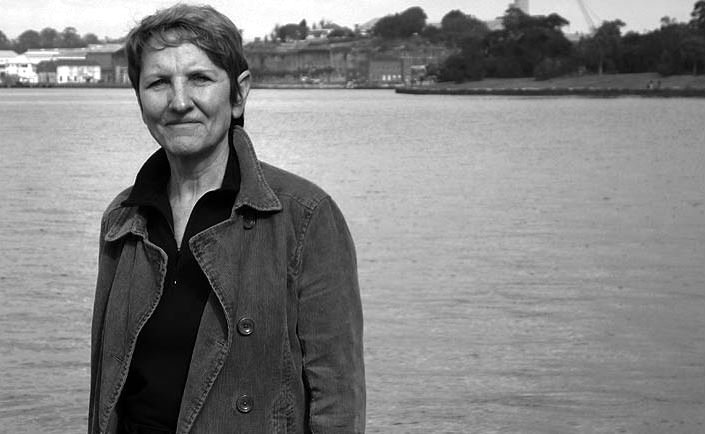
Pam Brown is not only one of Australia’s most prolific and important poets writing today, but also one of our richest archives on the history of late twentieth century Australian poetry. Since this is Cordite’s Sydney issue, I thought an interview with her might evince a valuably multifarious image of, perhaps, Australia’s most speedily shifting poetic landscape.
In particular, as a contemporary Australian poetic history of the late twentieth century stems in part from poets closely associated with the city, it only made sense to ask Pam Brown, Sydney avant-garde collaborator, instigator, publisher and poet. Author of 16 books and 10 chapbooks, Brown has lived most of her life in Sydney, and now lives with her partner in the suburb of Alexandria. As well as offer new understandings of a period thoroughly historicised, I hoped Brown’s personal recollections of the formative 1970s would illuminate the significance of those small press and handmade initiatives of the past that Astrid Lorange sees as ‘non-causal’ and ‘monadic’ in her Jacket2 archival commentary. Naturally, I was not disappointed.
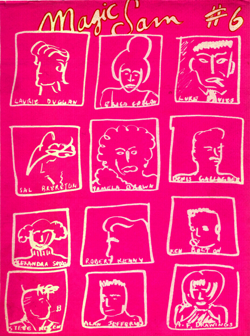
Corey Wakeling: It would be contentious to few to cite Sydney as central to a poetic boom in the 1970s. It was a movement of experimentation and poet-led production of magazines, pamphlets and books, in which you took part with a number of once Sydney-based associates and friends. These are some of Australia’s most important poets: Ken Bolton, Laurie Duggan, Sal Brereton, John Tranter, Rae Desmond Jones, joanne burns, Philip Hammial, Kris Hemensley, John Forbes, Stephen Kelen, and others. Magic Sam, the magazine of poetry you helped put together between 1975 and 1982, with editors Anna Couani, Ken Bolton and Sal Brereton, collects many of these people in its pages. Tell us about how you came to be involved with these poets.
Pam Brown: At the outset I should say that, as everyone knows, the slant given to past events depends on whoever reports them. My bias and experience of anything I can remember from the 1970s and into the 80s is bound to be different from others’ – and bound to be tempered by my own various and tentative examinings of those years during the decades since then. Nothing is fixed when it comes to the past.
Starting in 1972 I had published three small books of poetry, and also graphics, in an ‘underground’ way (what’s now called ‘independent’ publishing). I had also read poems in public in Sydney at the annual Balmain reading, the Paris Theatre and a few other places. I was engaged in a variety of counter-cultural activities – sculpture at Martin Sharp’s Yellow House, UBU films’ lounge-room screenings at our house and, earlier, film-making (Albie Thoms’ Sunshine City) in our flat on Crown Street, Surry Hills. Plus, after Pat Woolley moved the offset printing press out of the front room of our Surry Hills house across to Glebe Point Road around 1972, I set up Cocabola’s Silkscreen Printing at the front of the ‘shop’ and the offset printery became Tomato Press.
We made political pamphlets and an anti-censorship publication called X – with photos of friends having sex of all kinds – and distributed it widely. I was writing record reviews for Rolling Stone magazine and The Digger newspaper and I had a couple of day jobs in a bookshop and at a retro clothing stall at Paddy’s Markets. By 1975/76 I worked as a mail sorter and was playing music in the women’s band, Clitoris Band, and by 1977 I was involved in the anarcho-feminist theatre group, the Lean Sisters. I was also making video and film by then. I made a film with Gill Leahy about two female outlaws, Cattle Annie, in ’77. So I suppose that’s a brief background. I kept on writing poetry alongside these pursuits.
Some of the poets you’ve mentioned – John Tranter, Steve Kelen, Philip Hammial – were elsewhere for me at the time. (I met Steve in the early ’80s. I didn’t get to know John until around 1988). I had heard about Poetry Magazine and its difficult transformation to New Poetry from Laurie Duggan, who I’d been friends with since 1970 or ’71. But those magazines and their quarrels didn’t really register as being very innovative, edgy or interesting to me. They were the magazines of an institution called The Poetry Society of Australia. They seemed quite conventional and I thought that they were very dull-looking productions. Adelaide poet-artists Rob Tillett and Richard Tipping’s earlier MOK magazine (1968/69) had looked much more exciting to me. I was reading poetry from the US. The bookshop where I worked had City Lights’ books and other American publications. I had heard Andrei Voznesensky, Allen Ginsberg and Lawrence Ferlinghetti read in Sydney in 1972.
CW: I get the sense from Kris Hemensley’s introduction to Applestealers, published in 1974 and edited by Colin Talbot and Robert Kenny, that between the years 1968 and 1974 there was a perceived difference between the underground, small press poetry of Melbourne and the alternative canon proposed by John Tranter and Robert Adamson in their initiatives like New Poetry. However, for publishing poetry in Australia, the ‘70s seemed especially lively, with new magazines like Magic Sam often publishing poets from around Australia and perceived factions side-by-side. And then, as you’ve already noted, a variety of incipient poetry journals from around Australia were in limited, national circulation.
PB: I moved to Sydney in 1968. That year Tom Shapcott and Rodney Hall’s anthology New Impulses in Australian Poetry was published. It attempted to gather poets taking different directions from preceding traditions. I hadn’t published much then and I read it with great interest. It may not have been the editors’ intention but that anthology included poets who can now be seen as a ‘new’ establishment: Les Murray, Bruce Dawe, Geoffrey Lehmann, Chris Wallace-Crabbe, Andrew Taylor, and so on. I had nothing to do with the editorial activities of John Tranter and Bob Adamson at the time. They are both five years older than me; it might not seem much, but when change moved rapidly through the late ’60s–early ’70s, five years did mean difference. I had only heard of Bob Adamson in gossip about his skirmish with John Forbes at the Balmain poetry reading. My poetry and most of the poets in the earlier Shapcott/Hall collection weren’t included in John Tranter’s 1979 anthology The New Australian Poetry. In fact, Tranter’s anthology didn’t register with me until years later when I began to notice (and doubt) the eponymous phrase ‘generation of ‘68’’. But now that Tranter’s and Adamson’s products have been thoroughly historicised and though John Tranter’s selection was aiming at a fresh perspective at the time, I’m not sure that what they presented of Australian poetry was an ‘alternative’ canon. Perhaps their drive was mainly ‘generational’ and not necessarily a challenge to an existing status quo – as if they wanted in on a pantheon rather than to deconstruct one. New Poetry didn’t seem ‘new’ to me in the mid-1970s.
But yes, there was a difference between the Tranter/Adamson pursuits and the underground and small press poetry scene in both Sydney and Melbourne. The differences weren’t only aesthetic (e.g. experiment with new methods of poetic expression that were against high art); they were also, as everything always is, political. In Melbourne though I think experimental theatre venues were influential for poets. There were regular readings at Betty Burstall’s small Carlton theatre, La Mama. Perhaps this is one reason for the strong development of performance poetry that occurred in those days in Melbourne?
I can’t remember when I first read Contempa, edited in Melbourne by Robert Kenny, Michael Dugan and Phillip Edmonds, but it did seem fresh, broad and ‘of the times.’ As an example of what ‘political’ poetry publishing might be, in 1975 the more ‘upmarket’ Outback Press published the first anthology of Australian women’s poetry, Mother I’m Rooted, edited by Kate Jennings.
Looking back now, I could say that although it was publishing a few years later than New Poetry and Contempa, Magic Sam‘s ‘aesthetic’ and strong editorial direction was definitely oppositional to both Grace Perry’s Poetry Australia and the Australian Poetry Society’s magazines’ canonical aspirations, ‘alternative’ or otherwise. Ken Bolton says in a recent email: ‘Magic Sam was probably “anti-romantic” and against the high diction – against poetry strongly dependant on metaphor, myth, etc. The magazine carried a little self-description to that effect; actually, issue one said that its bias was towards work “that is modern”, in the sense of its being formally self-conscious, aware of its method of working, even exhibiting or drawing attention to its method(s).’ So, this differentiated it from both New Poetry and Poetry Australia. It had less European focus than The Ear or etymspheres, to which it was not opposed, tho it didn’t resemble them.’ (The Ear was Kris Hemensley’s magazine, The Ear in a Wheatfield (1973–76), and etymspheres was a magazine edited by Walter Billeter and John Jenkins).
‘Balmain poet’ Nigel Roberts was also active in loosening up the moribund and conservative notion of poetry publishing in the 1970s whenever he encountered it. He produced an irreverent gestetner magazine, Free Poetry. He published, like Magic Sam did later, international poets as well as Australians. I can’t remember how long Free Poetry lasted. (Free Poetry lasted eight issues, between 1968 and 1970 [ed.])
It was Nigel who sought me out in the early ’70s and invited me to read at the annual Balmain reading. Then in 1974 he invited me to join with him, artist Tim Burns and publisher Dave Morrissey in producing an assembly book. Called A Package Deal Assembly Book, it was modelled on Richard Kostelanetz’s assemblage books in the US. As the title ironically suggests this project was another one demonstrating (a bit like digital publishing can today) that published material can be altogether produced, distributed and controlled by the creators, independent of managerial or official structures. A Package Deal was collated and stapled at the Tin Sheds (the Art Workshop at the University of Sydney) with a group of willing workers (including Ken Bolton, though we didn’t meet ‘properly’ then) who gathered around the long tables with joints and a flagon of wine. (I spoke about this to Astrid Lorange recently in a Commentary for Jacket2)
By the end of the ’70s, a number of Sydney poets had cottoned on to independent publishing. Among the small presses were Tom Thompson’s Red Press, Anna Couani’s Sea Cruise Books, Steve Kelen’s Glandular Press and Final Taxi Review, Rae Jones’ zine Your Friendly Fascist, Nicholas Pounder’s Polar Bear Press, Ken Bolton’s Bier Rhymes with Beer Press, John Forbes’ Surfer’s Paradise magazine and my own Never-Never-Books.CW: Initiatives to which you contributed in Sydney – a kind of national hub of new poetry by a younger generation – seem to offer alternative histories to those we see in anthologies . From what you’re saying, it wasn’t so much that Sydney had so many poets, but rather that the city was central to the circulation and cross-germination of poetic experimentation in Australia – a moment both cosmopolitan (in a way Australian poetry had never been), and yet also more regional and locally representative. The Coalcliff period, when some of you spent time at a squat Ken Bolton and Sal Brereton lived in from 1979–1982, seems to me one of those alternative local histories. How do you remember these years?
PB: By 1978 I had a full-time job at Sydney College of the Arts. I was a member of the newly-formed Sydney Women Writers Workshop, later known as the ‘No Regrets Group’. That year, I met Sal Brereton, a prose writer, when Anna Couani introduced her to the writers’ group. Anna and Sal were the instigators of No Regrets: An Anthology, a compendium of writing by fifteen of the women involved in the group. Using the same gestetner, staples and wrap-around silk-screen printed cover as the Sea Cruise and Magic Sam productions it was published under the imprint Sao Press in 1979 and was, as the inside cover states, ‘edited by themselves’. It had been financed by benefit readings held at places like the Bondi Pavilion Theatre.
In 1979 Sal and Ken Bolton moved from Redfern to Coalcliff. We had become good friends. I only visited them at Coalcliff around four or five times but each visit was memorable for long meandering conversations about art, poetry, philosophy; for the walks around the dramatic coastal landscape; for cooking and sharing meals; and for the music from Ken’s wonderful collection of blues and r&b records. I would go down the coast to poetry readings and the Poets’ Ball they organised at the Ironworkers Club in Wollongong but I’d usually drive home afterwards. I helped collate one issue of Magic Sam at Coalcliff. I distinctly remember walking around and around the table rhythmically picking up the pages to Jimmy Cliff’s soundtrack from The Harder They Come. I stayed overnight at the Coalcliff house with my then-partner, artist Micky Allan, at Xmas-time once. I was in regular communication by phone and the postal service (remember letter writing?) with both Ken and Sal during those few years and we would meet up in Sydney sometimes as well. Magic Sam flourished during this period.
But yes, you’re probably right about an ‘alternative history’. I think Ken Bolton continued, with Magic Sam from Coalcliff (see: Coalcliff Days e-book catalogue from the 2011 exhibition at Wollongong City Art Gallery) and later, when he moved to Adelaide around 1982, with Otis Rush magazine – to provide a venue for a critique of entrenched or calcified ‘romantic’ and conservative notions of Australian poetry and its unending canonical, and these days, increasingly corporate, pomposities.


i want to read the rolling stone reviews
Pam’s remark about how fastidious Ken was when helping put mags
and publications together is almost a direct quote from Rae Desmond
Jones recently after a comment i made about Your Friendly Fascist
“did they use rusty staples when putting them together”? Rae responded
with that when Ken turned up the copies he put together were very tidy
against what others had put together (sheltered workshop conditions?)
the copies of Y.F.F. i’ve recently sighted the rust around the staples were
the brightest part of the cover!
pete spence
the POLAR BEAR great cover seen a fresh one recently the ice hadn’t melted
pete spence
be ok also to have a full set of DoDo mag too! and a rarity LeatherJacket
i’ve only seen one! there was a lot of mags going those days
pete
and of course the reason for the flurry of mags back then has
not changed a recent mag in the style is my ETZ first issue
now out…contact pete spence: spenvis@hotmail.com
for info or ordering
pete