
1
Someone says, “Poetry is about experience”. Then someone else says, “Poetry is about transcendence”. No sooner are these two statements allowed to engage each other than a vast, complicated world begins to form. Fierce conflicts arise between the advocates of experience and the defenders of transcendence. “Poetry holds a mirror to life”, we are told. “Poetry is no reflection”, we hear in reply, “it is a ‘furious ascension’”. Meanwhile, disputes break out over “experience”. For some, poetry is confessional, while for others it is a passage beyond the opacities of personality, a quest for a deep self or an escape from self. Other arguments rage over “transcendence”. One group affirms transcendence by way of the vertical. “Poetry is an illumination of the heights”, they ay, “it may disclose the meaning of being, reveal there is no meaning to being, or in questing beyond the world may undermine itself by disparaging language”. Another group figures transcendence as horizontal movement: poetry leads to places we never knew, and in doing so changes the author.
This strange world with its assertions, arguments and bewilderments is our own, the world of modern poetry. After living here for a while, one begins to pick out individual voices that are more subtle, more intriguing, or more commanding than others. Under the guise of Malte Laurids Brigge, Rilke observes that “verses are not, as people imagine, simply feelings [. . . ] they are experiences [Erfahrungen]. In order to write a single line of verse, one must see many cities, and men and things”.[ref]Rainer Maria Rilke, THE NOTEBOOKS OF MALTE LAURIDS BRIGGE, introd. Stephen Spender (Oxford: Oxford University Press, 1984), 19.[/ref] Were this literally true, we would dismiss the poetry of Emily Dickinson and Arthur Rimbaud. However, Rilke is not aiming at those who experience the world in little but at ‘beautiful souls’ who refuse to engage with the world at all. At first, Wallace Stevens appears squarely in Rilke’s sights when he says, “Poetry is the expression of the experience of poetry”.[ref]Frank Kermode and Joan Richardson, ed., WALLACE STEVENS: COLLECTED POETRY AND PROSE (New York: The Library of America, 1997), 904.[/ref] But his point is quite different: Keats found himself in reading Spenser, Yeats in reading Shelley, and so on. To look closely at any scene of authorial formation would doubtless be to find evasions in what poets say about becoming poets. Did T. S. Eliot discover himself in reading Dante, Baudelaire and Laforgue, as he leads one to believe? Or were his most significant encounters with Browning, Tennyson and Whitman? The latter, says Harold Bloom, while urging us to accept that one poet can escape the tyranny of another only by a per- verse and violent misreading. It is an uncomfortable truth, but one seldom looks to the truth for comfort.
If Stevens is right, no poetry simply reflects experience. At the least, a poem answers to experience and poetry. When pondering this situation, and wondering how a poem connects with its author’s life, it is salutary to listen to Allen Grossman meditating in the Summa Lyrica. “There is no poem of the experience at hand”, he says, while adding, “art is about experience (in the same sense that a cat indoors is “about” the house)”.[ref]Allen Grossman, ‘Summa Lyrica: A Primer of the Commonplaces in Speculative Poetics’, in THE SIGHTED SINGER: TWO WORKS ON POETRY FOR READERS AND WRITERS, Allen Grossman with Mark Halliday (Baltimore: The Johns Hopkins University Press, 1992), 268.[/ref] The thought that a poem might be “about experience”, an exterior reflection on what has happened, is dismissed. There is no naked fact that is later covered with interpretation: an event is constituted as meaningful while it occurs, and later interpretations extend or modify this constitution. So, for Grossman, a poem is “about experience” in that a body of experience is somewhere in a poem, although exactly where we cannot say.
Let us pause for a moment before agreeing completely with Grossman. Is art like a house? Does it contain experience? A poem may seem to be a verbal construction, yet this appearance is misleading. Although it usually belongs to the world of paper and print, a poem is fundamentally an act of understanding. It may be several or many related acts, not all of them complete or able to be completed, and it may involve understandings and misunderstandings of different acts or objects in distinct ways and to various extents. Some may have been seen, touched or tasted; some may have been imagined; others may be intellectual realities, like geometrical figures. (Eugène Guillevic wrote a number of charming lyrics about squares, triangles and quadrilaterals that he called Euclidiennes.) When talking about poetry one gets on the right track when seeing that ‘experience’ designates what a consciousness registers, not what a person physically encounters. And one begins to walk down this track when recognising that the important thing is not the poet’s consciousness but what could be called the “consciousness of the poem”: a work’s ability to signify in the absence of its maker. In poetry, experience does not abide within an organising intelligence; it is bespoken by a poem that, once written, has no further need of the poet. Poetry cannot be conceived simply as a representation of an experience, even one that includes a good deal of reflection. For in its dealings with forms, genres, languages, tropes and traditions, none of which can be fully controlled by an individual, a poem may present experience that the poet had only while writing or not at all.
Having come this far, we are in a position to hear what Maurice Blanchot says of poetry[ref]What follows is a paraphrase of Blanchot’s THE SPACE OF LITERATURE, trans. Ann Smock (Lincoln: University of Nebraska Press, 1982).[/ref] and experience. The act of composition, he tells us, leads a poet to risk losing everything: the poem’s unity, the poet’s self-identity, even the poet’s faith in God. One writes in order to name reality; but the “I” that appears on the page differs from the writer’s consciousness, and the immediacy of what one wishes to represent is destroyed by language itself. So language, even when rigorously used, is not the vehicle of la clarté, as French classicism teaches; rather, it embodies the noctural, the absent and the veiled. Yet language also reveals itself as reassuringly material: perhaps one can take it as the end of one’s quest, thereby regarding night as a simple modifica- tion of day. Almost immediately, though, the poet becomes aware of language as a play of rhythm and form that anonymously co-operates in writing the poem. Gazing into the heart of language, the poet beholds an immemorial and interminable combining and recombining of words that has no significance in itself. Here words no longer refer to things; they are empty images. In the grip of a fascination that resembles insomnia, the poet risks all identity and unity. Only by shaking itself free of this impersonal and strangely lucid gaze, older than all creation, can the work be saved from ruin. Indeed, “the work is this leap”.[ref]Blanchot, THE SPACE OF LITERATURE, 244. [/ref] This passage from consciousness to the very limit of indeterminate being is what Blanchot calls “experience”.
Writing for Blanchot is therefore a doubled event, at once active and passive: it begins in experiencing the world but is quickly diverted and becomes an “experience of non-experience”.[ref]Blanchot, THE INFINITE CONVERSATION, trans. Susan Hanson (Minneapolis: Minnesota University Press, 1993), 210.[/ref] The two events are lived together, not as a unity but as a neutral relation. In seeing things this way we have passed from experience to transcendence, although it must be said to a transcendence of a very dispiriting kind. Blanchot himself would prefer the word “transgression” and even then would surround it with many qualifications.[ref]See Blanchot, THE STEP NOT BEYOND, trans. Lycette Nelson (Albany, NY: SUNY, 1992), 27.[/ref] Certainly what draws Blanchot to his favourite writers from Sade to Beckett is that they brush against indeterminate being. In the last analysis, his readings of these authors are oriented by how this limit experience occurs and what consequences follow from it. Of particular interest to Blanchot is that writing leads one to glimpse not a state above or beyond the world but a condition before the world. Writing leads one to encounter the flux anterior to human existence, not to experience the most determinate being, transcendent being, Being itself, or the Wholly Other, all of which surpass human existence and which form the main western conceptions of God.
I think that Blanchot overstates one aspect of his case and then underexplains its central move. Is it true that language destroys whatever it touches? To be sure, Hegel observed that when Adam named the animals “he nullified them as beings on their own account, and made them into ideal [entities]”.[ref]G. W. F. Hegel, SYSTEM OF ETHICAL LIFE AND FIRST PHILOSOPHY OF SPIRIT, ed. and trans. H. S. Harris and T. M. Knox (Albany: SUNY, 1979), 222. Blanchot quotes this passage in ‘Literature and the Right to Death’.[/ref] That is, since language involves the mediation of concepts there can be no immediate presentation of anything in words. Yet particularity is not thereby lost to speech or writing. When Marianne Moore describes an ostrich in “He ‘Digesteth Harde Yron’” we may not grasp a bird in its immediacy but the poem nonetheless presents us with a singular creature, and does so in a unique manner. Blanchot’s crucial move, however, is that the work responds to the flux of primordial being by leaping away from its paralyzing gaze. Putting aside the questions why he shifts from author to work, and whether a poem can properly be said to have this kind of agency, one may still ask how and why the work escapes its condition of fascinated passivity. No explanation is given. At the very least such a leap presumes a tacit affirmation of being as a horizon if not an assembly of entities. If poetry draws us to what precedes human being, it also stirs us to return to the world about us.
Blanchot is right to emphasise that experience is double. In his terms, we name the possible and[ref]Blanchot, THE INFINITE CONVERSATION, 48.[/ref] respond to the impossible. The impossible, for him, is the limit of the possible, the site where power, truth and unity finally crumble. Perhaps so; yet the discovery of indeterminate being in no way precludes the experience of determinate being, transcendent being, the Wholly Other, or anything else. I therefore propose a broader understanding of the word “impossible”, one that allows a more uplifting experience of transcendence. Let us say that the possible is the other that yields to the same, while the impossible retains its alterity: only its approach or withdrawal can be experienced. Now an experience to be faced is always marked by the possibility of possibility: what happens may be anticipated, and its outcome conceived in advance. Yet it is marked also by the possibility of impossibility: what happens may be singular, groundless, unable to be readily assimilated to consciousness. To describe this event we use words like “enigma” and “mystery”, and to name its effects we say words like “calm” or “distress”. Sometimes only one possibility is realised to any considerable extent. Daily life is characterised by the triumph of the possible: I reach for a cup, drink from it, then put it down. Yet I may reach for the cup and be seized with wonder that it and I exist. At that moment my experience is constituted with the possible and impossible as more or less equally distant vanishing points. Perhaps, as with Blanchot, this moment conjures the approach of death; if so, the distribution of these vanishing points changes, and impossibility becomes sovereign. Or perhaps the moment becomes an affirmation of the God who disposes being and nonbeing. Once again, the impossible is broached.
These are extreme examples in life though not in poetry. In life or art, however, “to transcend experience” does not name the impossible, as people sometimes say. The expression merely indicates that experience is not the same in all regions of being. Experience is especially complex in the region we call poetry. Of course, most verse, of whatever school, abides almost wholly in the realm of the possible, and even so-called experimental poetry often does little more than rearrange formal possibilities. Fulfilling or destroying a form can expose one to the unknown, but it is the passage that is important not the vehicle. Despite appearances, devotional poetry has in itself no privileged relation to the impossible: the word “God” usually falls fast asleep in literature. A memorable poem, whether about a cup or God, passes from mastery to mystery, if only for a moment, though on rereading it one finds that the relation between the two cannot be narrowly specified.

Image: Dennis Mizzi, ‘Untitled’
2
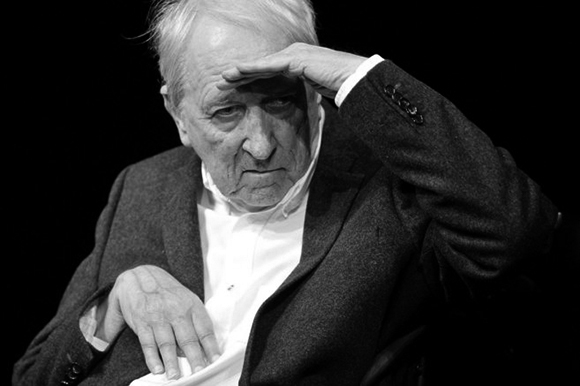
Were I to continue these reflections with Yves Bonnefoy in mind my comments would differ from those on other poets to whom I feel close: Philippe Jaccottet and Roberto Juarroz, for instance. Each speaks of the impossible in his own way.[ref]See Yves Bonnefoy, ‘But no, once again | Unfolding the wing of the impossible’, POEMS 1959-1975, trans. Richard Pevear (New York: Vintage Books, 1985), 63; Philippe Jaccottet, ‘The side I take now is that of the impossible’, Seedtime: EXTRACTS FROM THE NOTEBOOKS 1954-1967, trans. André Lefevere and Michael Hamburger (New York: New Directions, 1977), 23; Roberto Juarroz, ‘Celebrating the impossible. | Is there another path for cel- ebrating the possible?’, Vertical Poetry: RECENT POEMS, ed. and trans. Mary Crow (New York: White Pine, 1992), 25.[/ref] If I choose to read Tomas Tranströmer, whose work is equally close to me, it is because his poems not only open themselves to the impossible but also meditate on it without using the word.[ref]See Tomas Tranströmer, NEW COLLECTED POEMS, trans. Robin Fulton (Newcastle upon Tyne: Bloodaxe, 1997).[/ref]
Tranströmer lives in the wake of what Friedrich Hölderlin calls the “double infidelity”: God has turned away from human beings, leaving us to experience His absence, and we have turned from Him, no longer regarding this absence as significant. The poet abides in the space created by this twofold abandonment while remaining open to the chance of a new revelation of the divine. Certainly Tranströmer does not thematise this openness by way of an uncritical endorsement of Christianity. The Church is “the broken arm of faith”, and the Cross is “like a snap-shot | of something in violent motion”. The latter image suggests that Christianity has attempted to domesticate a spiritual energy that overruns all limits. Although Tranströmer affirms “the great unknown which I am a part of”, this mystery is not simply benign in its effects. Thus ‘Golden Wasp’:
The divine brushes against a human being and lights a flame
but then draws back. Why? The flame attracts the shadows, they fly rustling in and join
the flame, which rises and blackens. And the smoke spreads out
black and strangling. At last only the black smoke, at last only the pious executioner.
To write “the divine” [gudomliga] is already to claim more imaginative freedom than the word “God” [Gud] generally allows. Yet “God” is used now and then. In an earlier lyric, ‘Solitary Swedish Houses’, Tranströmer asks that the people he sees walking out- side in autumn may,
feel without alarm
the camouflaged wings
and God’s energy
coiled up in the dark.
The final image recalls the tremendous force pent-up in the Cross, yet the telling word is “feel” [känna] rather than “energy”. A mixture of the Modern and the Romantic in his poetic stance, Tranströmer inclines to the Romantics in his theology while avoiding any show of piety. One poem ends by describing itself as “my inside-out psalm”, and the expression is a fitting emblem of Tranströmer’s work as a whole. His poems are songs of consolation, hope and praise that – for all their “finish” as works of art – show the knots, loose ends and seams of experience, not the faultless pattern dreamed by a beautiful soul.
An early elegy proclaims “There’s a crossroads in a moment”, and a later poem about revisiting a childhood house tells us, “It’s always so early in here, before the crossroads”. There is a sense in which all Tranströmer’s poetry seeks a moment before decision, before the consequences of our choices can make us into adults. At the same time, this is a poetry that honours the “Beautiful slag of experiences [Erfarenheternas]” that compose a life, even when viewed from the perspective of death. There is a lost innocence we mourn, and a higher innocence we long for and strive to attain. More potent than the image of the crossroads, however, is that of the border, frontier or wall which pervades Tranströmer’s writing. The lines separating one nation from another, dreaming from waking, life from death, creation from self are all investigated and shown to be divided and equivocal. One might say of Tranströmer’s poems in general that experience courts transcendence, whether “horizontal” or “vertical”, and that the strongest poems affirm, ponder and explore a “vertical transcendence”, a mystery that can“neither be written nor kept silent”.
When I use the expression “vertical transcendence” I think of Jean Wahl distinguishing “transascendence” from “transdescendence”: an ascent to the heights, and a descent to the depths.[ref]See Jean Wahl, EXISTENCE HUMAINE ET TRANSCENDANCE (Neuchâtel: n.p., 1944).[/ref] Tranströmer writes of music having a way of following us “up | the depths”, and his images have a remarkable ability to reach up and down in the same movement, to be, as he says himself, “at the same time eagle and mole”. Indeed, his poems maintain close contact with the earth while gazing down on it from a great height, putting it in a broader context that enriches the physical world and does not devalue it. In their larger sweeps, his poems testify that “The other world is this world too”, that the impossible touches the possible, arises out of it or reaches out to it.
To keep this thought in play for a little while, I would like to cite an extraordinary poem by Tranströmer, one that names an artist whose work resonates with his own in certain respects. ‘Vermeer’ is a poem about walls, or rather about our abilities and inabilities to cross apparently clear dividing lines: inside and outside, madness and sanity, art and life, childhood and adulthood, life and death. We are told of,
Pictures that call themselves ‘The Music Lesson’
or ‘Woman in Blue Reading a Letter’ –
she’s in her eighth month, two hearts kicking inside her.
On the wall behind is a wrinked map of Terra Incognita.
Art historians say that the painting most likely represents a creased map of Holland not “Terra Incognita”. Yet Tranströmer’s point is precisely that the everyday and the nearby are an unknown country. An common event like having a baby requires the woman to balance what she knows with what cannot be predicted.
The chairs in the painting are covered with an “unknown blue material”. We are asked to consider how the fabric is fixed to the wood:
The gold studs flew in with incredible speed
and stopped abruptly
as if they had never been other than stillness.
The tension between energy and calm recalls the Cross that “hangs under cool church vaults” and that nonetheless seems to be “in violent motion”. The pressure in the painter’s studio comes from “the other side the wall”, the noise from the street out- side: art is sustained by life. But “wall” quickly takes on wider connotations when we hear that “It hurts to go through walls, it makes you ill” and that “the wall is part of yourself”. Once again, experience is leagued with transcendence.
What kind of transcendence? The poem’s final lines enrich the question rather than attempt a definitive answer:
The clear sky has leant against the wall.
It’s like a prayer to the emptiness.
And the emptiness turns its face to us
and whispers
“I am not empty, I am open”.
The Annunciation is quietly evoked then with- drawn: there is no angel, only daylight; the child is human, not divine; and conception occured months before. Only emptiness, certainly not divine plenitude, characterises our world after the “double infidelity”. Even here one may risk a prayer, however. No mention is made of God or the divine, yet the answer to the prayer is impressive and mysterious. There is no easy assurance –- the voice does not whisper of fullness –- and to be offered openness is an opportunity for further experience and further transcendence. In the words of a lyric that speaks more directly than ‘Vermeer’,
An angel with no face embraced me
and whispered through my whole body:
“Don’t be ashamed of being human, be proud!
Inside you vault opens behind vault endlessly.
You will never be complete, that’s how it’s meant to be.”
This essay first appeared in print in Cordite Poetry Review issue #4 (1998).